

Web3 is moving out of its experimental phase. In 2026, the most meaningful impact will come from practical infrastructure choices and institutional adoption. Here’s what we see as the key trends shaping Web3 for good in the year ahead.
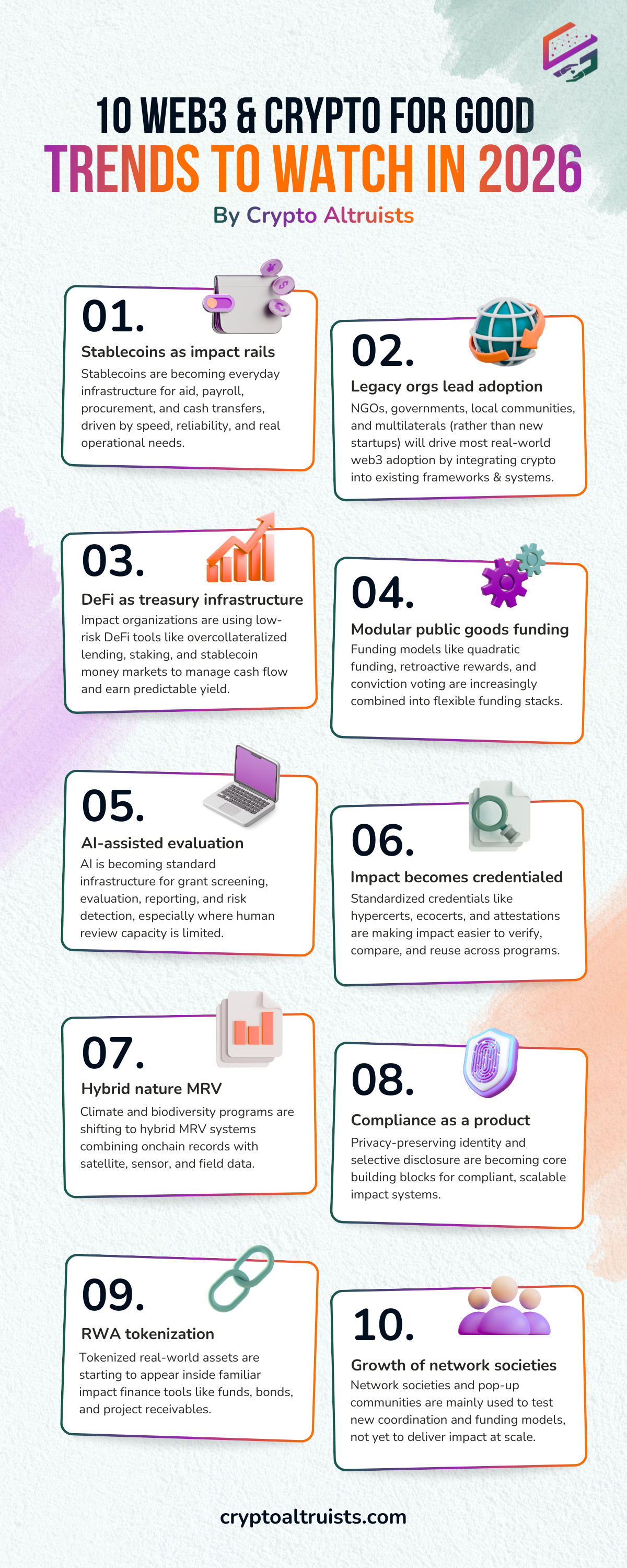
Stablecoins are increasingly treated as payment rails rather than a new crypto product. In 2026, more impact programs are expected to rely on them for payouts, procurement, cross-border payroll, and emergency cash, driven by practical needs like faster settlement and resilience in volatile economies.
Pilots by Mercy Corps Ventures in contexts like Syria show how stablecoin rails can materially improve aid delivery compared to traditional channels. At the user level, tools like MiniPay and remittance platforms such as Pesabase show how these rails are already being used for everyday payments and cross-border transfers, reaching non-crypto users through familiar interfaces. In more constrained environments, including Myanmar, the use of stablecoins by the National Unity Government illustrates how these rails can support fund transfers when access to traditional financial systems is restricted.
The most successful Web3 for good deployments in 2026 are likely to come from existing institutions and community organizations integrating crypto rails into their operations. NGOs, cooperatives, grassroots groups (including through movements like localism), multilaterals, and public-sector actors already have trust, users, and mandates, and the underlying infrastructure is now stable enough to fit into how they work.
As regulatory clarity improves, adoption will favor these legacy actors over new Web3-native impact startups. The most effective use cases will feel operational and unflashy, helping long-standing organizations and local communities scale coordination, payments, and governance without changing their core mission or identity.
In 2026, DeFi is expected to play a growing role in impact treasury management rather than just fundraising narratives. Organizations will increasingly use conservative DeFi tools for cash-flow smoothing, capital preservation, and predictable yield.
Projects like Octant and Lido Impact Staking are already showing how onchain yield can be routed into ongoing public goods funding, without relying on constant donor inflows or spending principal. On a more micro level, projects like Somos Axolotl are operating their own Solana validator to raise funds in support of their charitable mission. As DeFi products mature, this approach is likely to become more common.
In 2026, public goods funding is expected to move away from single mechanisms toward modular funding stacks. Rather than treating quadratic funding, retroactive rewards, or conviction voting as competing models, ecosystems are increasingly combining them to fit different types of public goods and stages of work.
Gitcoin has begun explicitly mixing mechanisms, such as combining conviction voting with retroactive rewards in recent rounds, while Filecoin’s Public Goods Funding program runs proactive grants and retroactive allocations in parallel. In 2026, this approach will become the norm, with allocators placing more emphasis on structured outcomes and clearer reporting before committing long-term capital.
AI is expected to become standard back-office infrastructure for Web3 for good. It will support grant screening, evaluation, reporting synthesis, and risk flagging in funding environments where human attention is limited.
We can also expect experimentation with prediction markets and market-based forecasting tools, including approaches such as deep funding, as inputs into funding decision-making.
Standardized credentials such as hypercerts, ecocerts, and attestations are expected to play a larger role in how impact is recorded and recognized. Funders will increasingly look for comparable, non-duplicated evidence, while builders and practitioners will seek portable ways to demonstrate their contributions across programs and ecosystems.
Climate and biodiversity programs are expected to rely more on hybrid MRV systems that combine onchain records with offchain sensing, satellite data, and field verification, with DePIN-style infrastructure reducing the cost and latency of data collection. Beyond reporting past outcomes, these systems are increasingly being explored for anticipatory action, using early signals to inform where funding and interventions are needed before impacts escalate.
In 2026, data quality is likely to be a primary constraint. Impact efforts will increasingly rise or fall on whether outcomes and risk signals can be measured and verified in ways funders and regulators trust, particularly in contexts such as extreme weather and natural disaster response.
As a16zcrypto notes, privacy is likely to be one of the most durable long-term advantages in crypto. In 2026, privacy-preserving identity and selective disclosure tools are expected to play a larger role in making crypto-based impact systems usable in practice, particularly for nonprofits navigating compliance, reporting, and data-risk concerns.
In use cases such as last-mile humanitarian aid, these tools can allow programs to verify eligibility and prevent duplication without exposing sensitive beneficiary data. More broadly, they enable organizations to meet regulatory and donor requirements without collecting or storing more information than necessary. For impact use cases, this shift toward compliance-by-design is likely to be essential for moving from pilots to wider nonprofit adoption.
In 2026, real-world asset tokenization is likely to appear inside familiar impact finance vehicles rather than new crypto-native products. This includes structures like climate donor-advised funds, development bonds, and project-level receivables, where capital today moves slowly and opaquely across borders.
Platforms such as ReFi Hub are already experimenting with tokenization of sustainability projects, including clean energy infrastructure, and integrating onchain ownership into existing climate finance models. These efforts point to how tokenization can fit into established impact workflows rather than creating entirely new products.
In 2026, network societies and pop-up communities are likely to function mainly as testbeds for new coordination and funding models rather than scalable impact delivery. As Vitalik Buterin notes in his new essay, Let a Thousand Societies Bloom, this space remains early and pluralistic, offering signals about coordination rather than mature solutions.
At Crypto Altruists, we’re looking forward to tracking how these trends translate into real programs, real users, and real impact over the year ahead. We’d be glad to have you join us by subscribing to our newsletter.
Support thoughtful, independent crypto journalism and help us continue highlighting blockchain’s potential for social and environmental impact.
cryptoaltruists.eth