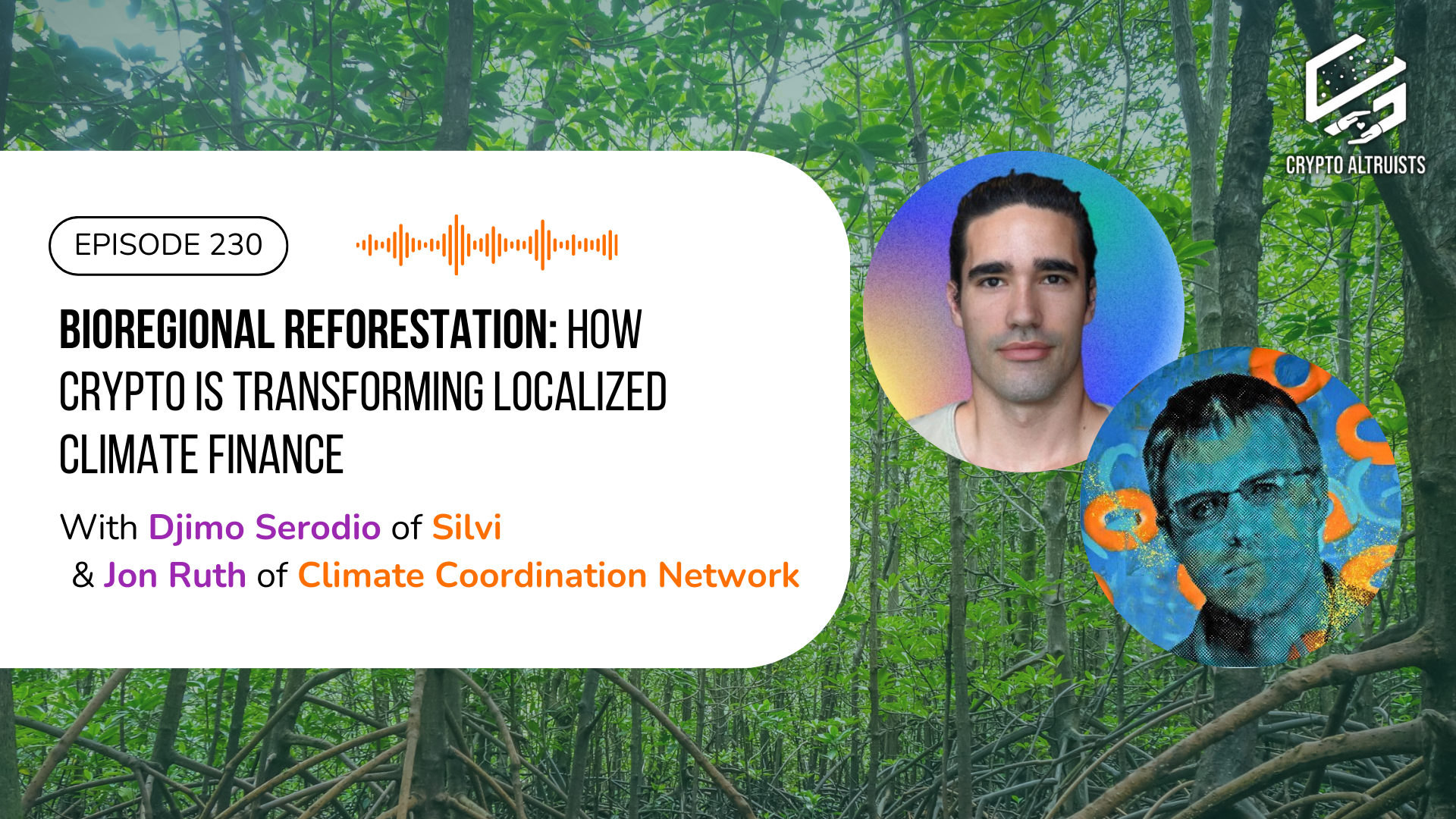


For Episode 230, we welcome Djimo Serodio, Founder of Silvi, and Jon Ruth, Co-Founder of the Climate Coordination Network, two leaders helping reimagine how the world funds and verifies ecological restoration.
Around the world, climate funding is struggling to reach the people doing the real work on the ground. Bottlenecks, slow reporting cycles, high admin costs, and opaque systems leave local stewards underfunded and undervalued. This grants round flips that script by using Web3 rails to move resources faster, measure outcomes transparently, and empower communities who are ready to restore their ecosystems today.
What Web3 brings to the table is the ability to coordinate globally while acting locally, to reward ecological action transparently, and to move resources directly to the people restoring their land.
In this episode, we unpack the newly launched Bioregional Reforestation Grants Round, the largest blockchain-native, outcomes-based reforestation funding mechanism to date, and explore why this may be a blueprint for the next era of regenerative climate finance.
You’ll learn:
🌱 Local wisdom drives better restoration: Bioregional reforestation puts decision-making in the hands of the people who know their ecosystems best. Planting the right trees in the right places requires deep local knowledge, which is perfectly aligned with Web3’s commitment to localism, community ownership, and bottom-up coordination.
🌍 A trillion trees requires global coordination: Silvi’s long-term vision is bold: planting 1 trillion trees in the coming decades. Achieving this demands unprecedented collaboration across regions, organizations, and funders. Web3 provides the coordination layer needed to align incentives and mobilize action at planetary scale.
🔗 Blockchain unlocks scalable verification and distribution: Web3 tools like smart contracts, crypto payment rails, and on-chain MRV tools enable transparent, efficient, and tamper-resistant verification of ecological outcomes. The Bioregional Reforestation Grants Round is a proving ground for this model, laying the foundation for large-scale, trustworthy, and transparent climate finance.

PIPE gDAO is leveraging blockchain for their University Real World Asset IP Launchpad that helps bring groundbreaking ideas from lab to market. By joining the Pipe Associate Network (aka PAN), associates can create a profile highlighting their skills, be notified of opportunities, and then contribute fractional work to pre-IPO companies in return for equity and tokens.
Check out their Linktree for links to all of their socials so you can get involved and join this growing community!
02:30 - Let’s start with an introduction to each of you and your journey to Web3. What first got you excited about blockchain, and how did it lead you to Climate Coordination Network and Silvi?
07:30 - For listeners who are new to your work, can you give a high-level overview of the mission of Silvi/Climate Coordination Network?
15:50 - To lay the ground work for the conversation, what does “bioregional finance” mean, and why is it such a powerful framework for addressing climate and ecological restoration?
18:25 - The Bioregional Reforestation Grants Round is the largest blockchain-native, outcomes-based reforestation grant round to date, and hopefully the first of many. Can you please give a high-level overview of the round, and what inspired you to launch it now?
25:20 - You’ve selected eight bioregions across the world. What criteria did you use to choose them, and what makes these regions especially well-positioned for outcomes-based reforestation?
31:20 - Let’s talk about the funding mechanism. Can you walk us through how the on-chain funding mechanism works and why blockchain is uniquely suited for this?
37:25 - A major unlock here is decentralized MRV. Can you tell me more about the technological primitives you’re using for impact monitoring & verification, and how do these technologies improve transparency, accountability, and ecological accuracy compared to traditional reforestation funding?
40:50 - This round involves collaborations with Gitcoin, Celo, BioFi, ReFi DAO, and many more. How do these partnerships shape the round, and what does this say about where climate coordination in Web3 is heading?
44:05 - For listeners who want to support the round and learn more about your projects, where should they go, and what’s the best way for donors, stewards, or organizations to get involved?
46:30 - Let’s zoom out to wrap things up. If this round succeeds, not just financially, but in demonstrating a new model, what could bioregional, outcomes-based climate finance look like at global scale in 5–10 years?
Please note: we make use of affiliate marketing to provide readers with referrals to relevant products and services.
Support thoughtful, independent crypto journalism and help us continue highlighting blockchain’s potential for social and environmental impact.
cryptoaltruists.eth
While we may discuss specific web3 projects or cryptocurrencies on this podcast, please do not take any of this as investment advice, and please make sure to do your own research on potential investment opportunities, or any opportunity. We host a variety of guests on this podcast with the sole purpose of highlighting the social impact use cases of this technology. That being said, Crypto Altruism does not endorse any of these projects, and we recognize that, since this is an emerging sector, some may be operating in regulatory grey areas, and as such, we cannot confirm their legality in the jurisdictions in which they operate, especially as it pertains to decentralized finance protocols. So, before getting involved with any project, it’s important that you do your own research and confirm the legality of the project. More available HERE.