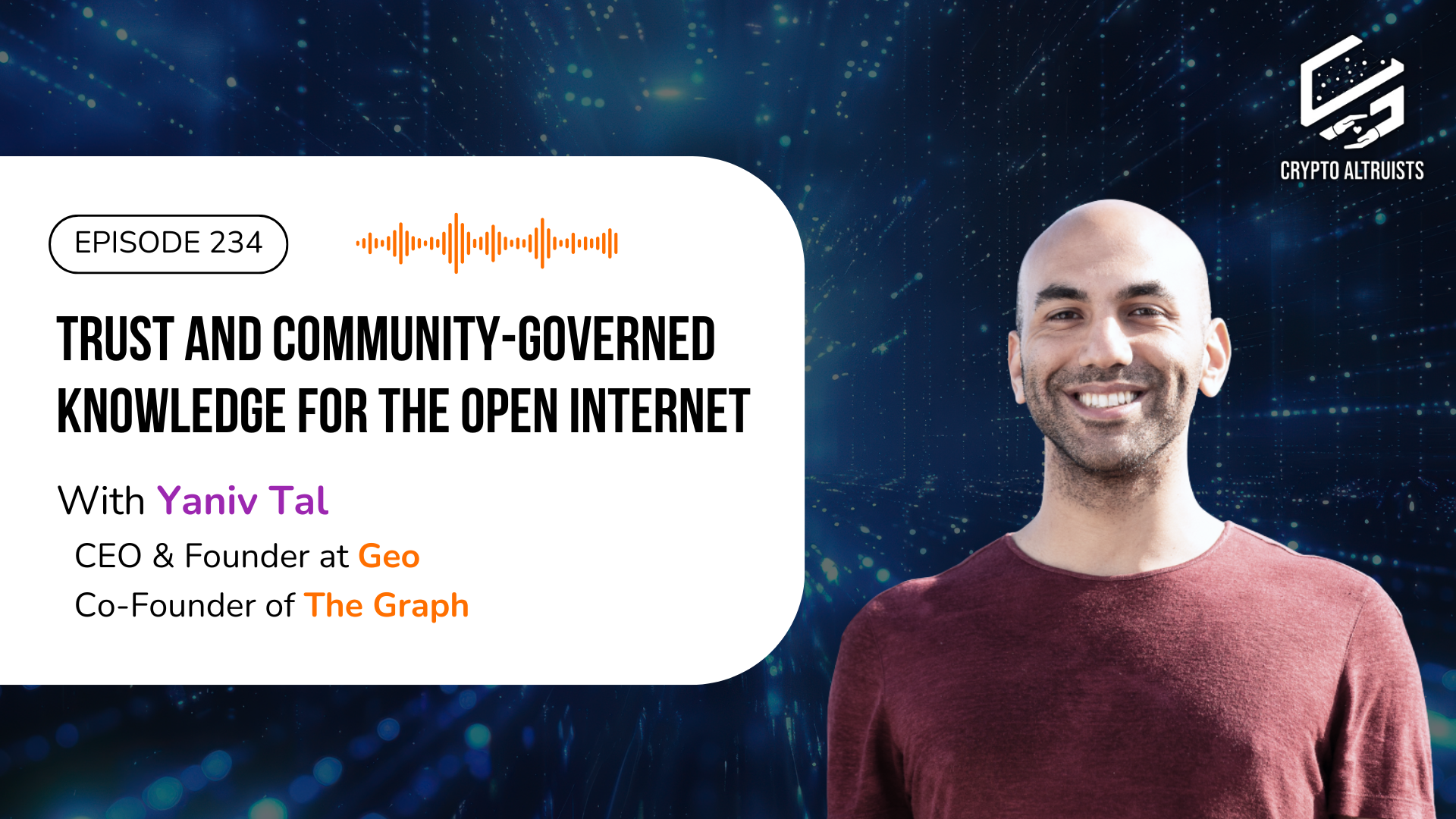


For episode 234, we’re excited to welcome Yaniv Tal, a legendary builder who has helped shape the foundations of Web3 as we know it. Yaniv is the co-founder and former CEO of The Graph, one of the most critical pieces of decentralized infrastructure in the ecosystem, powering tens of thousands of applications across Web3. Today, he’s building Geo, a project focused not on scaling transactions, but on rebuilding trust, knowledge, and coordination on the internet itself.
A lot of Web3 discussions focus on speed, scale, or financial innovation. But beneath all of that is a much deeper challenge: We no longer agree on what’s true, who to trust, or how collective decisions should be made online.
Yaniv’s work sits right at that fault line, asking hard questions about why the internet broke, why coordination is the real bottleneck to solving global problems, and how blockchain can help communities organize information, expertise, and governance in entirely new ways.
In today’s episode you’ll learn:
· 🌐 Why Yaniv believes “Web3 isn’t here yet,” and what’s missing for the internet to truly become decentralized
· 🧭 How failures in coordination and governance, not technology, are holding back global adoption and trust online
· 📢 Why giving communities real editorial power is essential to rebuilding shared facts, credibility, and legitimacy on the internet
· 🚀 And how Geo is experimenting with a new, community-governed knowledge layer for the web
🔍 Web3 hasn’t delivered its trust promise yet, but the direction is clear: One of Web3’s core ambitions is to provide a composable layer of trust, verification, and shared truth for the internet. Today, that promise remains out of reach: systems are still too complex, fragmented, and slow to counter the scale and speed of online misinformation. The challenge ahead isn’t just decentralization, it’s usability, coordination, and trust at human scale.
🧠 Knowledge graphs are foundational infrastructure for an open, trustworthy internet: Knowledge graphs organize information around entities and relationships rather than isolated posts or feeds, a model already used by major tech platforms behind the scenes. Bringing this structure into open, community-governed systems is essential for creating transparent, verifiable, and composable knowledge layers that anyone can build on, audit, and improve.
🤝 Consensus-building is broken, but it’s not lost: Society’s ability to reach shared understanding has fractured under algorithmic incentives and centralized control. This conversation highlights that consensus isn’t about enforcing agreement, but about creating credible processes for weighing evidence, expertise, and context. With the right tools, communities can regain editorial agency, rebuild shared facts, and restore trust in how knowledge is formed online.

PIPE gDAO is leveraging blockchain for their University Real World Asset IP Launchpad that helps bring groundbreaking ideas from lab to market. By joining the Pipe Associate Network (aka PAN), associates can create a profile highlighting their skills, be notified of opportunities, and then contribute fractional work to pre-IPO companies in return for equity and tokens.
Check out their Linktree for links to all of their socials so you can get involved and join this growing community!
02:35 - To kick things off, I’d love to start withyour journey. You have an incredible legacy in Web3, having co-founded and ledThe Graph, one of the most important pieces of Web3 infrastructure, and are nowbuilding Geo Protocol. What originally drew you into Web3?
04:30 - The Graph became core infrastructure forthousands of projects. Looking back, what did building at that scale teach youabout decentralization, coordination, and where Web3 actually succeeds?
12:10 - You’ve said publicly that “Web3 isn’t hereyet,” which is a powerful statement. What do you mean by that, and what’smissing from today’s Web3 stack to truly achieve global adoption?
16:00 - A big theme in your current work is trust.Today, we’re facing a breakdown in shared facts, credible information, andlegitimate authority online. From your perspective, what went wrong with theinternet as we know it?
22:00 - That brings us to Geo. For listeners who arenew to it, can you give a high-level overview of what Geo is, and what problemyou’re trying to solve?
26:35 - Why Web3? What does blockchain uniquelyenable here that couldn’t be achieved with traditional platforms?
30:15 - One of Geo’s core ideas is giving communitiesreal editorial power instead of relying on centralized platforms or opaquealgorithms. Why is governance such a critical missing piece in how informationis organized today?
35:40 - Geo introduces an interesting balance:everyone has a voice, but expertise carries weight. How does Geo think aboutcredibility, expertise, and participation without recreating old gatekeepers?
39:25 - For listeners who are excited by this vision,whether it be builders, researchers, organizers, or everyday internet users,what’s the best way to get involved with Geo today?
41:30 - To close us out: when you think about thefuture of the internet 10 or 20 years from now, what gives you the most hope?And what kind of digital legacy do you think our generation still has time tobuild?
Please note: we make use of affiliate marketing to provide readers with referrals to relevant products and services.
Support thoughtful, independent crypto journalism and help us continue highlighting blockchain’s potential for social and environmental impact.
cryptoaltruists.eth
While we may discuss specific web3 projects or cryptocurrencies on this podcast, please do not take any of this as investment advice, and please make sure to do your own research on potential investment opportunities, or any opportunity. We host a variety of guests on this podcast with the sole purpose of highlighting the social impact use cases of this technology. That being said, Crypto Altruism does not endorse any of these projects, and we recognize that, since this is an emerging sector, some may be operating in regulatory grey areas, and as such, we cannot confirm their legality in the jurisdictions in which they operate, especially as it pertains to decentralized finance protocols. So, before getting involved with any project, it’s important that you do your own research and confirm the legality of the project. More available HERE.