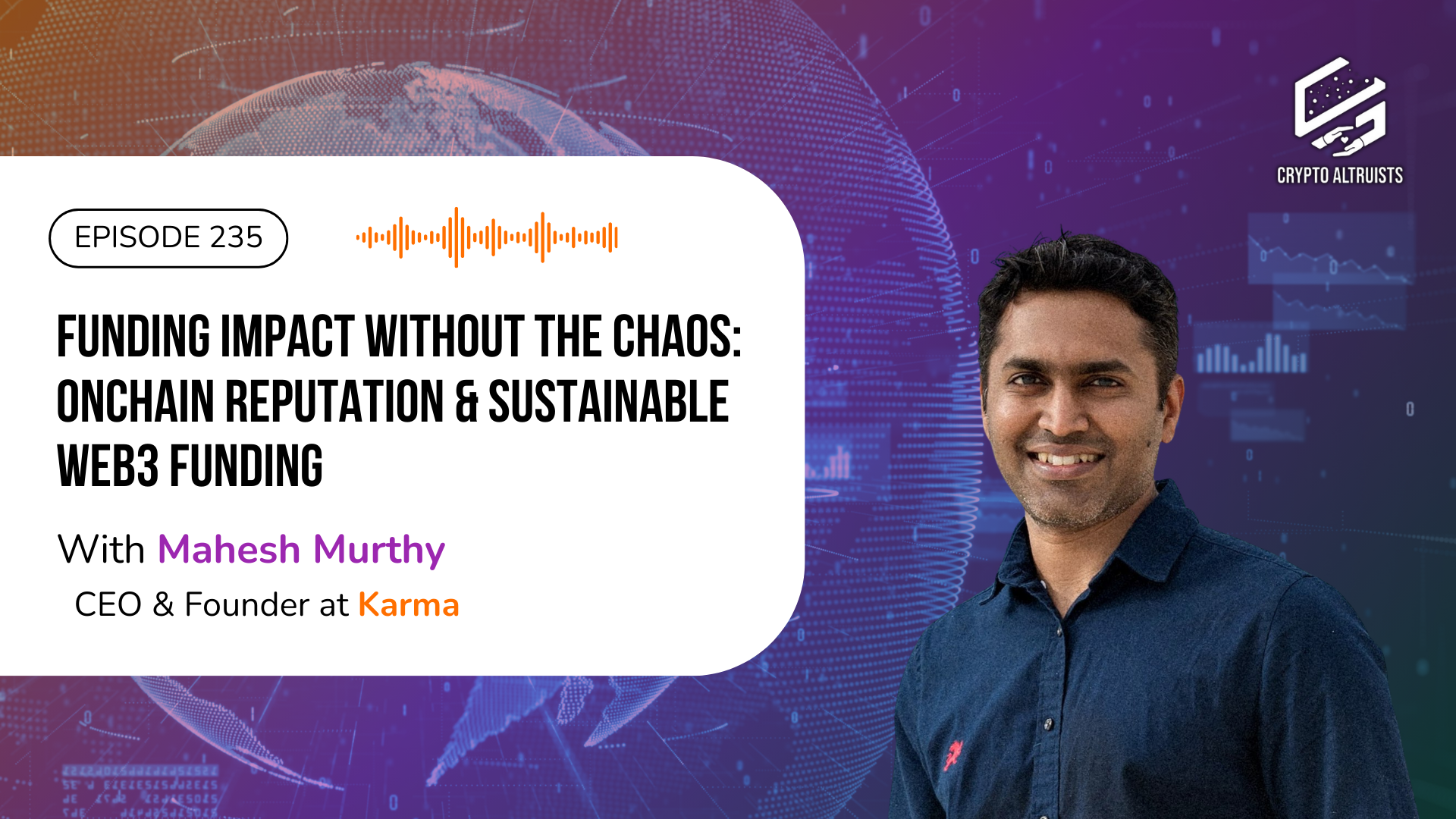


For episode 235, we’re excited to welcome Mahesh Murthy, Founder of Karma, a platform helping ecosystems fund projects in the open, and helping builders turn real work into reputation that actually sticks.
Before we dive in, I want to take a moment to frame why this conversation matters.
In Web3, grant programs have become one of the biggest engines for ecosystem growth. They’re how new teams get their first shot, how public goods get supported, and how communities try to allocate resources toward what matters most.
But anyone who has participated in these programs, as a builder, evaluator, or funder, knows the pain points: updates scattered across forums, milestones that are hard to verify, reputations that don’t carry over, and communities struggling to separate real progress from good marketing.
Mahesh and the Karma team are tackling that head on by turning impact reporting into structured, onchain data, and by building a public project registry where progress, credibility, and impact can be tracked over time.
In today’s episode, we explore what’s broken in crypto funding, why reputation portability is essential for builders, how their Grantee Accountability Protocol (GAP) and onchain attestations shift trust dynamics, and what it looks like when funding becomes more than capital, and starts becoming real coordination infrastructure for long-term growth.
You’ll learn:
🌀 Grant funding is broken by friction, not intention: For builders, grant programs often mean endless applications, reporting overhead, and context-switching, time that could be spent actually building. For funders, it’s slow and opaque. And for communities, it’s nearly impossible to follow along. The result is a system where everyone is overwhelmed, impact is delayed, and efficiency suffers across the board.
🔗 Onchain attestations unlock a shared layer of trust for Web3: By anchoring milestones, progress updates, and endorsements onchain, attestations create a verifiable, composable trust layer for the Ethereum ecosystem. This opens the door to powerful integrations where reputation, funding decisions, and coordination tools can all plug into the same source of truth.
🎒 Portable reputation is foundational to sustainable ecosystem growth: Builders shouldn’t have to start from zero every time they move between ecosystems. A unified, onchain reputation layer allows teams to own their impact history, prove their work, and carry credibility with them. This makes it easier for funders and communities to evaluate projects, reduce risk, and support what’s already working.

PIPE gDAO is leveraging blockchain for their University Real World Asset IP Launchpad that helps bring groundbreaking ideas from lab to market. By joining the Pipe Associate Network (aka PAN), associates can create a profile highlighting their skills, be notified of opportunities, and then contribute fractional work to pre-IPO companies in return for equity and tokens.
Check out their Linktree for links to all of their socials so you can get involved and join this growing community!
02:25 - To kick things off, I’d love to learn more about your journey to Web3. Was there an “aha” or lightbulb moment that first got you excited about this space and ultimately led you to founding Karma?
08:30 - Grant programs have become a major pillar of Web3 ecosystem growth, but they can also be fragmented and opaque. What do you see as the biggest structural problems with how funding has traditionally worked in crypto?
13:50 - For listeners who are new to Karma, how do you describe the platform in simple terms? What does Karma enable that didn’t really exist before?
16:50 - A big theme in Karma is treating a project profile like a portable, onchain résumé. Why is reputation portability so important for builders, especially those moving across ecosystems?
19:35 - Karma originally emerged around the idea of onchain accountability and milestones. Can you walk us through how GAP works and why onchain attestations can be a powerful tool to change the trust dynamic between funders and builders?
23:10 - You’ve said Karma is about more than just distributing capital. How does the platform help ecosystems move from “funding projects” to actually coordinating sustainability, long-term growth, and impact?
26:30 - Can you please introduce listeners to Karma Seeds?
30:40 - Karma now includes AI-assisted application evaluation and routing. Where does AI genuinely add value in grantmaking, and where do you still think human judgment is essential?
36:10 - You’ve worked with ecosystems like Optimism, Celo, Polygon, UNICEF Ventures, and more. What have you learned from running funding programs at this scale that surprised you?
39:20 - For listeners; whether it be funders, builders, or interested community members; what would be your CTA for them? What’s the best way for them to learn more?
41:05 - As we look toward the next few years, what does success look like for Karma? If this infrastructure really works, how does it change who gets funded, how trust is built, and what kinds of projects ultimately get to scale?
Please note: we make use of affiliate marketing to provide readers with referrals to relevant products and services.
Support thoughtful, independent crypto journalism and help us continue highlighting blockchain’s potential for social and environmental impact.
cryptoaltruists.eth
While we may discuss specific web3 projects or cryptocurrencies on this podcast, please do not take any of this as investment advice, and please make sure to do your own research on potential investment opportunities, or any opportunity. We host a variety of guests on this podcast with the sole purpose of highlighting the social impact use cases of this technology. That being said, Crypto Altruism does not endorse any of these projects, and we recognize that, since this is an emerging sector, some may be operating in regulatory grey areas, and as such, we cannot confirm their legality in the jurisdictions in which they operate, especially as it pertains to decentralized finance protocols. So, before getting involved with any project, it’s important that you do your own research and confirm the legality of the project. More available HERE.