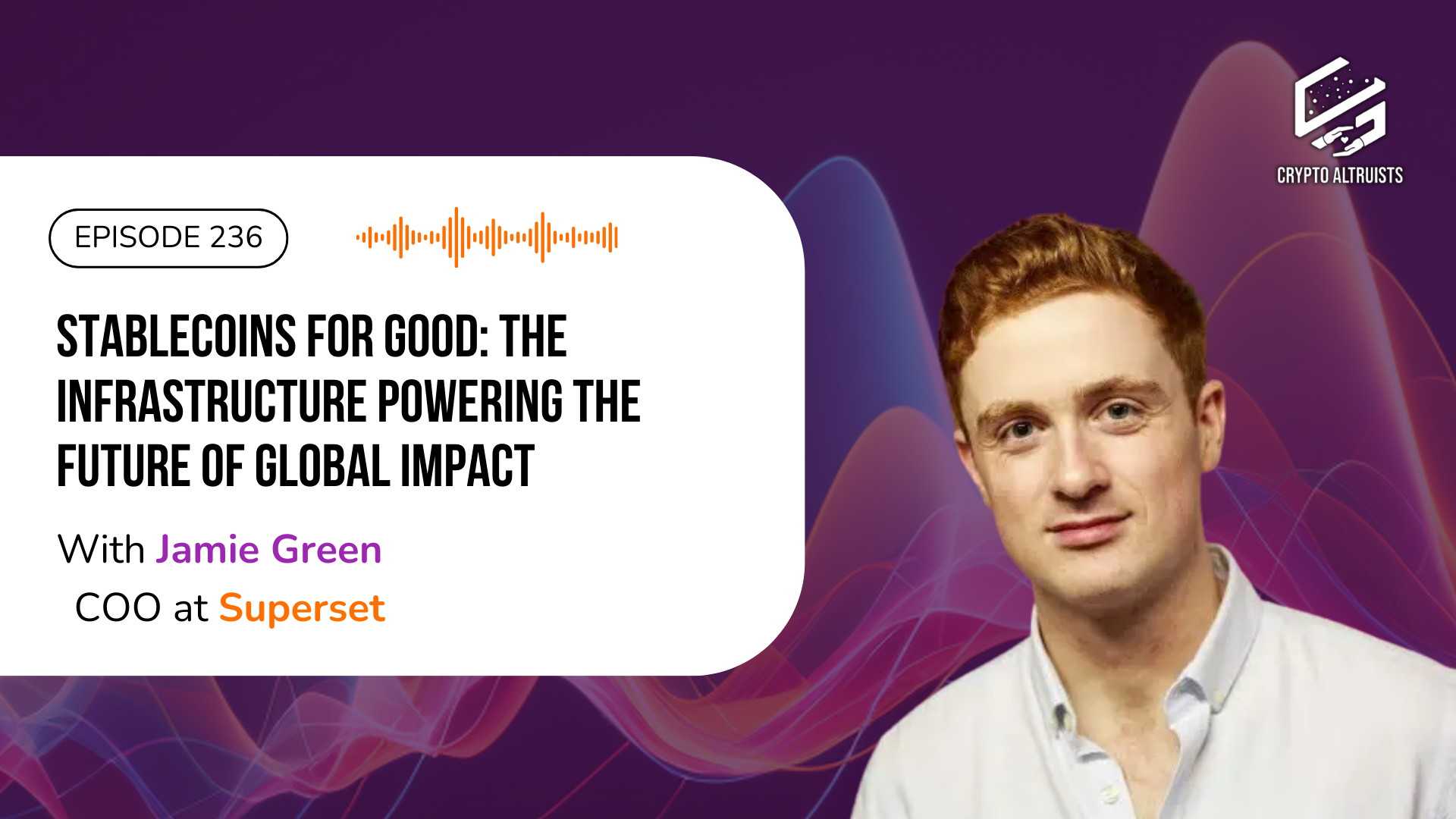


For episode 236, we’re excited to welcome Jamie Green, COO and Co-Founder of Superset, a crypto start-up on a mission to improve stablecoin efficiency & reliability.
Jamie has a rare perspective. Before building in Web3, he worked across startups, venture, and the United Nations; including on programs supporting Syrian refugees, where blockchain-based aid wasn’t theoretical, it was operational. Funds had to move quickly, reliably, and safely, or real people were affected.
That experience shaped a core insight we explore in today’s conversation:
If stablecoins are going to become global rails for humanitarian aid, remittances, and financial access, the infrastructure underneath them has to actually work.
In this episode, we dive into why fragmented stablecoin liquidity across chains is one of the biggest, and least talked about, bottlenecks to real-world adoption; how Superset is building infrastructure to make stablecoin FX cheaper and more dependable; and what builders can learn from operating at the intersection of finance, humanitarian systems, and Web3.
We also zoom out to talk about what it takes to build for the long haul in crypto: the habits, mistakes, and mental models that matter when you’re scaling infrastructure in high-variance environments.
You’ll learn:
💸 Why stablecoins are becoming critical global infrastructure, and why liquidity, reliability, and FX matter just as much as adoption
🌍 What it actually takes to move money in high-stakes humanitarian and real-world contexts, based on firsthand experience
🚀 Lessons learned from working with the UN to support refugees in Syria to founding Superset, and what it takes to scale “boring” infrastructure that unlocks real impact
🌍 Impact comes before ideology: Decentralization is a powerful goal, but it shouldn’t come at the expense of real-world outcomes. In practice, delivering impact sometimes means starting with more centralized or pragmatic approaches, then decentralizing over time once the system is working for the people who rely on it.
⚙️ “Boring” infrastructure unlocks real-world impact: Lower fees, deeper liquidity, and reliable execution may not be flashy, but they’re essential. This kind of infrastructure is what makes stablecoins usable for remittances, humanitarian aid, credit, and everyday financial access at scale.
💸 Fragmentation quietly taxes impact: When liquidity is scattered across chains and systems, less capital moves onchain, fewer people transact, and users pay more through slippage and fees. Solving fragmentation isn’t just a technical challenge, it’s a prerequisite for scaling adoption and impact.

PIPE gDAO is leveraging blockchain for their University Real World Asset IP Launchpad that helps bring groundbreaking ideas from lab to market. By joining the Pipe Associate Network (aka PAN), associates can create a profile highlighting their skills, be notified of opportunities, and then contribute fractional work to pre-IPO companies in return for equity and tokens.
Check out their Linktree for links to all of their socials so you can get involved and join this growing community!
02:45 - To kick things off, I’d love your story. You’ve worked across startups, venture, and the UN; what first pulled you into Web3, and what made you decide to build here for the long haul?
05:20 - You saw blockchain-based aid up close while working on programs supporting Syrian refugees. What did that experience teach you about what actually matters when you’re moving money in high-stakes, real-world contexts?
10:40 - For listeners new to Superset, what is it in plain English? What problem are you solving, and why does stablecoin liquidity fragmentation matter more than most people realize?
16:15 - Superset’s core idea is “virtualizing” liquidity into unified pools. Can you walk us through the Superset model at a high level; how SuperPools work, what a hub-and-spoke approach means, and what changes for traders and LPs?
18:40 - Superset talks about 300+ chains and a future where liquidity needs to “just work” everywhere. What does success look like in 12–24 months, and what are the key milestones you’re optimizing for?
20:35 - If stablecoins are becoming humanitarian rails, what infrastructure is missing today for them to work at scale for NGOs, remittances, and frontline communities; and how does Superset’s work ultimately help enable this work?
26:00 - You’ve been in some interesting rooms, from UN programs to crypto founder trenches. What’s the most surprising lesson about human behavior and incentives that you only learn by building in Web3?
30:50 - What’s one tool, habit, or “operator rule” you swear by as a COO in high-variance environments, and what’s one mistake you see teams repeat when scaling fast?
31:40 - Building in crypto comes with a lot of ups and downs, and plenty of setbacks. How do you stay motivated and bounce back from setbacks?
33:15 - For founders, stablecoin issuers, LPs, and impact builders listening, what’s the best way to get involved with Superset right now?
34:50 - To close us out: what would you say to the crypto-skeptical audience about why “boring infrastructure” like liquidity networks might be one of the biggest unlocks for real-world impact?
Please note: we make use of affiliate marketing to provide readers with referrals to relevant products and services.
Support thoughtful, independent crypto journalism and help us continue highlighting blockchain’s potential for social and environmental impact.
cryptoaltruists.eth
While we may discuss specific web3 projects or cryptocurrencies on this podcast, please do not take any of this as investment advice, and please make sure to do your own research on potential investment opportunities, or any opportunity. We host a variety of guests on this podcast with the sole purpose of highlighting the social impact use cases of this technology. That being said, Crypto Altruism does not endorse any of these projects, and we recognize that, since this is an emerging sector, some may be operating in regulatory grey areas, and as such, we cannot confirm their legality in the jurisdictions in which they operate, especially as it pertains to decentralized finance protocols. So, before getting involved with any project, it’s important that you do your own research and confirm the legality of the project. More available HERE.