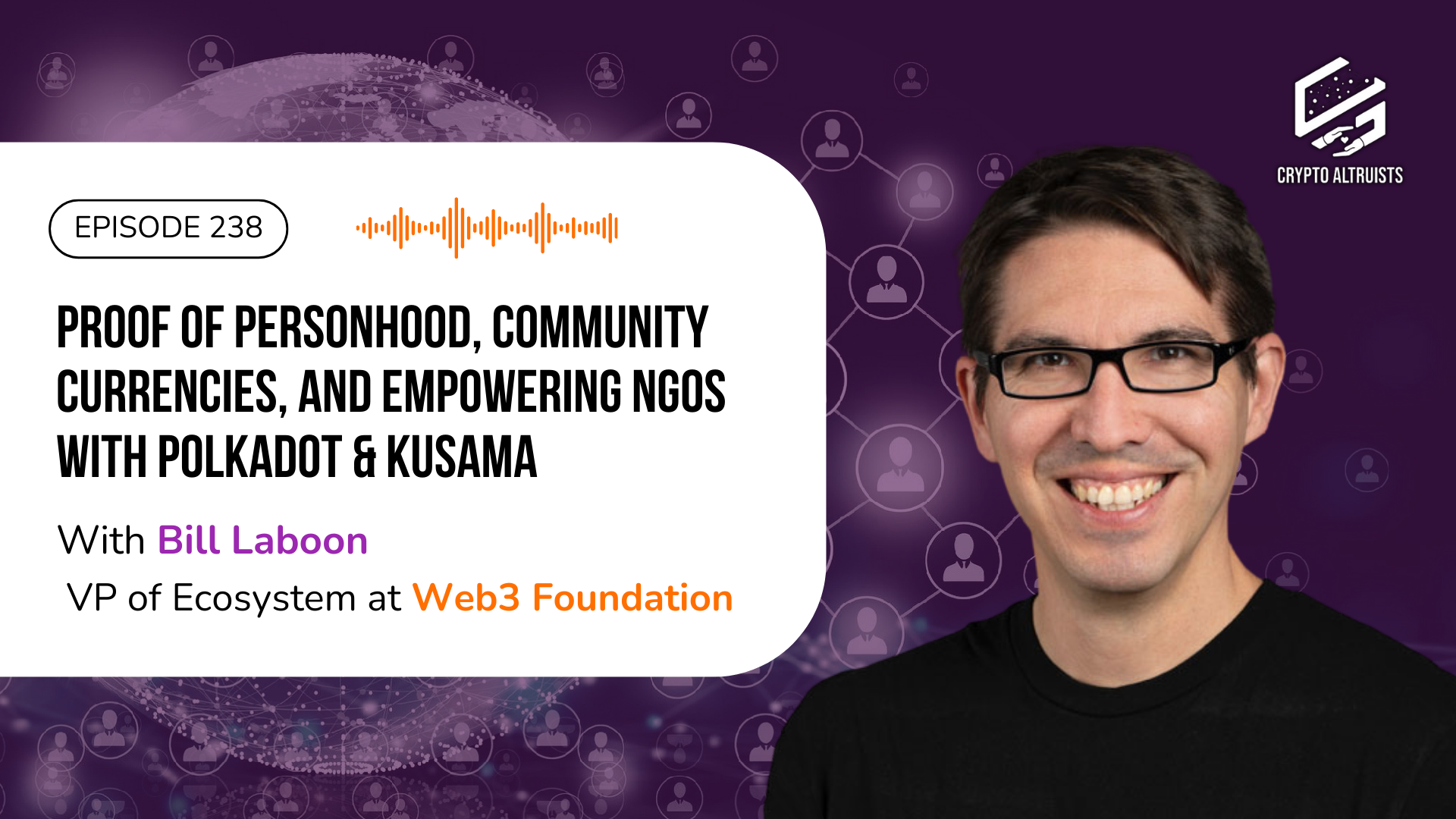


For episode 236, we’re excited to welcome Bill Laboon, VP of Ecosystem at Web3 Foundation. Some of you may remember Bill from a previous episode, but a lot has happened since then; both in his role and in the broader Polkadot and Kusama ecosystem.
Web3 Foundation has been at the forefront of building decentralized infrastructure since the early days, supporting everything from core protocol development to some of the most compelling impact pilots in the space. And today, we're going to dig into a few of those stories.
We'll explore Encointer, a project achieving remarkable results in Tanzania by combining blockchain with traditional community practices. We'll discuss Proof of Personhood and why decentralized identity is so critical for impact at scale. And we'll hear about Whiteflag Protocol, which is helping NGOs coordinate in conflict zones without compromising safety.
We'll also get personal, hearing what Bill has learned after years of building in this space, and what advice he'd give his younger self.
You’ll learn:
🌍 How Encointer is transforming community aid in Tanzania, achieving a remarkable 240% multiplier effect by blending blockchain with local practices like rotating savings groups
🪪 Why Proof of Personhood and decentralized identity are essential infrastructure for scaling impact projects and ensuring aid reaches real people
🏥 How the Whiteflag Protocol leverages Polkadot to help NGOs trustlessly share locations in war zones enabling coordination without compromising safety
💡 And hard-earned lessons from years of building in Web3, including what the ecosystem still gets wrong when it comes to real-world impact
🌍 Meet people where they are and build with them, not for them: The most successful blockchain-for-good projects don't parachute in with technology and expect adoption. They listen first. They learn from local customs, traditional practices, and existing community structures. Real impact comes from working alongside communities, respecting what already works, and designing solutions that amplify local wisdom rather than replace it.
🪪 Proof of Personhood is foundational infrastructure for impact and a better internet: In an age of AI-generated content, deepfakes, and rampant fraud, the ability to verify that a real human is behind an action is becoming essential. Proof of Personhood and decentralized identity aren't just nice-to-haves, they're critical for scaling aid, ensuring inclusion, and rebuilding trust online. For impact projects especially, knowing that resources reach real people is the difference between success and failure.
🔍 Stay curious and resist echo chambers: Bill's top advice for anyone building in Web3: be relentlessly curious. Explore other ecosystems instead of pledging allegiance to a single chain. Look to history for lessons that can inform the future. The builders who thrive long-term are the ones who stay open, keep learning, and draw wisdom from everywhere, not just their own corner of the space.

PIPE gDAO is leveraging blockchain for their University Real World Asset IP Launchpad that helps bring groundbreaking ideas from lab to market. By joining the Pipe Associate Network (aka PAN), associates can create a profile highlighting their skills, be notified of opportunities, and then contribute fractional work to pre-IPO companies in return for equity and tokens.
Check out their Linktree for links to all of their socials so you can get involved and join this growing community!
02:55 - You’ve previously been on the podcast, so some listeners may be familiar with you. Since then, you’ve been elevated to the role of VP of Ecosystem. Do you mind sharing your journey to Web3, and if there was specific “ah hah” moment that got you excited about this space?
05:40 - Web3 Foundation has supported everything from core protocol development to impact pilots. Can you give a high-level intro to Web3 Foundation and what you’ve been working on lately?
08:30 - I would love to discuss Encointer, an impact project in the Polkadot/Kusama ecosystem that is having an incredible impact in Tanzania. For listeners who haven’t followed the project closely, how do you describe Encointer in plain terms, and what problem is it solving?
10:15 - The Nyota community pilot in Tanzania showed a 240% multiplier effect on aid. From your perspective, why did this work when so many tech-for-good pilots struggle to stick?
13:30 - One thing that stood out is how Encointer combined blockchain with existing local practices like rotating savings groups. Why is that blending of culture + technology so critical, and what does Web3 get wrong when it ignores that?
18:00 - Projects like Encointer rely on participation, trust, and local verification. How do you see decentralized identity evolving in ecosystems like Polkadot and Kusama, especially for use cases involving aid, inclusion, and community economies?
21:10 - Proof of Personhood is a core focus of Web3 Foundation. Can you tell me more about the work you’re doing in this area, and some of the opportunities decentralized identity may unlock in the coming years?– decentralized way of proving you are a person
26:35 - Whiteflag Protocol is a unique project built on Polkadot that allows NGOs to trustlessly publish their location in conflict zones. Can
29:20 - You’ve been building in this space for a long time now. When you think back to your early days working in Web3 versus today, what’s changed most in how you personally think about impact, not just technology?
31:50 - You get to teleport back 5–6 years to your early days working for Web3 Foundation. What is one piece of hard-earned advice you would give yourself about building successful career in Web3?
37:20 - Do you have a CTA for listeners? Where can they go to learn more about you and Web3 Foundation?
40:20 - If you were to zoom out and look 10 years into the future, what would make you say that Web3 actually lived up to its promise?
Please note: we make use of affiliate marketing to provide readers with referrals to relevant products and services.
Support thoughtful, independent crypto journalism and help us continue highlighting blockchain’s potential for social and environmental impact.
cryptoaltruists.eth
While we may discuss specific web3 projects or cryptocurrencies on this podcast, please do not take any of this as investment advice, and please make sure to do your own research on potential investment opportunities, or any opportunity. We host a variety of guests on this podcast with the sole purpose of highlighting the social impact use cases of this technology. That being said, Crypto Altruism does not endorse any of these projects, and we recognize that, since this is an emerging sector, some may be operating in regulatory grey areas, and as such, we cannot confirm their legality in the jurisdictions in which they operate, especially as it pertains to decentralized finance protocols. So, before getting involved with any project, it’s important that you do your own research and confirm the legality of the project. More available HERE.