
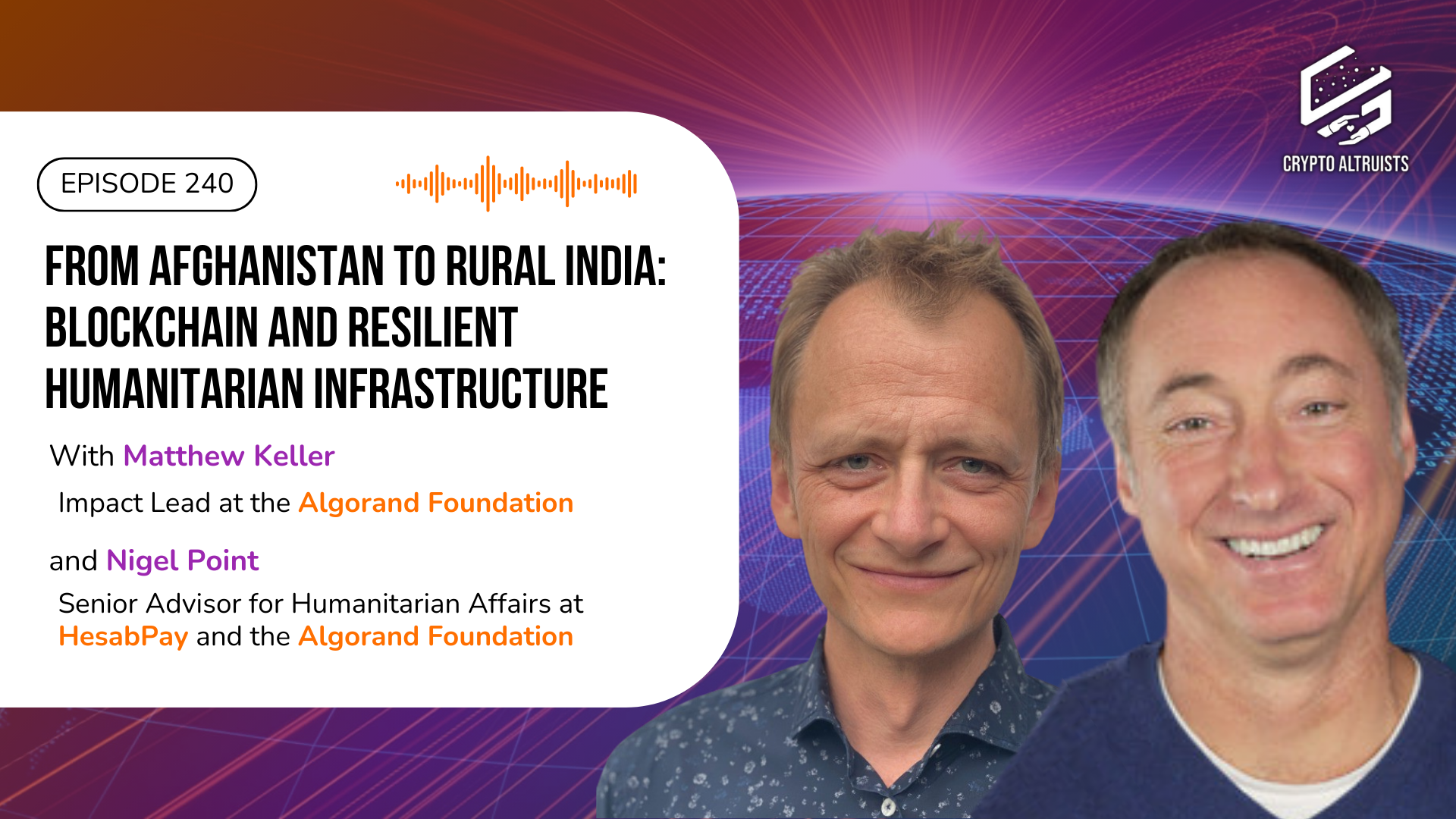


For episode 240, we’re excited to welcome Matthew Keller, Impact Lead at the Algorand Foundation, and Nigel Pont, Senior Advisor for Humanitarian Affairs at both HesabPay and the Algorand Foundation.
The humanitarian sector is at a crossroads. Massive funding cuts, especially the cuts to USAID, are estimated to result in millions of deaths by 2030, and there are growing concerns around transparency and accountability in how aid is delivered. At the same time, blockchain technology is proving itself as real infrastructure for getting resources to people who need them, faster, cheaper, and more transparently than traditional systems allow.
We explore some of the most compelling examples of this work in action. We'll hear about HesabPay, which is enabling digital payments and aid distribution in Afghanistan under incredibly difficult circumstances. We'll discuss partnerships with organizations like SEWA and Mann Deshi that are using blockchain to expand healthcare access and financial inclusion for women in India. And we'll learn about the Blockchain Academy, which is training the next generation of impact builders around the world.
You’ll learn:
🌍 How the humanitarian aid sector is facing a crisis of funding, trust, and accountability, and where blockchain fits into solving these systemic challenges
💳 The remarkable story of HesabPay, the first and only interoperable digital payments platform in Afghanistan, operating in incredibly challenging conditions
🏥 How blockchain-based digital health passports and credit scoring solutions are expanding healthcare access and financial inclusion for millions of women in India
💡 And hard-earned lessons from building blockchain infrastructure in underserved regions, from Afghanistan to rural India
🚨 Humanitarian aid is in crisis, and blockchain offers a path forward: With cuts to USAID and growing concerns around accountability and transparency, the humanitarian sector is facing a moment of reckoning. Blockchain technology offers a compelling solution: immutable records, transparent fund flows, and the ability to deliver aid directly to those who need it without layers of intermediaries. In a landscape where trust has been strained, blockchain can help rebuild confidence that resources are reaching the right people.
🌍 Necessity breeds innovation, and underserved communities are leading the way: Some of the most exciting crypto innovation isn't happening in Silicon Valley. It's happening in places like Afghanistan and rural India, where traditional banking and infrastructure have failed. These communities aren't waiting for legacy systems to catch up. They're leapfrogging entire generations of technology, building local solutions that meet real needs. When necessity drives development, the results are often more practical, resilient, and human-centered than anything designed in a boardroom.
🎯 Lead with impact, not tech: The best blockchain solutions are the ones users don't even realize are powered by blockchain. What matters is the outcome: a woman in rural India who can now prove her credit history, a family in Afghanistan who can receive payments instantly. The key is building experiences that meet people where they are, with intuitive interfaces that don't require understanding wallets, keys, or protocols. Technology should be invisible. Impact should be clear.
SEWA Digital Health Identity Partnership
Mann Deshi Credit Scoring Partnership

PIPE gDAO is leveraging blockchain for their University Real World Asset IP Launchpad that helps bring groundbreaking ideas from lab to market. By joining the Pipe Associate Network (aka PAN), associates can create a profile highlighting their skills, be notified of opportunities, and then contribute fractional work to pre-IPO companies in return for equity and tokens.
Check out their Linktree for links to all of their socials so you can get involved and join this growing community!
03:45 - To start, I'd love to hear from both of you; can you tell me about your journey to Web3, and if there was an “ah hah” moment that inspired you to work in the space?
08:05 - The humanitarian aid sector is facing a crisis due to funding cuts, changing political dynamics, and concerns over transparency and accountability. From your perspective, what are the biggest systemic challenges in how aid is delivered today, and where does blockchain fit into solving them?
15:50 - HesabPay in Afghanistan is a remarkable story. It’s the first and only interoperable digital payments platform in the country, operating in incredibly challenging conditions. Can you tell us about that partnership, what it took to build, and the impact it's having for people on the ground?
24:20 - I believe that necessity breeds innovation in Web3. What are your thoughts on this, and have you seen this in action in your work with Algorand?
26:45 - You recently partnered with the nonprofit SEWA on a blockchain-based digital health passport to expand healthcare access for millions of women in India. What did healthcare access look like for these women before, and how do you see this solution improving health outcomes in the long term?
33:00 - Projects like Mann Deshi and SEWA leverage digital identity in different ways to provide access to essential services. What does the end user experience look like with these tools?
37:40 - The Blockchain Academy, in partnership with UNDP's Alternative Finance Lab, has now trained over 500 participants from 134 countries. What's the vision behind the Academy, who is it designed for, and what kind of ripple effects are you seeing from alumni who've gone through the program?
41:35 - Do you have a call to action for listeners? Where can they go to learn more about Algorand Foundation and HesabPay?
45:00 - Finally, across all the work you've done; the cash transfers, the women's empowerment programs, the Academy, and more; is there a single story or moment that sticks with you? One that reminds you why this work matters?
Please note: we make use of affiliate marketing to provide readers with referrals to relevant products and services.
Support thoughtful, independent crypto journalism and help us continue highlighting blockchain’s potential for social and environmental impact.
cryptoaltruists.eth
While we may discuss specific web3 projects or cryptocurrencies on this podcast, please do not take any of this as investment advice, and please make sure to do your own research on potential investment opportunities, or any opportunity. We host a variety of guests on this podcast with the sole purpose of highlighting the social impact use cases of this technology. That being said, Crypto Altruism does not endorse any of these projects, and we recognize that, since this is an emerging sector, some may be operating in regulatory grey areas, and as such, we cannot confirm their legality in the jurisdictions in which they operate, especially as it pertains to decentralized finance protocols. So, before getting involved with any project, it’s important that you do your own research and confirm the legality of the project. More available HERE.


