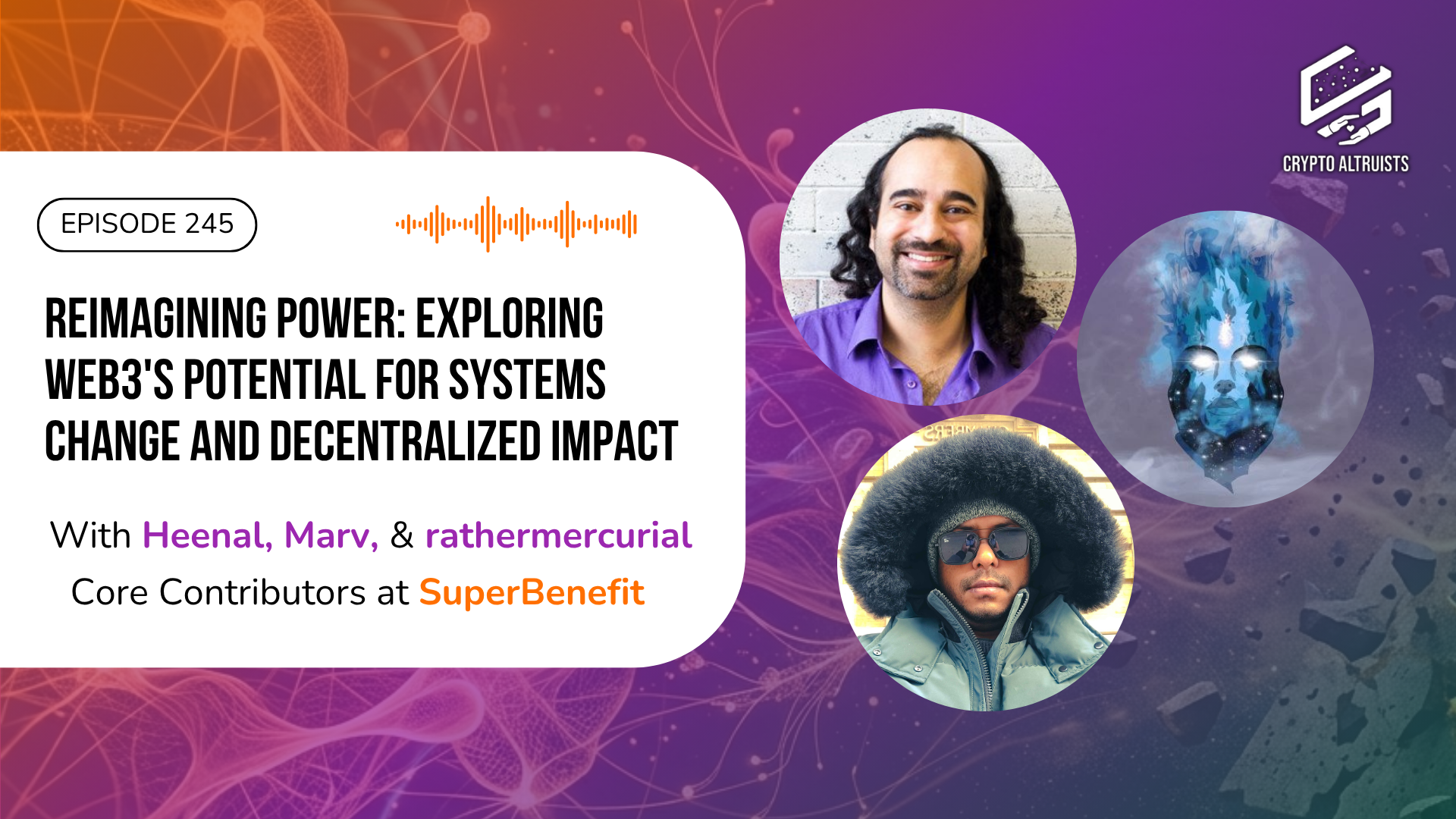


For episode 245 of the Crypto Altruists podcast, we’re excited to welcome Heenal, Marv, and rathermercurial of SuperBenefit, a decentralized collective on a mission to develop the social and financial flywheels that enable the invention and acceleration of a better world. We discuss their Reimagining Power series, a body of research exploring how Web3 can transform power dynamics in philanthropy, governance, and social impact.
This is part one of what will be an ongoing series of conversations in the coming months. Today, we're laying the foundation: the theory, the frameworks, and the uncomfortable truths at the heart of this work. We'll explore why so many systems designed to help have also perpetuated harm, how Web3 offers new possibilities for shifting power to those who have historically been excluded, and what it actually looks like to put these ideas into practice.
In today’s episode you’ll discover:
🌍 How Web3 creates new possibilities for distributing, sharing, and exercising power in ways that amplify the agency of those most impacted by systems of oppression
🔄 How the systems designed to "help" have often perpetuated harm through colonial development models, top-down philanthropy, and extractive capitalism
🛠️ Some of the most compelling decentralized primitives for giving communities power in funding, coordination, and governance
🌱 Sneak peeks into real-world case studies of impact organizations already putting these ideas into practice
⚠️ We must confront philanthropy's uncomfortable history and avoid repeating it in Web3: Philanthropy and international development have a complicated past. Colonial development models, top-down decision-making, and extractive practices have often perpetuated harm while claiming to help. As we build in Web3, we have a responsibility to learn from these mistakes rather than replicate them. If we're not intentional, we risk using new tools to exacerbate the same inequities. Reimagining power means honestly reckoning with this history and designing systems that center the communities most affected.
🔄 Web3 offers powerful primitives for shifting power, but only if we use them intentionally Web3 introduces new possibilities for how power can be distributed, shared, and exercised. DAOs, participatory grantmaking, transparent fund flows, and community governance all offer ways to move decision-making closer to the people most impacted. But these tools don't shift power on their own. They require intentional design, inclusive processes, and a willingness to cede control. The technology creates the opportunity; how we use it determines whether we actually create change.
🎯 “We're so excited about the mechanisms that we often forget about the outcomes”: It's easy to get caught up in the tooling: DAOs, tokens, governance frameworks, and decentralized infrastructure. But mechanisms are only valuable if they lead to meaningful outcomes for real communities. To get there, we need to shape a clearer narrative around Web3, one that communicates the tangible benefits for communities so they see the value and want to use it. The goal isn't adoption of the technology. The goal is impact, and the tech should be invisible in service of that.
rathermercurial.eth - Twitter/X
All In For Sport Substack Newsletter
02:40 - To start, I'd love to do a quick round of introductions. Can each of you share a bit about yourself and your journey? Was there a specific “ah hah” moment that really got you excited about web3?
09:30 - SuperBenefit describes its mission as developing the social and financial flywheels that enable the invention and acceleration of a better world. To lay the groundwork for the conversation, can you share how SuperBenefit came to be, and how it has evolved since those early days?
16:15 - Let's dive into the Reimagining Power series. What inspired this body of work, and what questions were you trying to answer when you started exploring how Web3 can transform power dynamics?
21:05 - There's an uncomfortable truth at the heart of this work: many of the institutions and systems designed to "help" have also perpetuated harm, whether through colonial development models, top-down philanthropy, or extractive capitalism. How do you hold that tension, and how does it inform the Reimagining Power framework?
25:30 - Historically, the people most affected by systems of oppression have had the least say in how resources are allocated or how change happens. From your work, what examples have you seen of how Web3 can address this and ensure those most affected have a voice?
34:30 - Charitable funding has always been difficult to navigate and has disproportionately benefitted larger organizations at the expense of smaller grassroots movements. What Web3 primitives do you feel have the most power to change this and build a more equitable and sustainable funding ecosystem?
38:15 - You've also developed a Reimagining Power Playbook. Can you walk us through what this is, who it's designed for, and how organizations or communities might use it to shift power dynamics in their own contexts?
49:10 - This is part one of a series of conversations. Without giving too much away, what are you most excited for listeners to explore in the case studies and examples that we'll dig into in future episodes?
53:40 - For listeners who want to dive deeper into the Reimagining Power series, explore SuperBenefit's work, or get involved, where should they go? And what's your call to action for people inspired by this conversation?
Support thoughtful, independent crypto journalism and help us continue highlighting blockchain’s potential for social and environmental impact.
cryptoaltruists.eth
While we may discuss specific web3 projects or cryptocurrencies on this podcast, please do not take any of this as investment advice, and please make sure to do your own research on potential investment opportunities, or any opportunity. We host a variety of guests on this podcast with the sole purpose of highlighting the social impact use cases of this technology. That being said, Crypto Altruism does not endorse any of these projects, and we recognize that, since this is an emerging sector, some may be operating in regulatory grey areas, and as such, we cannot confirm their legality in the jurisdictions in which they operate, especially as it pertains to decentralized finance protocols. So, before getting involved with any project, it’s important that you do your own research and confirm the legality of the project. More available HERE.