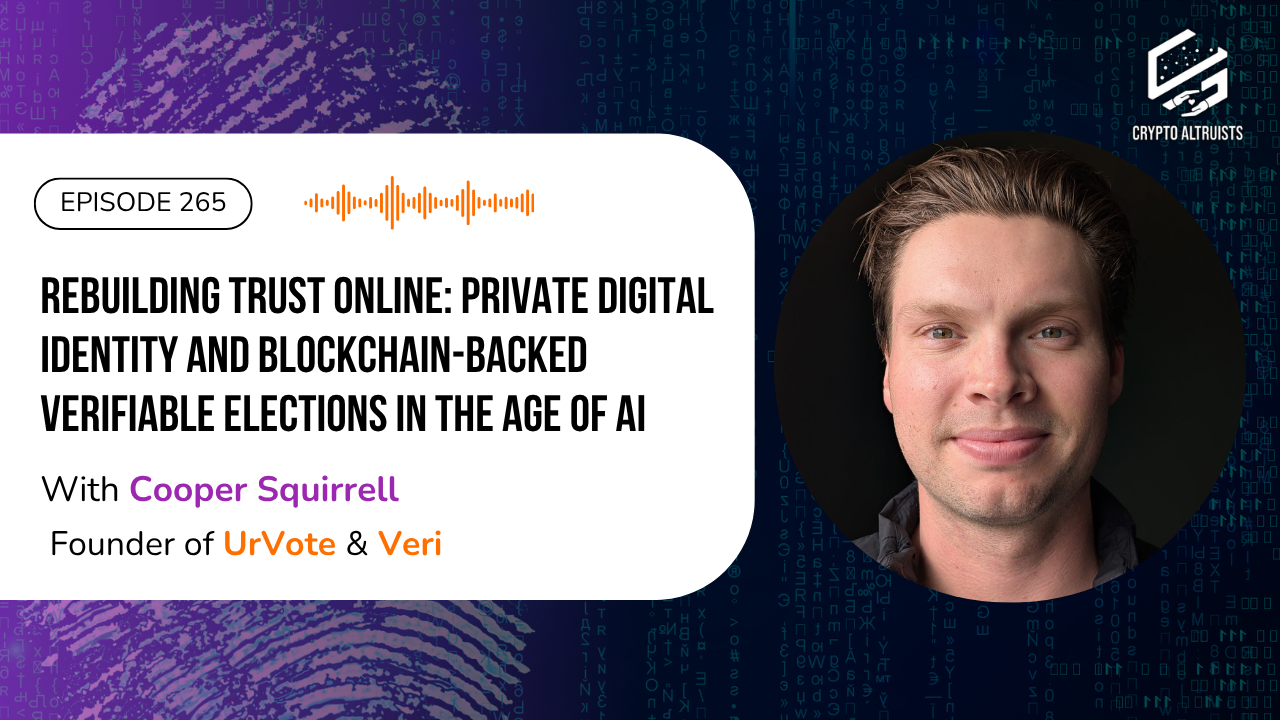


For episode 265 of the Crypto Altruists podcast, we're excited to welcome Cooper Squirrell, Founder of UrVote and Veri, two companies tackling one of the most important and underappreciated problems of our time: how do you verify what's true online without giving away everything else?
We've all felt that unease. The email that lands in your inbox warning that your data may have been compromised. The intense verification process that asks you to hand over your passport, a selfie, and proof of address just to confirm one small fact about yourself. So much of our digital world runs backwards: we over-share by default, exposing our entire identity to prove a single thing.
And the stakes go far beyond spam and inconvenience. Around the world, trust in institutions is fraying, democracy is under real pressure, and faith in the integrity of elections is being tested. Now more than ever, we need systems people can actually trust.
And this is the intersection Cooper is building at. Through UrVote, he's built blockchain-backed voting technology designed to be both anonymous and auditable. And through Veri, he's building privacy-preserving digital identity infrastructure, including one of the first zero-knowledge email credentials. In this conversation, we demystify zero-knowledge proofs, explore how to build elections people can trust, dig into what a better model for digital identity looks like, and talk about where privacy, verification, and trust are all headed over the next decade, especially as AI makes it harder to tell what, and who, is real.
In today's discussion you'll learn:
🔐 What zero-knowledge proofs are, explained in plain language, and why they might be one of the most important privacy tools of the next decade
🗳️ How blockchain-backed voting can be both anonymous and auditable, and what that means for rebuilding trust in elections
🆔 A better model for digital identity, one where you can prove what matters without handing over your entire personal life
🤖 Why verification and privacy are becoming existential questions in the age of AI, deepfakes, and bots
📨 Subscribe to the Crypto Altruists' Newsletter!
🧰 Check out the Web3 Impact Toolkit early access
🔐 Getting digital identity right is more important than ever: We're at a pivotal moment. As AI makes it harder to tell what's real and who's real online, the questions of digital privacy, identity, and trust are becoming existential. From deepfakes to bots to endless data breaches, the old model, where we hand over our entire identity just to prove a single fact, is breaking down. The next decade will determine whether digital identity empowers people or exploits them, and whether our elections and institutions can earn back the trust they've lost.
⚙️ The best technology fades into the background: One of the most important lessons from this conversation is that blockchain works best when you don't even notice it's there. For all the power of zero-knowledge proofs and on-chain verification, none of it matters if regular people can't use it or find it confusing. The goal isn't to make everyone understand the cryptography under the hood, it's to bake the technology into the background and deliver a simple, intuitive user experience. Real adoption comes from meeting people where they are instead of asking them to become experts in blockchain.
🗳️ Privacy and verification don't have to be a trade-off: At the heart of this work is an idea that sounds almost contradictory; that elections can be both completely private and fully auditable. Everyone should be able to participate while keeping their vote private, and at the same time, receive an onchain receipt of their vote and the ability to independently verify that it was counted. For so long, we've been told we have to choose between privacy and accountability. But zero-knowledge technology shows that's a false choice. You can protect the individual and prove the integrity of the whole, at the same time.
Cooper
UrVote
Veri
03:10 - To kick things off, can you tell us a bit about your journey? What led you to your work with UrVote and Veri?
05:20 - The core problem you are looking to address is how to prove something is true without exposing everything else? Can you unpack that a little for our listeners? Why is that tension becoming so urgent right now?
09:45 - A lot of people hear "zero-knowledge proofs" and their eyes glaze over. Can you break down, in plain language, what a zero-knowledge proof is, and why it's such a powerful tool for privacy?
12:10 - Let's talk about UrVote, a blockchain-based digital voting platform. Can you tell me the role blockchain plays and how it’s built into the technology?
15:00 - Trust in elections and institutions feels shaky in a lot of places right now. How do you see verifiable, privacy-preserving voting technology playing a role in rebuilding trust and engagement in democratic processes, and what are the limits of what technology alone can do?
17:30 - I’d love to hear some case studies. Tell me more about the election pilots you’ve run and the types of organizations that you’ve been working with.
22:10 - So much of our online life right now works by handing over more personal data than we need to, our email, our documents, our whole identity, just to prove one small thing. What does a better model look like, and how does Veri help get us there?
24:40 - This feels especially urgent in the age of AI. As it gets harder to tell what's real and who's real online with the propagation of more bots and deepfakes, how does the kind of verification you're building help?
27:15 - There's a real tension in this space between privacy and accountability. Some argue that too much anonymity enables bad actors, while others worry that verification systems become tools of surveillance. How do you think about walking that line responsibly?
29:40 - For individuals who are part of an organization or DAO that could benefit from UrVote’s election platform, walk me through the process for how they can get started.
35:10 - You have a rare vantage point, building for both elections and everyday digital identity. When you to the future, what are some of the key trends in the space we should be keeping an eye on?
38:10 - For listeners who want to learn more about UrVote and Veri, follow your work, or get involved, where should they go? Do you have a call to action for listeners?
39:00 - If we get digital identity right over the next decade, what does that change for an ordinary person? And if we get it wrong, what's at stake?
Support thoughtful, independent crypto journalism and help us continue highlighting blockchain’s potential for social and environmental impact.
cryptoaltruists.eth
While we may discuss specific web3 projects or cryptocurrencies on this podcast, please do not take any of this as investment advice, and please make sure to do your own research on potential investment opportunities, or any opportunity. We host a variety of guests on this podcast with the sole purpose of highlighting the social impact use cases of this technology. That being said, Crypto Altruism does not endorse any of these projects, and we recognize that, since this is an emerging sector, some may be operating in regulatory grey areas, and as such, we cannot confirm their legality in the jurisdictions in which they operate, especially as it pertains to decentralized finance protocols. So, before getting involved with any project, it’s important that you do your own research and confirm the legality of the project. More available HERE.