

Octant has been one of the most innovative experiments in sustainable public goods funding on Ethereum, using staking yield to fund community-chosen projects without depleting principal. Now, the protocol is evolving.
Octant v1 proved that staking rewards could power decentralized funding through fixed epochs and GLM token locking. Octant v2 takes the model further, opening up to multiple funding sources, continuous allocations, and integration with DeFi protocols and DAO treasuries.
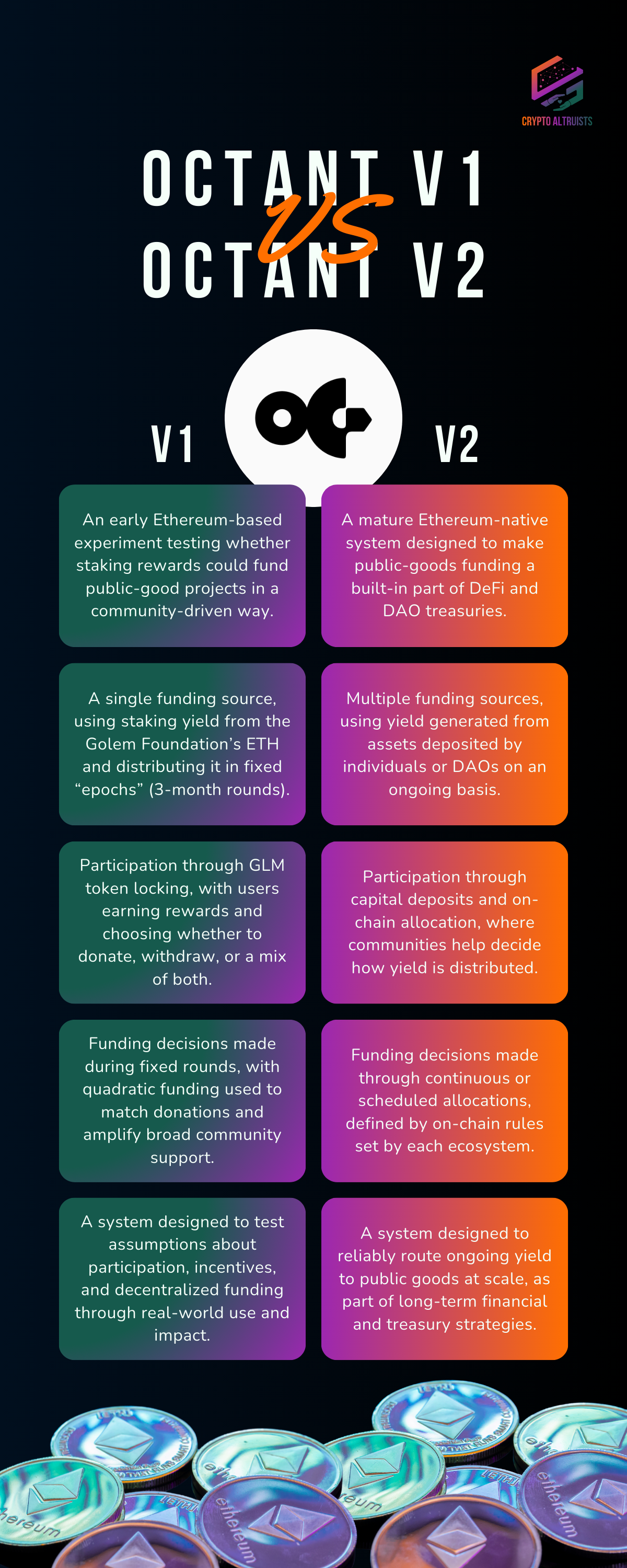
This infographic breaks down the key differences between the two versions, and the implications for the broader Ethereum ecosystem.
An early Ethereum-based experiment testing whether staking rewards could fund public-good projects in a community-driven way.
A single funding source, using staking yield from the Golem Foundation’s ETH and distributing it in fixed “epochs” (3-month rounds).
Participation through GLM token locking, with users earning rewards and choosing whether to donate, withdraw, or a mix of both.
Funding decisions made during fixed rounds, with quadratic funding used to match donations and amplify broad community support.
A system designed to test assumptions about participation, incentives, and decentralized funding through real-world use and impact.
A mature Ethereum-native system designed to make public-goods funding a built-in part of DeFi and DAO treasuries.
Multiple funding sources, using yield generated from assets deposited by individuals or DAOs on an ongoing basis.
Participation through capital deposits and on-chain allocation, where communities help decide how yield is distributed.
Funding decisions made through continuous or scheduled allocations, defined by on-chain rules set by each ecosystem.
A system designed to reliably route ongoing yield to public goods at scale, as part of long-term financial and treasury strategies.
Support thoughtful, independent crypto journalism and help us continue highlighting blockchain’s potential for social and environmental impact.
cryptoaltruists.eth