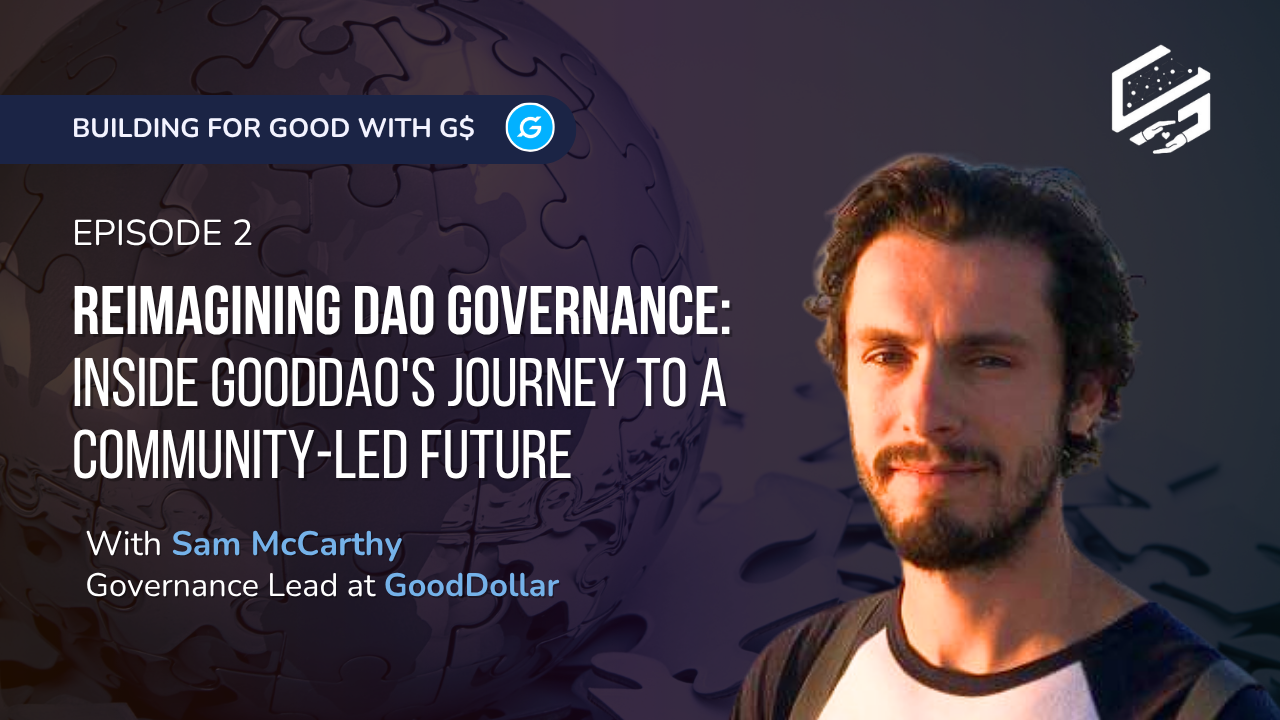


For the second installment of our series, Building for Good with G$, we're excited to welcome Sam McCarthy, who has been leading GoodDollar's work to rebuild its governance through GoodDAO. The series explores the people, projects, and communities powering the GoodDollar ecosystem.
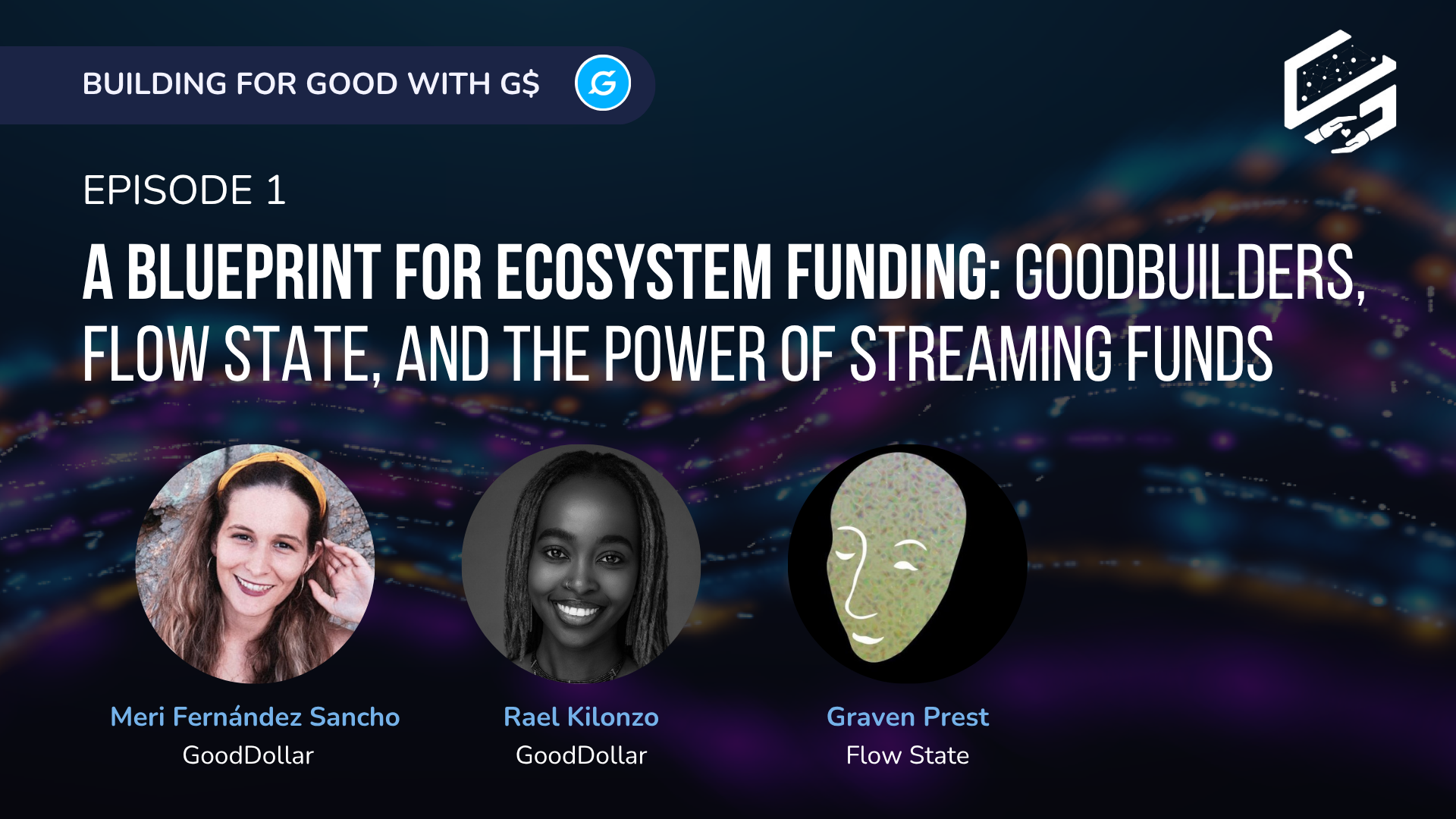
In episode 1, we sat down with Rael, Meri, and Graven to explore a big shift underway at GoodDollar. The project started with a focus on distributing G$ as universal basic income, but its vision has since grown into creating an open economy, where G$ circulates through builders, communities, and public goods. We dug into GoodBuilders, the partnership with FlowState, and why streaming funds are a better way to fund public goods.
In this episode, we turn to the glue that holds it all together: governance. An open economy isn't just about moving money. It's about deciding, together, where that money goes, who gets a say, and how a community stays aligned with its mission as it grows. That's something many DAOs struggle with, as governance too often ends up as a handful of insiders voting on proposals most people never read, while participation drops and power concentrates.
GoodDollar decided to take that challenge head on. This year, they launched a governance re-vision to rebuild GoodDAO from the ground up, in the middle of a bear market, no less. And rather than designing it behind closed doors, they brought the community into the process through CoGov, a collaborative governance hackathon, and launched the House of Alignment, a new mechanism for allocating capital to public goods and the wider G$ ecosystem. Sam walks us through why community-centred governance matters to GoodDollar's bigger vision, what they learned by building it with the community, and how anyone can get involved, whether you're a builder, a funder, or someone who's never touched a DAO before.
In today's discussion you'll learn:
🗳️ Why GoodDollar is rebuilding its governance from the ground up, and why they chose to do it in the middle of a bear market
🤝 How CoGov, a collaborative governance hackathon, invited the community to help design GoodDAO from the ground up
💸 How the new House of Alignment is changing the way GoodDAO funds public goods and the G$ ecosystem
🌱 Lessons on building a DAO that's healthy, sustainable, and community-led
🗳️ Good governance serves two purposes at once: GoodDollar's governance re-vision is built around a dual goal. On one hand, it's about enabling the community to participate meaningfully. Instead of just casting the occasional vote on proposals they haven't had a hand in shaping, it’s about genuinely influencing the direction of the DAO. On the other hand, governance has to serve the broader objective of growing the GoodDollar ecosystem and its vision of an open economy around G$. Doing both of those together is challenging, and it's where many DAOs fall short, either becoming so focused on process that nothing moves, or so focused on growth that the community stagnates.
🤝 Design from first principles, and design for people: Rather than copying an existing governance template, GoodDollar went back to first principles, and put people at the centre of the design. CoGov, their collaborative governance hackathon, brought good people and good energy together, with a goal of creating a core group of highly engaged contributors with a stake in the outcome that goes beyond just financial. When people help build the system, they care about it, show up for it, and stick with it, which is what helps a DAO move past the low participation and concentrated power that often hurts decentralized governance.
🔄 It's all about the movement of value: At its heart, GoodDAO's work is about creating movement throughout the G$ ecosystem. Not just the movement of capital, but the movement of ideas, talent, and energy, all interconnected. A good idea from the community can attract contributors, contributors can attract funding, and funding can unlock new projects that bring in more people and ideas. When governance is designed to keep all of these flowing together, the ecosystem becomes more than the sum of its parts.
GoodDollar
Sam
03:10 - To kick things off, can you introduce yourself and tell us how you found your way to GoodDollar, and the work you're leading now with GoodDAO?
05:25 - In our first episode of this series, we explored GoodDollar's bigger shift, from a project focused on distributing G$ as UBI, toward building an open economy around G$. For listeners who are just joining us, can you set the stage? Where does governance fit into that bigger vision?
08:40 - You've described this year as a kind of "governance re-vision" for GoodDollar, essentially rebuilding GoodDAO, and doing it in the middle of a bear market. Why take this on now, and what was the thinking behind redesigning the governance system from the ground up?
12:50 - I’d love to highlight some of the initiatives that have been launched this year. The first I want to dig into is CoGov, a collaborative governance hackathon with the community. Can you tell us what CoGov was, how it worked, and what came out of it?
16:15 - What did you learn from running governance as a collaborative, hands-on experiment with the community, rather than designing it top-down? Were there any surprises, or moments that reshaped how you're thinking about GoodDAO?
20:00 - Next is the House of Alignment, a new capital allocation mechanism. Can you walk us through what the House of Alignment is, how it works, and what problem it's designed to solve?
26:55 - You've also recently announced a Treasury Committee to activate the GoodDAO treasury. Can you tell me more about this and the vision behind it?
30:20 - When looking at all these initiatives together; CoGov, the House of Alignment, the Treasury Committee; it sounds like you're positioning GoodDAO not as a rubber-stamp voting body, but as an active, living governance ecosystem. What does a healthy, active DAO look like to you, and how is GoodDAO getting there?
36:20 - A lot of people find DAO governance intimidating or opaque, especially if they're new to Web3. You're rolling out a new structure to invite broader participation. What are you doing to make GoodDAO accessible to newcomers, not just the crypto-native crowd?
40:50 - Can you walk us through the different ways listeners, whether they’re builders, funders, or community members, can get involved in GoodDAO? Where should they go to learn more?
Support thoughtful, independent crypto journalism and help us continue highlighting blockchain’s potential for social and environmental impact.
cryptoaltruists.eth
While we may discuss specific web3 projects or cryptocurrencies on this podcast, please do not take any of this as investment advice, and please make sure to do your own research on potential investment opportunities, or any opportunity. We host a variety of guests on this podcast with the sole purpose of highlighting the social impact use cases of this technology. That being said, Crypto Altruism does not endorse any of these projects, and we recognize that, since this is an emerging sector, some may be operating in regulatory grey areas, and as such, we cannot confirm their legality in the jurisdictions in which they operate, especially as it pertains to decentralized finance protocols. So, before getting involved with any project, it’s important that you do your own research and confirm the legality of the project. More available HERE.