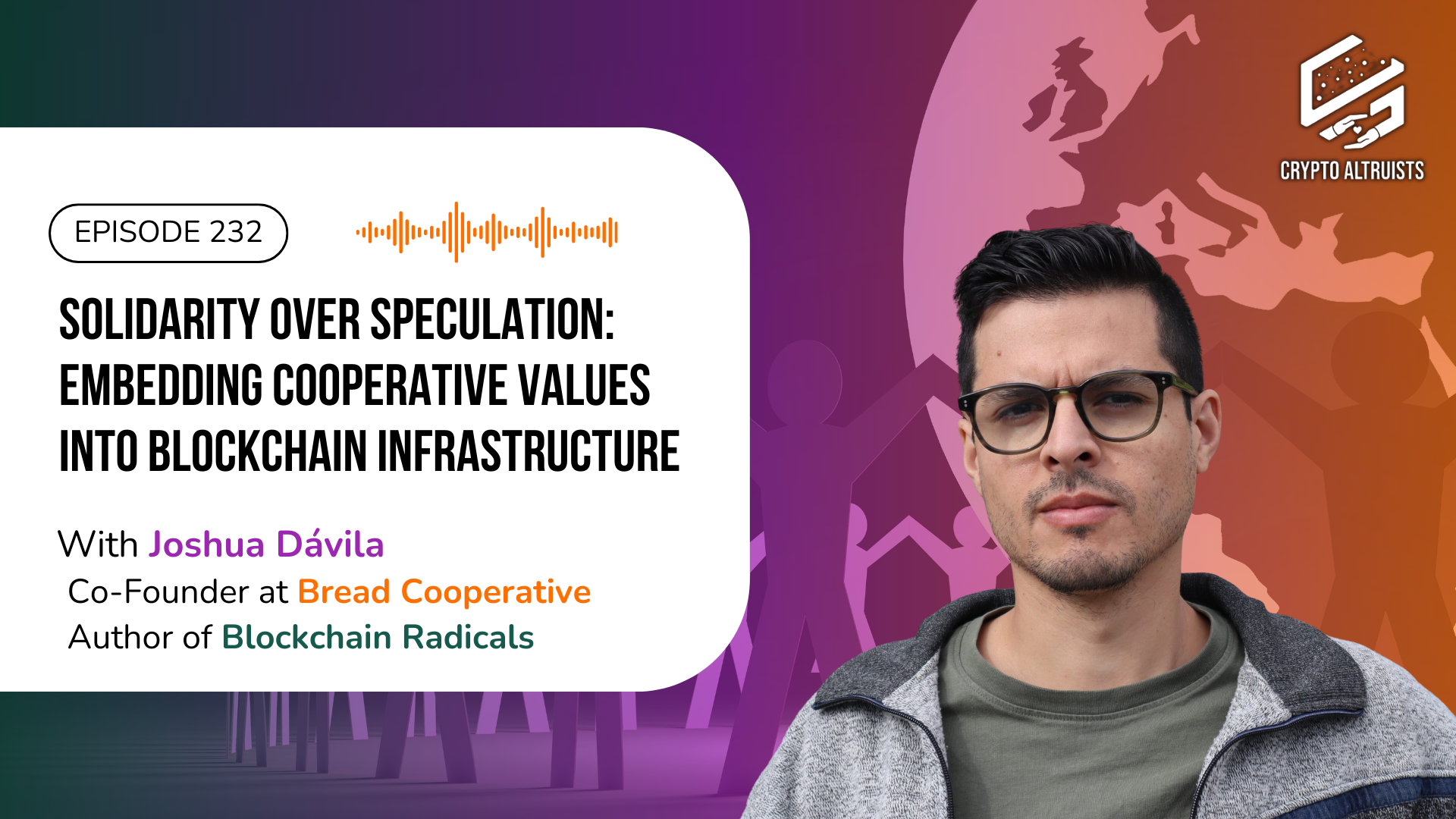


For episode 232, I’m excited to welcome Joshua Dávila, a longtime organizer, writer, and builder at the intersection of progressive politics and crypto. Josh is the host of The Blockchain Socialist podcast, the author of Blockchain Radicals, and a core contributor to Bread Cooperative, a worker-owned collective building real financial tools rooted in solidarity, not hype.
Before we dive in, I want to take a moment to frame this conversation.
So much of crypto discourse today revolves around markets, price action, and individual upside. But beneath the noise is a deeper question: Who controls our financial infrastructure, and who benefits from it?
Josh’s work starts from a different place. It asks what happens when working people own their tools, govern their money together, and design systems that prioritize mutual support over extraction.
We explore Bread Cooperative’s Solidarity Fund, the $BREAD community currency, the idea of “solidarity primitives,” and what crypto can actually offer movements for worker power, economic justice, and collective care.
In today’s episode you’ll learn:
🔁 Old Models, New Scale: Decentralized economic systems like cooperatives, savings circles, and mutual aid networks have existed for generations. Blockchain doesn’t replace these models, it helps communities coordinate, sustain, and scale them globally without losing their local, human roots.
🧩 Values Can Be Designed Into Infrastructure: Technology is never neutral. By intentionally building solidarity primitives, financial tools designed around cooperation, care, and shared ownership, projects like Bread Cooperative show how Web3 can move beyond extractive finance toward systems that serve communities first.
🏗️ Reclaiming Control of Financial Systems: For too long, financial institutions have privatized profits and socialized losses. Community-owned financial infrastructure offers a powerful alternative; one where people have real ownership, voice, and upside, not just financial elites. Web3 makes this shift possible at an entirely new scale.

PIPE gDAO is leveraging blockchain for their University Real World Asset IP Launchpad that helps bring groundbreaking ideas from lab to market. By joining the Pipe Associate Network (aka PAN), associates can create a profile highlighting their skills, be notified of opportunities, and then contribute fractional work to pre-IPO companies in return for equity and tokens.
Check out their Linktree for links to all of their socials so you can get involved and join this growing community!
02:20 - To start, I’d love to hear your journey. You’ve been one of the leading voices exploring the intersection of left politics and crypto through The Blockchain Socialist podcast, your book Blockchain Radicals, and now Bread Cooperative. What first drew you toward Web3, and how did that evolve into building financial infrastructure grounded in solidarity rather than speculation?
07:30 - For listeners new to Bread.Coop, can you give us a high-level overview of your mission?
10:40 - Can you please highlight some of the projects in the Bread Cooperative ecosystem that demonstrate solidary use cases?
17:30 - A major theme in Blockchain Radicals is the idea that technical systems always embed political values. How does Bread Cooperative intentionally encode values like solidarity, worker ownership, and anti-extractive design into its architecture?
23:55 - Many of Bread’s tools draw inspiration from long-standing structures like co-ops and rotating savings and credit associations (ROSCAs). How do these traditional practices shape your design choices, and what does Web3 make possible that wasn’t previously feasible?
30:00 - The monthly cycle where BREAD holders allocate the sDAI yield is an interesting experiment in participatory budgeting. What have you learned so far about democratic governance, voter participation, and how communities prioritize collective benefit over individual gain?
35:30 - Bread.Coop’s roadmap imagines tools like community currencies, cooperative credit unions, on-chain budgeting, and even Gnosis Pay integrations. What does the “endgame” look like for a world where working people collectively control their digital financial tools?
40:35 - You’ve personally worked on helping route aid into Gaza using crypto rails during a time when traditional channels were blocked. What did that experience teach you about the strengths and limitations of decentralized financial infrastructure in urgent humanitarian contexts?
46:45 - For listeners who resonate with your vision, whether they’re workers, organizers, builders, or simply people tired of extractive finance, what’s the best way to join the cooperative, contribute, or start using Bread’s tools in their own communities?
49:20 - Drawing from your experience across media, theory, and building real infrastructure, what is one key message you want progressive leaders, especially the crypto-skeptical ones, to know about how blockchain can genuinely support worker power and economic justice?
Please note: we make use of affiliate marketing to provide readers with referrals to relevant products and services.
Support thoughtful, independent crypto journalism and help us continue highlighting blockchain’s potential for social and environmental impact.
cryptoaltruists.eth
While we may discuss specific web3 projects or cryptocurrencies on this podcast, please do not take any of this as investment advice, and please make sure to do your own research on potential investment opportunities, or any opportunity. We host a variety of guests on this podcast with the sole purpose of highlighting the social impact use cases of this technology. That being said, Crypto Altruism does not endorse any of these projects, and we recognize that, since this is an emerging sector, some may be operating in regulatory grey areas, and as such, we cannot confirm their legality in the jurisdictions in which they operate, especially as it pertains to decentralized finance protocols. So, before getting involved with any project, it’s important that you do your own research and confirm the legality of the project. More available HERE.