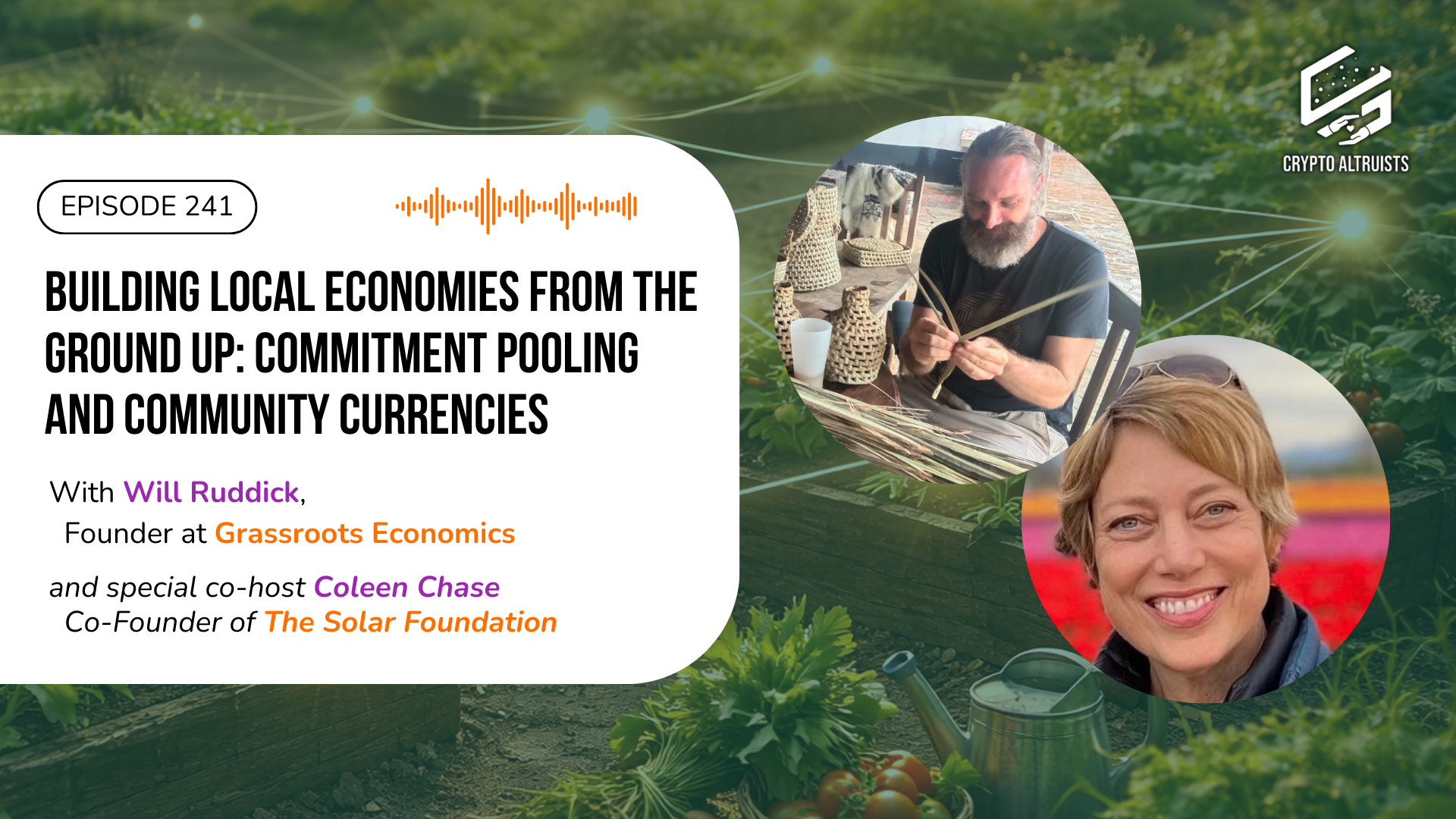


For episode 241, we’re excited to welcome Will Ruddick, Founder of Grassroots Economics and the architect behind the Sarafu Network and the Cosmo-Local Credit DAO. We are also joined by a special Co-Host, Coleen Chase, who brings great perspective from her work with community saving circles with The Solar Foundation.
Will's work sits at a fascinating intersection: traditional community practices like rotating savings groups and mutual aid, combined with modern Web3 infrastructure to help communities build their own local economies. At the heart of it is a concept called commitment pooling, where communities pool their promises to provide goods and services, and use those collective commitments as the foundation for a local currency.
In many underserved regions, traditional money is scarce, but skills, goods, and willingness to work are abundant. Grassroots Economics has built a model that lets communities create exchange systems backed by what they already have, keeping value circulating locally and building resilience from the ground up.
We'll explore how this works in practice, how blockchain enhances the model, how organizations can get involved, and the deeper philosophy that drives Will's work, including traditional principles and community practices.
You’ll learn:
🌍 How Grassroots Economics is empowering communities to create their own local economies using commitment pooling and community currencies
🔗 What commitment pooling is, how it works, and why it's such a powerful model for building local resilience in underserved regions
🌱 How blockchain enhances these community-driven models, enabling trust, transparency, and coordination at scale
☀️ How organizations like The Solar Foundation are exploring ways to get involved through savings circles and solar assets
🌍 Building trust means respecting history and learning from communities: When introducing new technologies like Web3 into communities, we must recognize the history of colonialism and extraction that has shaped many of these regions. The most effective approaches don't impose solutions from the outside. They listen first, learn from practices that communities have refined over centuries, and build alongside them with humility and respect.
🔗 Blockchain can help connect local economies without extracting from them: Communities have always had their own ways of exchanging value: bartering, cash economies, rotating savings groups, and local currencies. Web3 doesn't replace these practices. It enhances them by bringing liquidity and coordination across commitment pools, enabling communities to create and retain value locally while connecting to a global network. Economies don't have to route through traditional money. There are many ways communities can define and exchange value on their own terms.
🤝 The four interfaces of commitment pooling create resilient local economies: Commitment pools operate through four key activities: curation, valuation, limitation, and exchange. Curation determines what commitments are accepted into the pool. Valuation establishes how those commitments are measured against each other. Limitation sets boundaries to maintain balance and prevent overextension. And exchange enables the flow of value between participants. Working together, these interfaces create a self-governing, resilient economic system rooted in community trust and mutual accountability.
Will & Grassroots Economics
Coleen & The Solar Foundation

PIPE gDAO is leveraging blockchain for their University Real World Asset IP Launchpad that helps bring groundbreaking ideas from lab to market. By joining the Pipe Associate Network (aka PAN), associates can create a profile highlighting their skills, be notified of opportunities, and then contribute fractional work to pre-IPO companies in return for equity and tokens.
Check out their Linktree for links to all of their socials so you can get involved and join this growing community!
02:50 - To start, we'd love to hear your story. How did you get started with Grassroots Economics, and what was the journey from there to the Sarafu Network and now the Cosmo-Local Credit DAO?
10:45 - In many communities, especially in underserved regions, traditional money is scarce but skills, goods and willingness to work are abundant. At Grassroots Economics, you’ve built a model where communities can develop their own exchange systems backed by what they already have. I really like how you describe each pool as a stewarded venue with its own local governance by participating members, and also the 4 commitment pool interfaces/activities: curation, valuation, limitation & exchange. Can you walk us through how commitment pooling works, how it becomes the engine behind Sarafu Network, and why this model is so powerful for local economies?
20:30 - I just read your recent Journal of a Grassroots Economist substack article entitled: Where Promises Travel. I liked the description of the Commitment Pooling Protocol (CPP) as the road standard across multiple hubs so that there are many routes vs. just a default highway. Can you describe this idea further, and what makes this model so effective for building local resilience?
27:15 - How does blockchain enhance commitment pooling? What becomes possible when you bring these community-driven models onto Web3 infrastructure?
34:45 - Recognizing the unique context and histories of each setting you work in, and the long history of colonialism many communities face, how do you build trust and mutual respect when working with new communities?
40:30 - I'm personally interested in how organizations can get involved with Grassroots Economics. For example, The Solar Foundation is running Solar Savings Circles in Tanzania, working with local partners and local savings groups to seed communities with solar assets. I like the section of the Grassroots Economics website under the Support tab on How to Get Involved. Is it possible for an organization like ours to get involved today and participate as a Pool Steward or Liquidity Provider; if so, what does that process look like or what would you recommend?
43:45 - You sometimes reference the proverb: "The child that is not loved will burn the village to feel warm." It's a powerful statement, especially given what we're seeing in the world today. How does this idea inform your approach to building community economies, and what role do you see crypto playing in fostering that sense of belonging and mutual care?
Please note: we make use of affiliate marketing to provide readers with referrals to relevant products and services.
Support thoughtful, independent crypto journalism and help us continue highlighting blockchain’s potential for social and environmental impact.
cryptoaltruists.eth
While we may discuss specific web3 projects or cryptocurrencies on this podcast, please do not take any of this as investment advice, and please make sure to do your own research on potential investment opportunities, or any opportunity. We host a variety of guests on this podcast with the sole purpose of highlighting the social impact use cases of this technology. That being said, Crypto Altruism does not endorse any of these projects, and we recognize that, since this is an emerging sector, some may be operating in regulatory grey areas, and as such, we cannot confirm their legality in the jurisdictions in which they operate, especially as it pertains to decentralized finance protocols. So, before getting involved with any project, it’s important that you do your own research and confirm the legality of the project. More available HERE.