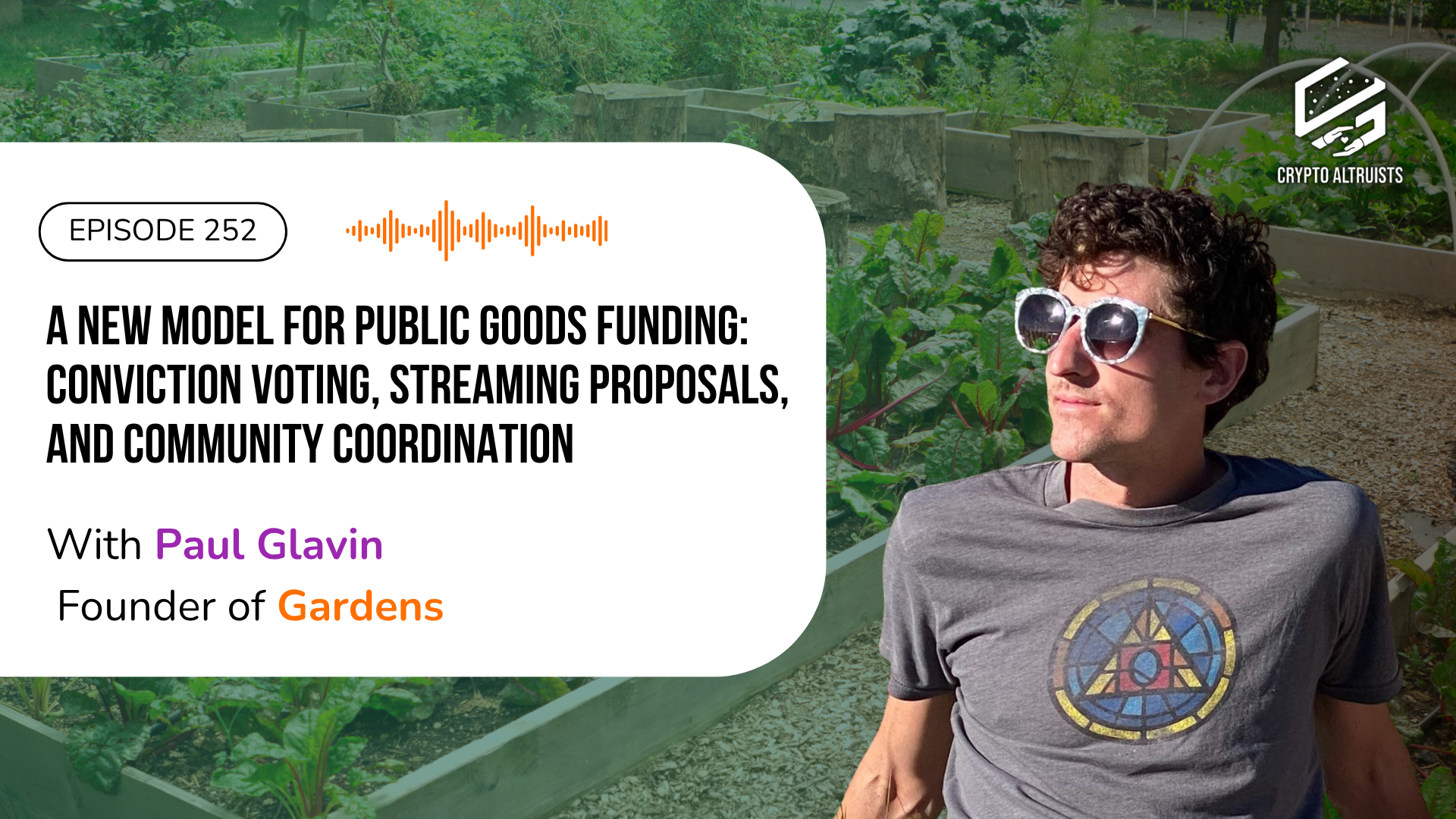


For episode 252 of the Crypto Altruists podcast, we’re excited to welcome Paul Glavin, a contributor to 1Hive and Gardens, a bottom-up governance framework for Web3 ecosystems. Gardens provides coordination infrastructure and funding mechanisms designed to help communities fund public goods in a way that's healthy and sustainable.
At the heart of Gardens is conviction voting, a mechanism where community members signal their preferences continuously rather than casting votes in single, time-boxed sessions. The longer you support a proposal, the stronger your conviction grows. It's a model that rewards patience, long-term commitment, and genuine alignment over quick coordination and whale dominance.
We're also going to explore streaming proposals, where funding flows continuously to contributors rather than arriving as a single lump sum. It's a fundamentally different way of thinking about how communities resource ongoing work.
And we'll talk about what it actually takes to make governance engaging. Because if participation feels like a chore, people won't show up. Gardens is trying to change that.
In today’s discussion you’ll learn:
🗳️ How conviction voting – a time-weighted voting mechanism where support grows stronger the longer it's held – is changing the game for community coordination
💸 The power of streaming proposals, where funds continuously flow to contributors over time, rather than though one-off grants
🌱 How communities like GoodDollar and Bread Cooperative are using Gardens to fund public goods in a more open, transparent, and sustainable way
🗳️ Conviction voting flips the script on traditional governance: Most voting mechanisms force decisions into single, time-boxed windows. You show up, cast your vote, and hope for the best. Conviction voting works differently. It's time-weighted: the longer you support a proposal, the stronger your conviction grows, and the more power your voice carries. This creates continuous signaling from the community rather than rushed, last-minute decisions. It also helps address some of the biggest problems in DAO governance, like last-minute vote swings where people hold their votes until the final moments, or whale dominance where large token holders can overpower smaller voices. Conviction voting rewards patience and genuine alignment over quick coordination and concentrated power.
💸 Streaming funds make sustainable resourcing possible at any scale: Traditional grants are one-off: you apply, you wait, you get a lump sum, and then you're back to scrambling for the next round. Streaming proposals flip that model. Funding flows continuously to contributors based on ongoing community support. This works for everything from a small group of open-source contributors to a massive treasury allocation. It aligns incentives over time, reduces the boom-and-bust cycle of traditional funding, and creates a more sustainable foundation for ongoing work. When funding is continuous, contributors can focus on building rather than constantly fundraising.
🥱 Governance doesn't have to be a burden: Let's be honest: governance is often administratively heavy, complex, and sometimes just boring. Low participation isn't surprising when voting feels like a chore. Gardens is trying to change that by breaking decisions down into digestible pieces. Rather than asking everyone to weigh in on everything, it allows individuals to participate in the ways they want and vote on the things they care about. The goal is governance that feels less like a committee meeting and more like something people actually want to show up for.
A Brief History of Conviction Voting by Michael Zargham
02:15 - To kick things off, can you please share a little bit about yourself, your journey to Web3, and how you came to work on Gardens?
06:00 - For listeners who may not be familiar, can you give us an introduction to Gardens? What's the mission, and what problem are you trying to solve for communities and public goods funding?
07:20 - At the heart of Gardens is conviction voting, which is quite different from traditional voting mechanisms. Can you explain how it works and why it's such a powerful tool for community coordination?
12:30 - One of the things that stands out about Gardens is the concept of streaming proposals, where funding flows continuously rather than in one-time allocations. Can you walk us through how this works and why it's a gamechanger for how communities fund impact?
18:10 - What is dynamic funding and how does it tie into the funding streams?
21:30 - Can you tell us about some of the communities currently using Gardens? I know GoodDollar and Bread Cooperative are among them. What kinds of organizations are drawn to this model, and how are they using it?
24:35 - Governance can feel burdensome and overwhelming to many. How have you approached the user experience to make participation feel less like a chore and more like something people actually want to do?
28:05 - What are your thoughts about delegate voting and the role it could or should play in governance?
30:10 - For someone listening who wants to get involved, what does the process look like? How does someone join an existing community on Gardens, and what does it take to launch a new one?
31:45 - You've also recently launched a new product called Markee. Can you tell us what it is and how it connects to the broader Gardens ecosystem?
36:10 - What are some of the biggest lessons you've learned from building Gardens and working with communities over the years? What's surprised you, and what would you do differently?
38:20 - For someone listening who's been burned by traditional governance, who's sat through endless votes that went nowhere or watched funding dry up after a single grant cycle, what would you want them to know about what's possible with Web3?
Support thoughtful, independent crypto journalism and help us continue highlighting blockchain’s potential for social and environmental impact.
cryptoaltruists.eth
While we may discuss specific web3 projects or cryptocurrencies on this podcast, please do not take any of this as investment advice, and please make sure to do your own research on potential investment opportunities, or any opportunity. We host a variety of guests on this podcast with the sole purpose of highlighting the social impact use cases of this technology. That being said, Crypto Altruism does not endorse any of these projects, and we recognize that, since this is an emerging sector, some may be operating in regulatory grey areas, and as such, we cannot confirm their legality in the jurisdictions in which they operate, especially as it pertains to decentralized finance protocols. So, before getting involved with any project, it’s important that you do your own research and confirm the legality of the project. More available HERE.