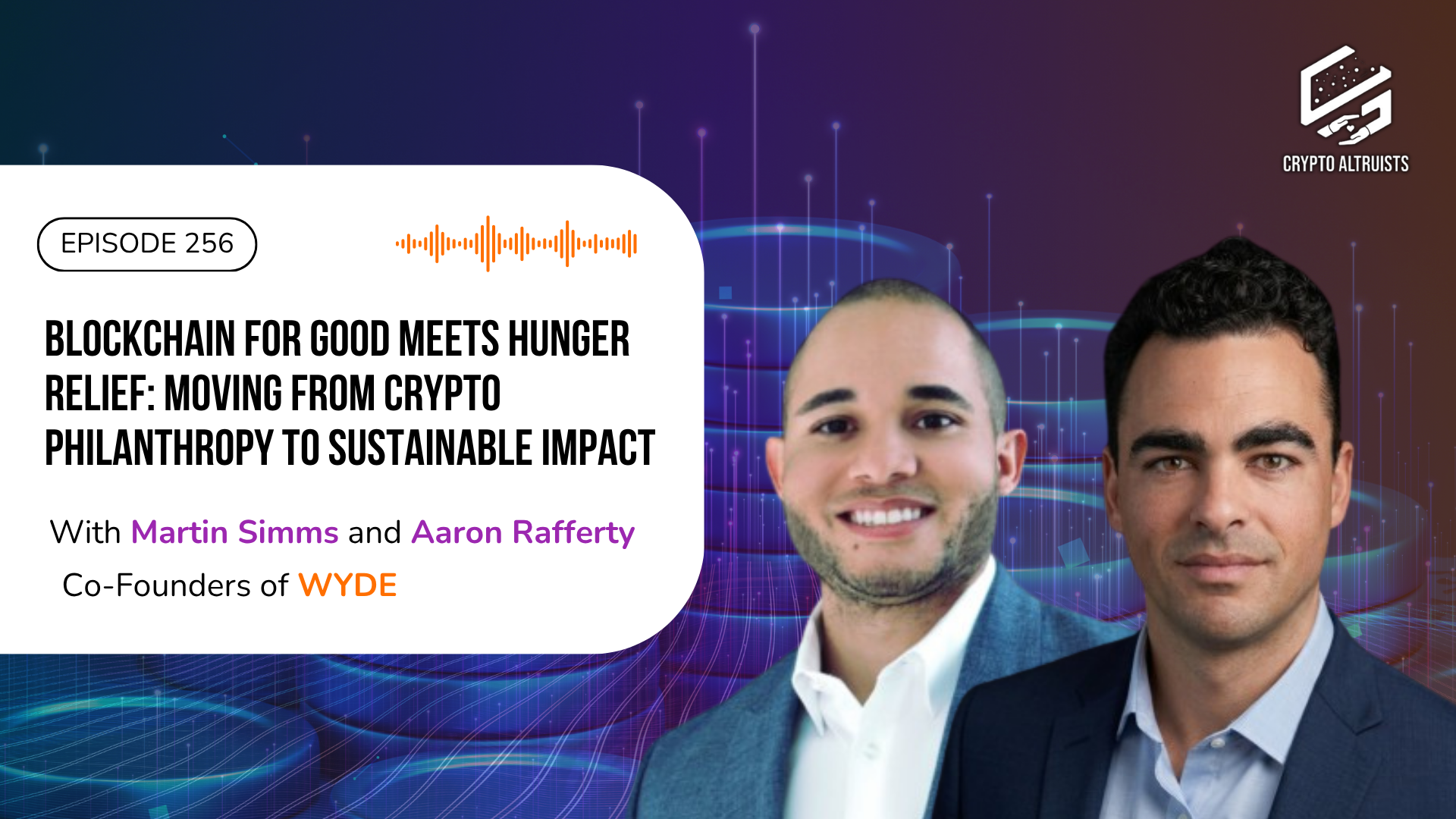


For episode 256 of the Crypto Altruists podcast, we’re excited to welcome Martin Simms and Aaron Rafferty, co-founders of WYDE, a social impact exchange built on Base, the Ethereum Layer 2, where transaction-based fees are directed into verified charitable grants for hunger relief.
They call themselves an "Impact Exchange," and the model is built on a concept called "contributory consumption," where everyday financial activity like crypto trades or even debit card purchases generate charitable impact by design, rather than relying on one-off acts of generosity. At the core of it is the $EAT token. When someone buys, sells, or transfers it, a portion of every transaction flows toward funding meals. And it's all recorded on the blockchain for public verification, so you can actually see the impact happening in real time.
WYDE recently announced an exclusive national partnership with Feed the Children, an organization that reached nearly 15 million people last year, and they have big hopes of growing that number. They've already helped fund tens of thousands of meals. They've run their first "Trade-to-Feed-athon," a trading competition that generates funding for meals. And this month, they announced the $EAT debit card, extending the model from crypto into everyday spending.
But what really gets me excited is the bigger vision. Martin and Aaron talk about a future of "smart currency," where you might hold a hunger token or a cancer research token that quietly does good in the background as you go about your life. It's an ambitious idea at the intersection of blockchain and social impact, and today we're going to dig into all of it.
In today’s discussion you’ll learn:
🍽️ How WYDE is turning everyday financial activity into thousands of meals for those in need
🪙 The mechanics of the $EAT token, where a portion of every trade flows directly to hunger relief with no extra donation required
🤝 How an exclusive national partnership with Feed the Children is helping turn cryptocurrency transactions into real charitable impact
🌍And How WYDE is reimagining crypto philanthropy, moving beyond one-off donations to a sustainable model where every transaction funds hunger relief automatically
Support Crypto Altruists in Octant Epoch 12
Check out the Web3 Impact Toolkit early access
🍽️ Impact built in by design beats impact as an afterthought: For too long, giving has been treated as a separate act, something you do on top of everything else. WYDE flips that with a model they call "contributory consumption," where everyday financial activity generates charitable impact automatically. When someone trades or spends, a portion flows to hunger relief without requiring a separate donation. By building generosity directly into the mechanics of money, WYDE makes impact something that happens by default, not by willpower.
🤝 Sustainability is what separates real impact from the screenshot: Martin put it bluntly: most crypto philanthropy is a founder writing a check after a token rally and posting the screenshot. It's a one-time moment of generosity that doesn't last. WYDE is structured to avoid that trap. By tying funding to ongoing transaction activity and grounding it in a verified partnership with Feed the Children, they've built something that keeps generating impact over time, not just in a single viral moment. And because every grant is recorded onchain, the trust is built right in.
🚀 Markets themselves can be a force for good: The big, audacious idea at the heart of WYDE is that the systems we use every day, trading, spending, transacting, can be redesigned to do good at scale. With a vision of "smart currency" and a goal of funding a billion meals, WYDE is making the case that impact doesn't have to compete with financial activity, it can be embedded within it. If they succeed, they'll have proven that the act of participating in markets can feed millions, turning everyday transactions into a powerful engine for good.
Aaron
Martin
Wyde
03:50 - To kick things off, can you share a bit about your journey to the world of Web3, and what led you to create WYDE?
08:00 - Let’s start at a high level. You describe yourselves as an "Impact Exchange." What does that mean, and what problem are you trying to solve?
12:30 - At the core of WYDE is a model you call "contributory consumption," where everyday financial activity generates charitable impact by design, versus 1-off donations. Can you break down how this works and why it’s such a powerful unlock?
16:25 - Let's talk about the $EAT token. When someone buys, sells, or transfers it, a portion of each transaction goes toward funding meals. Can you walk us through the mechanics, and how 25% of every trading fee flows to hunger relief?
22:40 - You recently announced an exclusive national partnership with Feed the Children, an organization that reached nearly 15 million people last year. How did that partnership come about, and what does it unlock for both sides?
28:15 - You recently ran your first "Trade-to-Feed-athon," a trading competition that rewards participation while generating funding for meals. Can you tell us how that went and what you learned from it?
35:30 - Martin, you've said that most crypto philanthropy is "a founder writing a check after a token rally and posting the screenshot." How is WYDE structured to avoid that trap and build something sustainable instead?
41:15 - For listeners who want to learn more about WYDE and get involved, what’s the best place for them to go, and do you have a call to action?
45:55 - If WYDE succeeds at the scale you're aiming for, you've talked about funding a billion meals. What would it mean to prove that markets themselves can be a force for good, that the act of trading could feed millions?
Support thoughtful, independent crypto journalism and help us continue highlighting blockchain’s potential for social and environmental impact.
cryptoaltruists.eth
While we may discuss specific web3 projects or cryptocurrencies on this podcast, please do not take any of this as investment advice, and please make sure to do your own research on potential investment opportunities, or any opportunity. We host a variety of guests on this podcast with the sole purpose of highlighting the social impact use cases of this technology. That being said, Crypto Altruism does not endorse any of these projects, and we recognize that, since this is an emerging sector, some may be operating in regulatory grey areas, and as such, we cannot confirm their legality in the jurisdictions in which they operate, especially as it pertains to decentralized finance protocols. So, before getting involved with any project, it’s important that you do your own research and confirm the legality of the project. More available HERE.