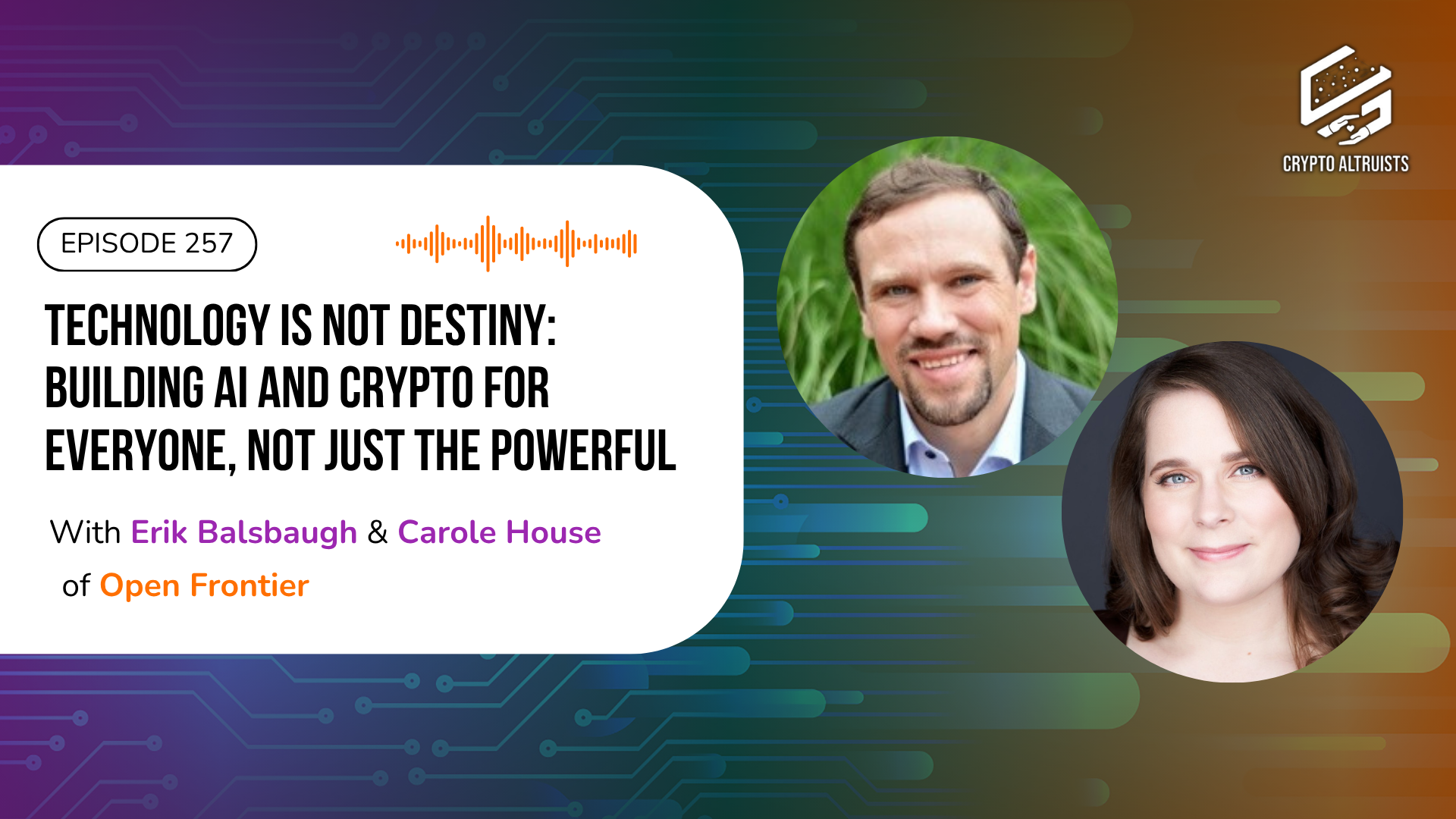


For episode 257 of the Crypto Altruists podcast, we’re excited to welcome Erik Balsbaugh and Carole House of Open Frontier, a non-profit advocacy organization and a leading voice on how digital currencies, Artificial Intelligence, and emerging technologies can empower underserved communities and advance the values so many of us care about: inclusion, accountability, and financial freedom. We have a fascinating conversation on how to build technology for everyone, everywhere, and the real risks if we don't act. It's about whether the technologies defining our future serve everyday people, or just the already powerful.
A few episodes back, I released a solo episode on AI, the hype cycle, and the principle of "do no harm." And the response really moved me. It clearly struck a chord, because so many of you are feeling the same tension I am. We're living through a moment of extraordinary technological change, and it's not entirely clear who it's being built for.
You can feel it in the pushback happening all around us. Communities are organizing against data centers. There's a growing unease about how much power is concentrating in the hands of a few enormous tech companies and the ultra-wealthy. And there's a real fear, one I think is worth taking seriously, that these powerful new technologies, AI and digital finance among them, could end up deepening the very inequities they promised to solve.
Here's the thing. Technology is not destiny. It's not something that just happens to us. It's built by people, shaped by choices, and governed by rules that we get to have a say in. The question isn't whether AI and digital finance will reshape our world. They will. The question is who's at the table when those systems are designed, who benefits from them, and whether they're built with people and the planet in mind, or just as another tool for wealth creation.
In today’s discussion you’ll learn:
⚖️ Why technology is not destiny, and how the future of AI and digital finance depends on who shapes it, who benefits, and what rules govern it
🌍 How values-driven communities can help build technology for everyone, rather than letting it concentrate power in the hands of the already powerful
🛡️ What "smart regulation" actually looks like, and how to strike the balance between moving fast and protecting people
✨ The most inspiring ways blockchain, digital finance, and AI are advancing inclusion, accountability, and financial freedom around the world
Check out the Web3 Impact Toolkit early access
⚖️ It's not about blocking technology. It's about building it wisely. The conversation we too often get stuck in, innovation versus regulation, is a false choice. The real goal is smart regulation: thoughtful guardrails that enable innovation while protecting people and the planet. Done well, regulation isn't a barrier to progress, it's what makes technology safer, more trustworthy, and more broadly beneficial. The aim is to design systems that put power in the hands of everyday people, not just a select few. That means moving fast enough to build meaningful things, but carefully enough that we don't leave people behind in the process.
🔄 We've seen this pattern before, and we need to learn from it: Crypto, AI, and frontier technologies are at risk of following the same path as the internet and Web2: starting with the promise of openness and democratization, only to be captured by corporate interests and used to consolidate power in fewer and fewer hands. This is a recurring pattern throughout the history of technology. If we're not paying attention, these powerful new tools could deepen the very inequities they promised to solve. The good news is that patterns can be broken, but only if we recognize them and choose to act differently this time.
🪑 Technology is not destiny, so we need to be at the table: Perhaps the most important idea from this conversation: technology is not something that simply happens to us. It's built by people, shaped by choices, and governed by rules we have a say in. That means the future of AI and digital finance isn't predetermined. It depends on who shows up. If values-driven communities opt out because these spaces feel too tainted, we cede the design of the next era to whoever does show up. History is clear about who that tends to be. The call to action is simple: we need to be at the table.
Carole
Erik
Open Frontier
03:20 - To kick things off, I'd love to hear from each of you. Can you share a bit about your journey and what led you to the work you're doing with Open Frontier?
10:40 - For listeners who aren't familiar, can you give us an introduction to Open Frontier? What's the mission, and what gap did you see that made this work feel necessary right now?
13:55 - On your website, it mentions how “technology is not destiny. What matters is who shapes it, who benefits from it and what rules govern it.” Can you unpack that? Why does it matter who's at the table when these systems are being designed?
21:25 - Let's talk about safeguards. You advocate for "smart regulation," and Carole, you've framed it well, stating how the challenge isn't innovation versus regulation, it's whether we have the vision to design smart rules and trustworthy tech together. How does that look in practice?
26:40 - There's a real irony here: a technology built on the promise of decentralization and democratization could just as easily end up concentrating power in the hands of a few. What's the nightmare scenario if values-driven communities stay on the sidelines, and how close are we to it
31:15 - For listeners around the world who care about these issues and want to make sure digital finance serves everyday people, what are some tangible steps they can take, and how can they engage with Open Frontier's work?
34:10 - Let's talk about hope. What are some of the most inspiring ways you've seen these technologies used to advance values like inclusion, democratic accountability, and financial freedom? What gets you genuinely excited about where this is heading?
40:10 - Every financial system in history has eventually been captured by the powerful, no matter how egalitarian it started. What makes you believe that AI and digital finance can break that pattern, and what has to be true for it to happen?
Support thoughtful, independent crypto journalism and help us continue highlighting blockchain’s potential for social and environmental impact.
cryptoaltruists.eth
While we may discuss specific web3 projects or cryptocurrencies on this podcast, please do not take any of this as investment advice, and please make sure to do your own research on potential investment opportunities, or any opportunity. We host a variety of guests on this podcast with the sole purpose of highlighting the social impact use cases of this technology. That being said, Crypto Altruism does not endorse any of these projects, and we recognize that, since this is an emerging sector, some may be operating in regulatory grey areas, and as such, we cannot confirm their legality in the jurisdictions in which they operate, especially as it pertains to decentralized finance protocols. So, before getting involved with any project, it’s important that you do your own research and confirm the legality of the project. More available HERE.