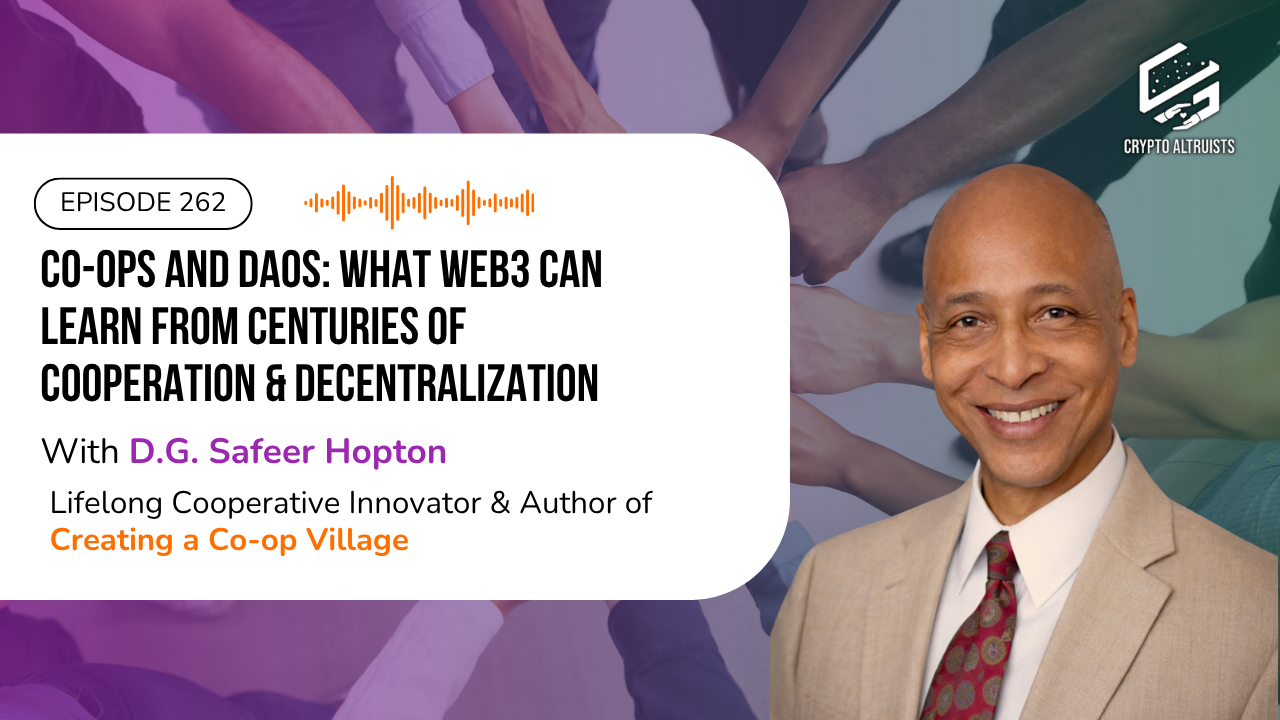


For episode 262 of the Crypto Altruists podcast, we're excited to welcome D.G. Safeer Hopton, a lifelong cooperative innovator, author, and founder of the Global Village Co-op. With more than 50 years in the cooperative movement, going all the way back to 1970, D.G. brings a rare depth of experience in community-owned, democratically governed systems.
In crypto, we sometimes talk about decentralization like we invented it. We celebrate DAOs, decentralized autonomous organizations, as a radical new idea: communities that pool resources, share ownership, and make decisions democratically, without a central authority calling the shots. And it is genuinely exciting. But that model isn't new. Not even close.
Cooperatives have been proving that decentralization works for decades, even centuries. At its simplest, a co-op is an organization owned and democratically controlled by the people who use it, whether that's workers, customers, or an entire community. The value created stays with the people who created it. And while the modern movement is often traced to a group of weavers in Rochdale, England, in 1844, its roots run far deeper, with profound origins in African and Indigenous economics that D.G. explores in his book, Creating a Co-op Village.
So today, we're bridging these two worlds. We explore what cooperatives really are, their deep history, and the striking parallels between co-ops and DAOs. Because if these digital communities are, in many ways, reinventing the co-op with a digital wrapper, then we have an enormous amount to learn from someone who's been doing this the whole time.
In today's discussion you'll learn:
🌍 What cooperatives are, their deep history, and how they've been proving decentralization works long before Web3 existed
🤝 How keeping prosperity circulating locally can build community wealth and close the gaps traditional systems leave behind
⛓️ The striking parallels between co-ops and DAOs, and the hard-won lessons decades of cooperative experience offer today's digital communities
💡 Practical wisdom for anyone looking to start a co-op, strengthen a DAO, or build a more inclusive community from the ground up
📨 Subscribe to the Crypto Altruists' Newsletter!
🌍 Web3 has a lot to learn from the past, because co-ops have been here all along: In crypto, we love to talk about decentralization like it's a brand new invention. But cooperatives have been practicing shared ownership and democratic governance for decades, even centuries, with roots reaching deep into African and Indigenous economics. The governance challenges DAOs are wrestling with today, like how to make decisions fairly, how to keep members engaged, or how to stop power from concentrating in a few hands, are the same challenges the cooperative movement has been solving all along. We didn't invent decentralization. We inherited it. And the more we honor and learn from that lineage, the stronger the communities we build will be.
🤝 Whatever the structure, it's all about keeping prosperity circulating locally: Whether you call it a co-op, a DAO, or something else entirely, the underlying goal is the same: keep the value that a community creates within that community, rather than letting it flow out to distant owners and extractive middlemen. So much of our spending leaves our communities the moment we make a transaction. Cooperative economics flips that, keeping prosperity circulating locally and building real, shared wealth. And critically, this is about inclusion, creating systems that everyone can participate in and benefit from, especially the communities that traditional wealth-building has left behind.
⛓️ DAOs create new opportunities to build on what co-ops started: This isn't just about Web3 learning from co-ops. The exchange runs in both directions. Cooperatives have long faced real challenges around raising capital, scaling up, and keeping members active and engaged over time. The new mechanisms emerging in Web3, from transparent onchain governance to programmable incentives to new ways of pooling and moving resources, could help solve some of these longstanding problems. When you combine the hard-won wisdom of the cooperative movement with the fresh tools of decentralized technology, you get something genuinely exciting: a chance to build more resilient, inclusive, community-owned systems than either could create alone.
05:45 - You've spent more than 50 years in the cooperative movement, going all the way back to early co-op village work in 1970. To start, what first drew you to cooperation as a way of organizing communities, and what's kept you committed to it for five decades?
08:00 - In your book, called Creating a Co-op Village, you discuss the history of co-ops globally, including their deep roots in African and indigenous economics. Can you tell me more about this, and how cooperative models have been used by these communities for centuries?
17:45 - You've said cooperation isn't just an ideal, it's a business strategy. A lot of people assume co-ops are charities or feel-good projects that can't compete. What does the track record show, and why is cooperation a smart economic model?
20:30 - Digital communities like Decentralized Autonomous Organizations (DAOs) are, in a lot of ways, are trying to reinvent the wheel, and they're running into challenges co-ops solved decades ago: how to govern fairly, how to keep members engaged, how to avoid power concentrating in a few hands. What hard-won lessons from the cooperative movement do you think these new communities most need to hear?
28:30 - We’ve spoke about the importance of building on what already works, and I’m curious what you feel blockchain brings to the table when it comes to elevating cooperative movements?
34:10 - You have framed cooperation as a way to close wealth gaps and build a fairer economy. For communities that have been shut out of traditional wealth-building, what does economic justice through shared ownership make possible?
39:15 - For a listener inspired by this, maybe someone who wants to start a co-op, bring cooperative principles into their DAO, or just build a stronger, more inclusive community, where can they go to learn more about your work?
41:05 - You've carried these ideas for half a century, and now a whole new generation is discovering them. If you could pass one piece of wisdom to new leaders building decentralized communities today, what would it be?
Support thoughtful, independent crypto journalism and help us continue highlighting blockchain’s potential for social and environmental impact.
cryptoaltruists.eth
While we may discuss specific web3 projects or cryptocurrencies on this podcast, please do not take any of this as investment advice, and please make sure to do your own research on potential investment opportunities, or any opportunity. We host a variety of guests on this podcast with the sole purpose of highlighting the social impact use cases of this technology. That being said, Crypto Altruism does not endorse any of these projects, and we recognize that, since this is an emerging sector, some may be operating in regulatory grey areas, and as such, we cannot confirm their legality in the jurisdictions in which they operate, especially as it pertains to decentralized finance protocols. So, before getting involved with any project, it’s important that you do your own research and confirm the legality of the project. More available HERE.