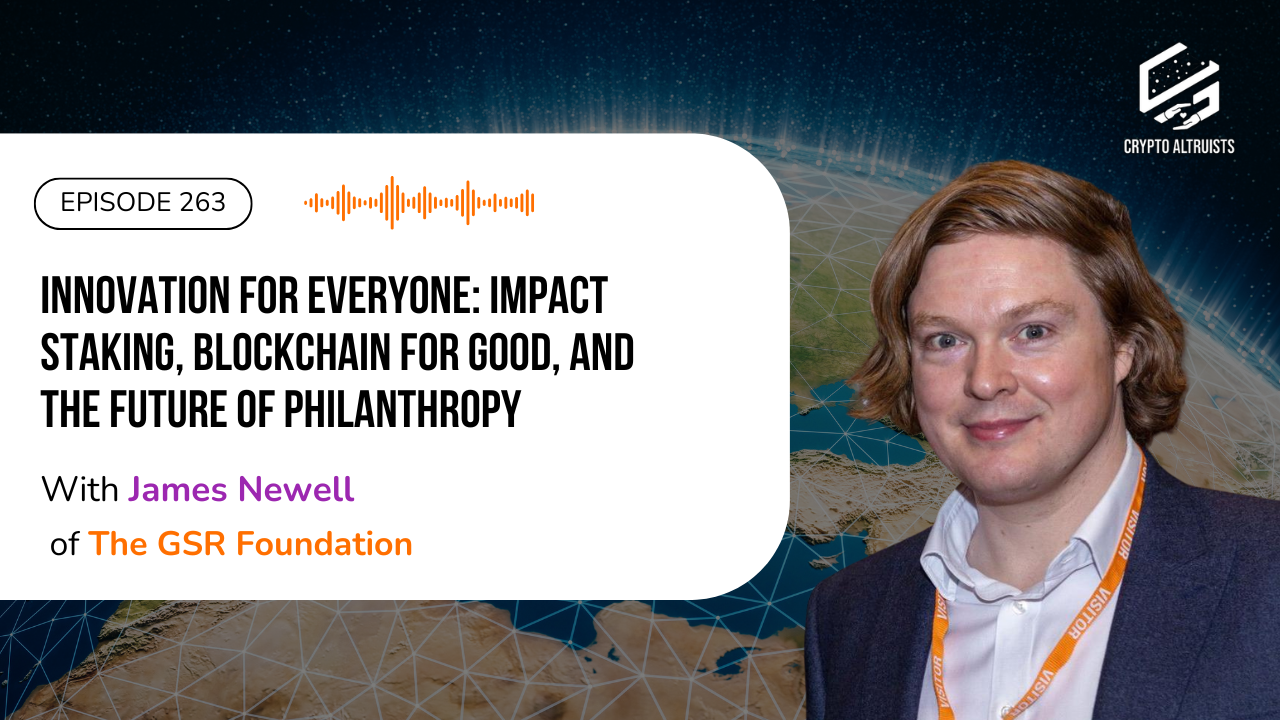


For episode 263 of the Crypto Altruists podcast, we're excited to welcome James Newell of the GSR Foundation, a global charity and grantmaker working to ensure that no one is excluded from the benefits of technology. Their tagline says it beautifully: inclusion powers innovation. GSR Foundation is also a supporter of Crypto Altruists and has been essential in helping us get our Web3 Impact Toolkit off the ground.
On this show, we spend a lot of time exploring new models for funding impact, and this episode dives into one of the most exciting and forward-thinking approaches we've come across. Some of you will recognize the GSR name from the crypto and trading world, and we get into the relationship between the company and the Foundation. But what really drew us to this conversation is how the Foundation is using the tools of this space to drive real-world impact, in ways that point toward the future of philanthropy.
Here's what I mean. The GSR Foundation is directing Ethereum staking rewards, through Lido Impact Staking, to fund incredible partners like UNICEF, Mercy Corps Ventures, and Grassroots Economics. It's a model where you can put your crypto to work generating yield, and direct that yield toward causes that matter, all without giving up your underlying assets. It’s truly a positive-sum way to give. We also explore their work supporting partners like Relay Funder, which is building blockchain tools for displaced communities, how they're pioneering new ways to use stablecoins to fund impact, and why education is such a critical part of their mission.
In today's discussion you'll learn:
🌍 An introduction to the GSR Foundation and their mission to ensure no one is excluded from the benefits of technology
🤝 The exciting blockchain-for-good projects they support, from new funding models for high-impact NGOs to tools for displaced communities and platforms for Web3 education
⛓️ The power of stablecoins and impact staking to fund and power real-world social impact
📚 How we can build accessible educational opportunities that bridge the gap between the crypto world and the traditional nonprofit sector
📨 Subscribe to the Crypto Altruists' Newsletter!
🧰 Check out the Web3 Impact Toolkit early access
🤝 Relationships over transactions in grantmaking: The GSR Foundation is founded and funded by GSR, the company, but it operates as an independent charity with its own mission and priorities. What really sets it apart is its approach to funding. Rather than the transactional, one-off model that characterizes so much of traditional grantmaking, where you apply, receive a check, and file a report, the Foundation is built around genuine relationship-building and longer-term partnerships. They seek out aligned partners, invest in their growth over time, and stay engaged well beyond the initial grant. That patient, relationship-driven approach is what allows them to back bold, early-stage work that more transactional funders might shy away from.
⛓️ Impact staking as a core engine for good: Impact staking has become a central pillar of how the GSR Foundation funds its work. The model lets you put crypto to work generating yield through staking, and then direct that yield toward causes that matter, all without ever giving up the underlying assets. It's a a positive-sum way to give where your capital stays intact while continuously generating support for high-impact partners like UNICEF, Mercy Corps Ventures, and Grassroots Economics. For a foundation focused on sustainable, long-term impact, it's a powerful tool, turning on-chain yield into a renewable source of funding for impact work.
🧭 Helping nonprofits navigate crypto by starting with the pain points: We're in a deeply uncertain time. Aid budgets are being cut, funding is drying up, and nonprofits are under enormous pressure, all while trying to make sense of unfamiliar tools like crypto and blockchain. The GSR Foundation helps bridge that gap. They take on the risk by supporting nonprofits as they experiment, and crucially, they stay honest about the limitations of blockchain, rather than overselling it as a fix for everything. James mentions how nonprofits should start by identifying their actual pain points and then explore the specific pilots and use cases that can address them. It's not about adopting technology for its own sake. It's about finding where these tools can actually help.
James
The GSR Foundation
GSR
03:30 - To kick things off, can you tell us a bit about your own journey, and what led you to the work you're doing with the GSR Foundation?
06:30 - For listeners who aren't familiar, can you introduce the GSR Foundation? Your tagline, "inclusion powers innovation," really stands out. What's the mission, and what does the Foundation set out to do?
10:10 - Many in our audience will know GSR as a major name in the crypto and trading world. Can you tell us about the relationship between GSR the company and the GSR Foundation? How did the Foundation come to be, and what does it mean to have that kind of backing behind a charitable mission?
13:40 - Can you walk us through your funding verticals, blockchain for good, education infrastructure, and internet provision, and how you decide where to focus?
16:55 - Let's talk about impact staking, because this is something we've explored on the show and I find fascinating. GSR Foundation is directing Ethereum staking rewards through Lido Impact Staking to fund partners like the UNICEF Venture Fund, Mercy Corps Ventures, and UNICEF Giga. Can you break down how that works, and why this model of channeling on-chain yield into real-world impact is so compelling?
21:00 - You're also pioneering something called Stablecoin for Impact, using stablecoin lending yield to help fund UNICEF Giga's mission of connecting every school in the world to the internet. Can you tell us more about that, and why these new onchain funding mechanisms matter for the future of philanthropy?
22:45 - I understand that you are supporting a number of UNICEF initiatives, including their Venture Fund and CryptoFund, and their Giga project. Can you tell me more about this partnership and the work you’re doing together?
26:45 - In addition to your work with UNICEF and Mercy Corps Ventures, you also support smaller projects and pilots like Relay Funder, which is building blockchain tools for displaced communities. Can you tell me more about Relay Funder?
31:00 - A lot of your work isn't just about funding, it's about education, and on a personal note, we're grateful that GSR Foundation sponsored our own Web3 Impact Toolkit. Why is education such an important piece of the puzzle, and what's holding the nonprofit sector back from embracing these tools?
33:50 - There's a lot of hesitancy in the traditional nonprofit and philanthropy world around crypto and blockchain. As someone bridging both worlds, how do you make the case? What do you say to a skeptical charity leader about why these tools are worth exploring?
37:30 - For those interested in learning more about the GSR Foundation, its mission, and the projects you support, where should they go, and do you have a CTA for them?
39:00 - To wrap up, your thesis is that "inclusion powers innovation," and that no one should be excluded from the benefits of technology. When you look ahead, what makes you most hopeful about the role these technologies can play in building a more inclusive world?
Support thoughtful, independent crypto journalism and help us continue highlighting blockchain’s potential for social and environmental impact.
cryptoaltruists.eth
While we may discuss specific web3 projects or cryptocurrencies on this podcast, please do not take any of this as investment advice, and please make sure to do your own research on potential investment opportunities, or any opportunity. We host a variety of guests on this podcast with the sole purpose of highlighting the social impact use cases of this technology. That being said, Crypto Altruism does not endorse any of these projects, and we recognize that, since this is an emerging sector, some may be operating in regulatory grey areas, and as such, we cannot confirm their legality in the jurisdictions in which they operate, especially as it pertains to decentralized finance protocols. So, before getting involved with any project, it’s important that you do your own research and confirm the legality of the project. More available HERE.