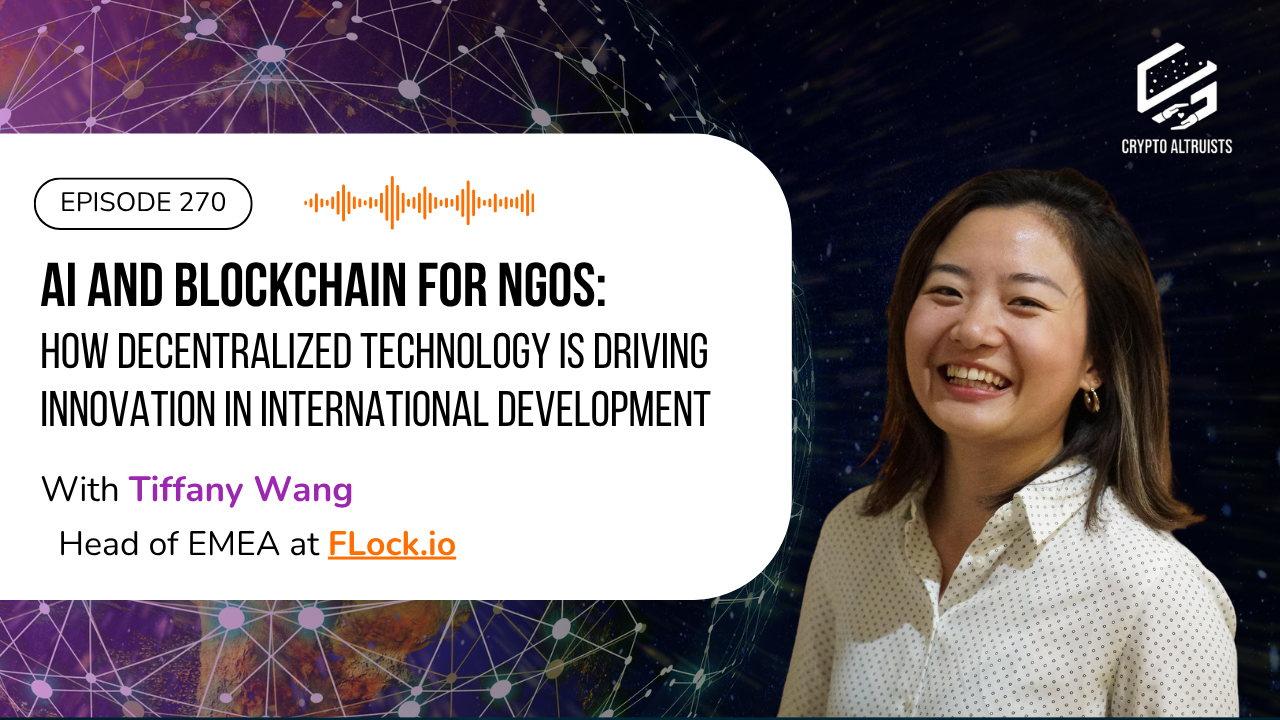


For episode 270 of the Crypto Altruists podcast, we're excited to welcome Tiffany Wang, Head of EMEA at FLock.io, and a contributor to the Blockchain for Good Alliance, to explore how NGOs, nonprofits, and civil society organizations can harness AI and blockchain for innovation and impact.
If you work in the nonprofit or international development space, you've probably felt the pressure lately. Funding is tighter, needs are growing, and everywhere you turn, someone is telling you that AI and blockchain will change everything. But for many NGOs and civil society organizations, the real question is much more practical: where do we actually start, and how do we do it without putting the communities we serve at risk?
FLock.io offers a compelling answer. They're building decentralized AI, an approach where models can learn from data without that data ever leaving the communities it belongs to, a powerful alternative to AI trained by a few large companies on data gathered from everyone else. And they're putting it into practice at a global scale as the AI Strategic Partner for the United Nations Development Programme's SDG Blockchain Accelerator. From microinsurance for smallholder farmers in the Dominican Republic, to gorilla conservation in Rwanda, artisans in Morocco, healthcare in Mauritius, and faster aid delivery in Liberia, these projects show what becomes possible when AI and blockchain are designed around the needs of last-mile communities.
We also explore the work of the Blockchain for Good Alliance, a collaborative hub bringing together global organizations, universities, and grassroots builders to strengthen blockchain for social impact. Along the way, we dig into data sovereignty, how this technology can help communities capture the value they create rather than losing it to intermediaries, and what it will take for decentralized, community-owned AI to become the norm rather than the exception.
In today's discussion you'll learn:
🤖 How decentralized AI and blockchain can help NGOs and nonprofits innovate, without handing over sensitive community data
🌍 Inside FLock.io's work as the AI Strategic Partner for the UNDP's SDG Blockchain Accelerator, and the projects transforming lives across Africa, Asia, and Latin America
⚡ How this technology is getting aid to people faster, and helping communities capture the value they create rather than losing it to intermediaries
🤝 How the Blockchain for Good Alliance is bringing together the UN, universities, and grassroots builders to turn good ideas into real-world impact
🤝 Explore AI & Web3 consulting opportunities with Crypto Altruists
🔐 AI doesn't have to be a trade-off between efficiency and privacy: One of the biggest misconceptions about AI is that organizations have to choose between the efficiency these tools offer and protecting the people they serve. Decentralized approaches like federated learning show that you can have both. Instead of gathering sensitive data in one central place, the model travels to the data, learning from it where it lives, so communities keep control of their information. And just as importantly, AI can be designed with its wider costs in mind, working to reduce its environmental and social footprint rather than ignoring it.
🤝 Communities over intermediaries: Today, AI is driven largely by a handful of large companies, which are positioned to capture most of the wealth and power generated by the people who use their tools and supply their data. It's a familiar pattern of local communities creating value while intermediaries capture profits. FLock.io's work points the other way. From farmers and artisans to conservation communities, the projects coming out of the UNDP's SDG Blockchain Accelerator show how AI and blockchain can help communities create value for themselves and keep more of it. For NGOs and civil society, the goal shouldn't just be adopting new technology. It should be making sure that technology shifts power toward the communities it's meant to serve.
🌱 Start small, build locally, then scale: The path to meaningful impact doesn't start with the biggest, most powerful model available. It starts with a specific problem. Purpose-built models designed for a single, well-defined use case are often cheaper, less energy-intensive, and more effective than massive general-purpose models that try to do everything. The approach that works is to build locally, test with the communities involved, learn what works, and then scale globally. For NGOs unsure where to begin with AI, you don't need a huge budget or a giant model. You need a clear use case, the right partners, and the willingness to start small.
Tiffany
FLock.io
Blockchain For Good Alliance
03:45 - To kick things off, can you tell us a bit about your own journey, and what led you to the work you're doing with FLock.io and the Blockchain for Good Alliance?
05:15 - Can you break down, in plain language, what FLock.io does, and why combining AI and blockchain matters for NGOs and non-profits?
07:45 - One theme I find really compelling in your work is data sovereignty, this idea that communities and individuals shouldn't have to hand over their private data to benefit from AI. Why is that so important, especially for the vulnerable and last-mile communities we often talk about on this show?
09:35 - FLock.io has been working with the United Nations Development Programme as the AI Strategic Partner for the UNDP's SDG Blockchain Accelerator. Can you tell us about that accelerator, how it came together and the impact of the projects that FLock.io has led in the developing world?
12:45 - You’ve worked closely with the United Nations on the accelerator. What has it been like working with a large organization like the UNDP on a web3 project, and what has been their reception towards new technologies like blockchain and AI?
15:40 - There are diverse projects taking part in Cohort 2 of the accelerator, including microinsurance for smallholder farmers in the Dominican Republic, gorilla conservation in Rwanda, artisans in Morocco, and healthcare in Mauritius, to name a few. Are there one or two that really capture the essence of what this tech can do that you’d like to share?
18:40 - A pattern I noticed across several of these pilots is speed of relief, getting money to people fast. In Liberia, for example, blockchain payments cut disbursement times from up to a week down to near-real-time, with options for feature phones and even paper vouchers for those without phones. Why is that combination of speed and accessibility so important?
23:10 - Historically, local communities have created value while intermediaries capture the profits. Another recurring theme in FLock.io’s work is fairness and benefit-sharing, making sure the communities creating value capture it. How can this technology help non-profits cut out the intermediaries and gatekeepers that have historically excluded these communities?
25:15 - There is a lot of anxiety right now about Big Tech concentrating power and wealth. Your whole model points the other way, toward AI that's decentralized and community-owned. What would it take for that vision to become the norm rather than the exception?
27:20 - There’s so much happening in the world of AI for good. So many new tools, models, and it can be hard for nonprofits to keep up. Tell me about your new model, and what you have been working on at FLock.io that listeners need to know about? What are some practical ways you see nonprofits using your new model?
32:05 - Let's zoom out to the bigger picture for civil society and NGOs. Many are curious about AI and blockchain but unsure where to start, or worried about the risks. From your vantage point, what's the real promise of these technologies for the development sector; what's holding adoption back?
34:50 - Let's turn to the Blockchain for Good Alliance, which you work with alongside FLock.io. For listeners who aren't familiar, can you introduce its mission and how it supports initiatives in driving social impact?
36:40 - Both FLock.io and BGA work with global organisations like the UN, universities like Cambridge, and grassroots builders. Why is this cross-sector collaboration so essential to making this technology shift from a nice idea to real-world impact?
40:30 - To wrap up, for the builders, NGOs, and changemakers who want to learn more, get involved with FLock.io or BGA, or bring these tools to their communities, where should they start?
Support thoughtful, independent crypto journalism and help us continue highlighting blockchain’s potential for social and environmental impact.
cryptoaltruists.eth
While we may discuss specific web3 projects or cryptocurrencies on this podcast, please do not take any of this as investment advice, and please make sure to do your own research on potential investment opportunities, or any opportunity. We host a variety of guests on this podcast with the sole purpose of highlighting the social impact use cases of this technology. That being said, Crypto Altruism does not endorse any of these projects, and we recognize that, since this is an emerging sector, some may be operating in regulatory grey areas, and as such, we cannot confirm their legality in the jurisdictions in which they operate, especially as it pertains to decentralized finance protocols. So, before getting involved with any project, it’s important that you do your own research and confirm the legality of the project. More available HERE.