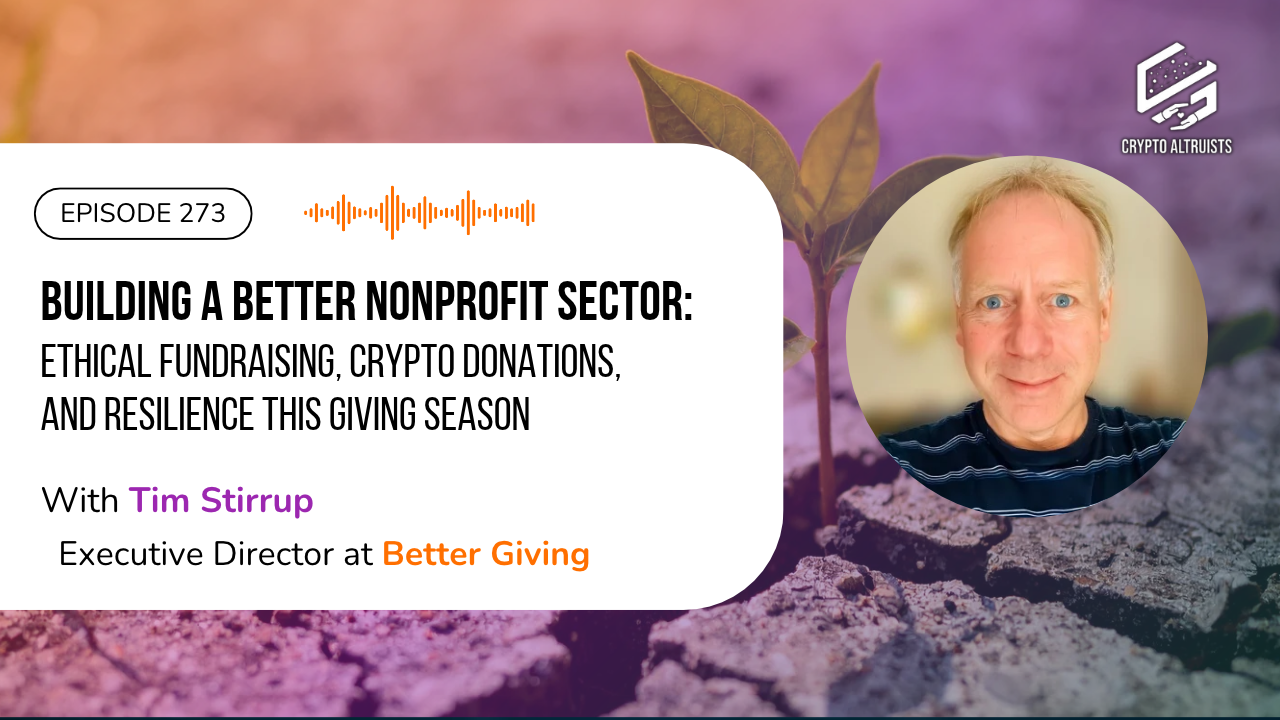


For episode 273 of the Crypto Altruists podcast, we’re thrilled to welcome back Tim Stirrup, Executive Director of Better Giving, a member-powered, open-source fundraising and financial commons for nonprofits, and a nonprofit itself.
Over the last couple of episodes, we’ve been exploring the state of the impact sector, from the two funding storms hitting impact builders in The Great Funding Reset, to the resilient ways communities care for each other in our episode on mutual aid. In this conversation, we bring that discussion down to the day-to-day reality of running a nonprofit. Because in 2026, nonprofits and NGOs are being asked to do an almost impossible job. Funding is being cut, attitudes toward giving are shifting, the technology they rely on is getting more complex, and situations on the ground can change overnight. Through it all, they’re expected to do more with less, often with very little support and flawed tools.
So how do we build a nonprofit sector that doesn’t just survive this moment, but actually thrives? And what role should the tools and platforms nonprofits depend on play in that? Tim shares what Better Giving has been building, including a donation platform that accepts crypto, card, bank transfers, stock, and donor-advised funds, without charging nonprofits a platform fee. We dig into why Better Giving endorsed the National Council of Nonprofits’ Principles for Ethical Online Fundraising Platforms, built on nonprofit consent, transparency, partnership, and accountability. We also explore why Better Giving went fully open source, how its portability guarantee frees nonprofits from vendor lock-in, and how tools like its Sustainability Fund and fiscal sponsorship can help organizations build reserves and reach new donors around the world as we head into Giving Season.
In today’s discussion you’ll learn:
🌍 Why nonprofits and NGOs are being asked to do an impossible job as they navigate funding cuts, rising complexity, and growing expectations with very little support
🤝 How to build ethical impact tools that put nonprofits’ needs, values, and autonomy first
🔓 How data portability and open-source code can free nonprofits from vendor lock-in, and build trust you can truly verify
🌱 Practical ways nonprofits can build resilience, reach new donors, and plan for the uncertain Giving Season ahead
🤝 Explore Crypto Fundraising, AI, and Web3 consulting opportunities with Crypto Altruists
🌍 Nonprofits need tools that lighten the load, not add to it: Nonprofits and NGOs are being asked to do an almost impossible job right now. Funding is being cut, attitudes toward giving are shifting, technology is growing more complex, and situations on the ground can change overnight. In that environment, the last thing organizations need is tools that add hidden costs, confusion, or risk. Yet too often, fundraising platforms have raised money in a nonprofit’s name without its consent, buried fees, or set default tips donors don’t notice. That’s why principles like nonprofit consent, transparency, partnership, and accountability matter so much. The tools nonprofits depend on should treat them as equal partners, and make their work easier, not harder.
🔓 Trust is strongest when you can verify it, and own it: Many nonprofits don’t realize until it’s too late that they can be locked into their donation platforms, unable to take their own donor relationships with them, or forced to pay to get them back. Just as we expect to keep our phone number when we switch carriers, nonprofits should be able to keep their donors when they switch providers. Data portability and open-source code both come back to the same principle: nonprofits should own their relationships, and be able to verify what’s happening with their money rather than taking it on faith. Ownership and verifiability are the foundation of trust.
🌱 Resilience is built through reserves, reach, and shared infrastructure: If this year has taught the sector anything, it’s how vulnerable organizations are without reserves or diverse sources of funding. Building resilience starts with turning some of today’s gifts into tomorrow’s safety net, through tools like reserve funds that can grow over time. It also means meeting donors wherever they are, whether they want to give by card, stock, donor-advised fund, or crypto, and helping organizations around the world reach new donors directly through models like fiscal sponsorship.
Tim
Better Giving
03:50 - A lot has changed since we last spoke, both at Better Giving and in the wider nonprofit world. For listeners who are new, can you give an intro to yourself and what you’re building at Better Giving?
07:10 - Nonprofits and NGOs right now are facing funding cuts, shifting attitudes toward giving, increasingly complex technology, and situations on the ground that change overnight. It often feels like they’re being asked to do an impossible job with very little support. From where you sit, working with nonprofits every day, what are you seeing? What’s the reality for organizations right now?
10:00 - Better Giving recently endorsed the National Council of Nonprofits’ Principles for Ethical Online Fundraising Platforms. For listeners who aren’t familiar, the NCN has raised concerns about platforms collecting donations for nonprofits without their knowledge or consent, using outdated information that misrepresents a nonprofit’s mission, or charging hidden fees and setting excessive platform tips as the default. Talk to me about these challenges, and why you decided to endorse these principles?
13:40 - In the back-and-forth before our interview, you made a point that stuck with me: nonprofits can be “held hostage” by donation processors that refuse to share recurring donor details, or charge them to do so. You made the comparison that portability is accepted in other parts of life, like switching phone carriers or banks, so why not for nonprofits? Tell me about your Recurring-Donor Portability Guarantee and how it works?
18:00 - Better Giving has now gone fully open source, which you highlight on your website as “trust you can verify in code, not just promises.” Trust is a theme we discuss constantly in Web3 and on this podcast; why make that move, and why does open source matter for nonprofits?
19:55 - Better Giving doesn’t charge a platform fee, and relies on an optional contribution from donors. In a sector where so many tools have been funded by fees, subscriptions, or investors who eventually want returns, how do you build a platform that’s sustainable without extracting from the nonprofits it serves?
22:30 - Better Giving also offers fiscal sponsorship, so organizations outside the US can receive tax-deductible gifts from US donors. With international aid falling sharply, how important is it to help local organizations around the world access new sources of funding directly, rather than relying on intermediaries?
26:20 - One feature that feels especially relevant right now is the Sustainability Fund, which helps nonprofits put a share of what they raise into reserves that can grow over time. Why did you build this, and how should nonprofits think about building reserves when they’re already stretched so thin?
29:20 - Better Giving has its roots in Web3, and you accept crypto alongside card, bank transfers, stock, and donor-advised funds. How has your thinking about crypto evolved over the years? Where do you see it helping nonprofits today, and where do you think the sector needs to be more cautious?
32:15 - We’re heading into Giving Season, the busiest time of year for most nonprofits. For organizations listening, what’s your best advice on choosing technology partners that work in their interests?
34:40 - And for donors, what advice do you have this giving season, and what should they look for to make sure their gifts are reaching the causes they care about?
36:20 - For nonprofits, donors, or community members who want to learn more about Better Giving, where is the best place to go?
38:15 - You describe Better Giving as a “financial commons” for nonprofits. If we embrace that idea, with shared, open, nonprofit-owned infrastructure, what would a thriving impact sector look like in 10 years?
Support thoughtful, independent crypto journalism and help us continue highlighting blockchain’s potential for social and environmental impact.
cryptoaltruists.eth
While we may discuss specific web3 projects or cryptocurrencies on this podcast, please do not take any of this as investment advice, and please make sure to do your own research on potential investment opportunities, or any opportunity. We host a variety of guests on this podcast with the sole purpose of highlighting the social impact use cases of this technology. That being said, Crypto Altruism does not endorse any of these projects, and we recognize that, since this is an emerging sector, some may be operating in regulatory grey areas, and as such, we cannot confirm their legality in the jurisdictions in which they operate, especially as it pertains to decentralized finance protocols. So, before getting involved with any project, it’s important that you do your own research and confirm the legality of the project. More available HERE.