

As a scientist, you may spend years chasing a finding worth sharing. But when you finally publish, the paper lands behind a paywall. Your colleagues review it, without pay, as a service to the field. And your institution then pays thousands of dollars a year in subscriptions to read that same work, to journals that did neither the research nor the reviewing.
Publishing is just one piece of it. NIH grant rates fell from 29.8% in 2023 to 18.5% in 2025, and researchers now spend close to half their working time writing applications rather than running experiments. Even when the work does get across the finish line, more than 70% of scientists have tried and failed to reproduce another researcher's published findings.
Despite the problems, science has been slow to reform itself.
And in 2025, that fragility became even more visible. In the US, thousands of grants were cancelled or suspended mid-cycle, tens of thousands of federal science staff departed, and a survey found that three in four scientists were considering leaving the country. For many researchers, it was the year the system stopped feeling reformable from within altogether.
Meanwhile, there’s a movement that has been building around exactly these problems. Using tokens, community treasuries, smart contracts, and decentralized storage, it set out to rethink how science gets funded, published, and owned. This is Decentralized Science (DeSci).
DeSci is still young, and it has already been through a rough cycle: A speculative frenzy in late 2024 sent DeSci token valuations past a billion dollars combined, far outstripping any actual research being done, and the correction that followed was sharp. But the projects that kept building through it are doing more interesting work than ever, at a moment when the traditional system is visibly struggling.
This Crypto Altruists' guide maps what DeSci is, where it came from, what's being built, and where the space has yet to prove itself.
What happens if a community of people—not a grant committee, a journal publisher, or a pharmaceutical company—gets to decide which research is funded and who benefits from it? That’s the question DeSci was built around. Using Web3 tools, it aims to rethink the infrastructure of science from the ground up.
The Ethereum Foundation defines it as "a movement that aims to build public infrastructure for funding, creating, reviewing, crediting, storing, and disseminating scientific knowledge fairly and equitably using the Web3 stack." Some academics frame it more ambitiously as "the fourth major decentralization of knowledge," following the alphabet, the printing press, and the internet. Whether that turns out to be true depends entirely on what gets built in the next decade.
To understand where DeSci came from, it helps to start with Sci-Hub.
In 2011, Alexandra Elbakyan, a Kazakhstani researcher frustrated by paywalled science, launched Sci-Hub: a website offering free access to tens of millions of academic papers. Publishers sued it across multiple jurisdictions, governments tried to shut it down, and scientists kept using it.
At its peak, Sci-Hub was fielding millions of requests daily, many from researchers at well-funded institutions who simply couldn't be bothered to navigate their own library systems, let alone pay $30 for a single paper.
You can think of it as Napster for research… just as Napster showed the music industry that something fundamental was broken in how it distributed music, Sci-Hub made the same case for scientific publishing. It didn't fix the system; it was too legally precarious for that. But it proved that the demand for open access was massive, global, and not going away.
In late 2024 and into 2025, a Sci-Hub token emerged on Solana, with Elbakyan endorsing the effort and publishing a whitepaper for an official SCI token aimed at rewarding knowledge sharing and funding open-access infrastructure. The initiative remains small and contested, with reasonable questions about whether tokens translate into actual research funding, but the underlying idea is extremely powerful.
This same frustration that drove the creation of Sci-Hub has found its way into Web3 tools, and DeSci is where it's trying to advance further.
DeSci as a named movement coalesced around 2021. The term's exact origin is debated, but what's clear is that several groups were working toward similar ideas at the same time.
One of the most important was Molecule, which emerged in Berlin in 2018. Founded by Paul Kohlhaas, Tyler Golato, and Titian Steiger, Molecule was developing a tool called an IP-NFT: a way of attaching intellectual property rights to a blockchain token, so that ownership and licensing could be handled transparently onchain rather than buried in institutional paperwork. The idea was bold and, to most scientists, completely alien.
DeSci entered mainstream scientific discourse in December 2021, when Sarah Hamburg published a letter in Nature titled "Call to join the decentralized science movement." For many researchers, that piece was the first time they'd encountered the idea in a serious scientific outlet. It didn't resolve anything, but it opened the conversation.
The case for DeSci starts with a diagnosis, and it's a grim one. Traditional science has structural problems that have been compounding for decades, and the current political moment has made them acute.
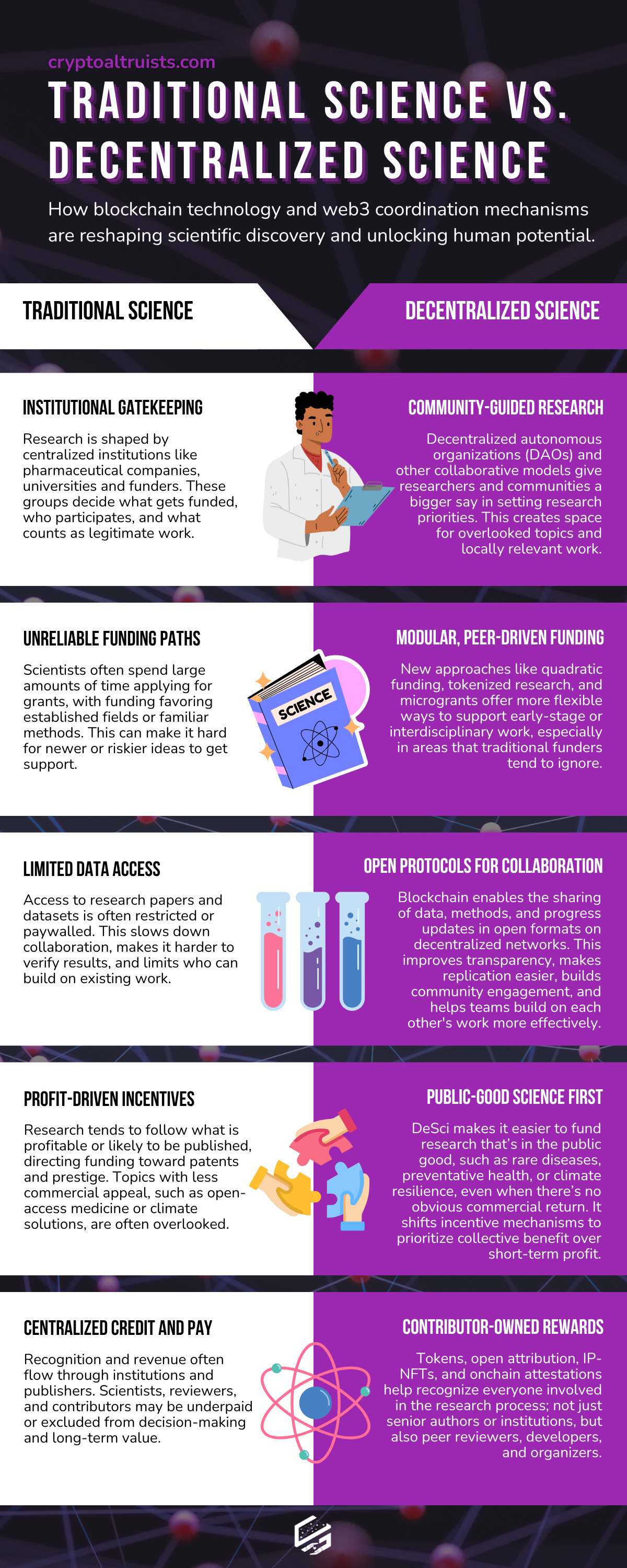
Getting a research grant has always been competitive, but the odds have been in freefall. In 2025, NIH funded 5,885 individual research grants, down from 7,720 the year before. NIH compounded the problem by eliminating transparent paylines across all twenty-seven of its institutes in early 2026, meaning applicants can no longer benchmark their chances before even applying.
What's less visible in those numbers is the sheer amount of time that evaporates in the process. One analysis of Australian research proposals found that 3,727 submissions consumed the equivalent of 550 working years of researcher time, most of it for proposals that were ultimately rejected. It's a system that burns through talent to fund a small fraction of the science that needs doing.
When research does get done, publishing it creates another bottleneck. The five largest academic publishers (Elsevier, Springer Nature, Wiley, SAGE, and Taylor & Francis) control roughly half of all scholarly output, and the European Commission estimates that 64% of scholarly publications remain behind paywalls, despite much of the underlying research being publicly funded.
The economics are striking. Elsevier's parent company RELX runs its scientific publishing division at operating margins of around 38%, on content that scientists produce for free and governments largely fund. Peer reviewers work without pay. Universities then pay those same publishers billions every year to access research their own faculty created. The money flows in one direction, and it isn't toward the science.
Even published research has a quality problem. A large-scale replication effort in psychology found that only around 40% of findings held up under scrutiny. And in a 2016 Nature survey, more than half of researchers said they had failed to reproduce their own prior work.
This matters far beyond academia, since drug development, public health policy, and further scientific research all build on published literature. If the foundation is shaky, everything built on top of it is too.
Between a promising lab finding and an approved treatment lies a long, expensive gap that most research never crosses. Around 90% of drugs that enter Phase I clinical trials fail before reaching patients as approved treatments. The total cost of bringing a drug to market runs into the billions over fifteen to twenty years. Most early-stage academic research can't attract that kind of capital, and venture capital is selective about which areas it enters.
On top of that, large categories of disease, from rare conditions and neglected tropical diseases to anything without an obvious commercial market, get very little attention, regardless of how many people they affect.
One of the clearest illustrations of how funding priorities shape research is women's health. Women were routinely excluded from clinical trials for decades; NIH didn't require their inclusion until 1993, and conditions that disproportionately or exclusively affect women remain underfunded relative to how many people they harm. In 2023, only about 2% of all health-related venture capital went to women's health issues, according to a Deloitte analysis.
The mismatch between medical need and research investment runs through the whole system, and we'll return to how DeSci addresses it when we get to AthenaDAO.
DeSci's response is to rebuild parts of that infrastructure using Web3 tools: community-governed funding pools in place of grant committees, onchain IP rights that give researchers ownership of their discoveries, decentralized storage to keep findings permanently accessible, and incentivized peer review to replace the slow, unpaid process most academic publishing currently relies on.
The core principles the movement organizes around:
What connects all of these is a shift in power, from the institutions that have long controlled research to the researchers, patients, and communities those institutions were built to serve.
Think of an IP-NFT as a title deed for a piece of research, one that travels with the science wherever it goes and can be transferred, licensed, or fractionalized without going through an institution's legal department.
NFT stands for non-fungible token: a unique digital token on a blockchain that represents ownership of something. In this case, what it represents is intellectual property rights.
Pioneered by Molecule starting in 2021, an IP-NFT wraps legal IP rights inside a smart contract on Ethereum, with three distinct layers. There's an ownership layer (the token itself), a legal layer (encrypted licensing agreements accessible only to the token holder), and a data layer where research files are stored on decentralized networks like IPFS or Arweave, keeping them permanently accessible. Whoever holds the token holds the IP rights, and the terms live in the contract rather than in institutional paperwork that can disappear.
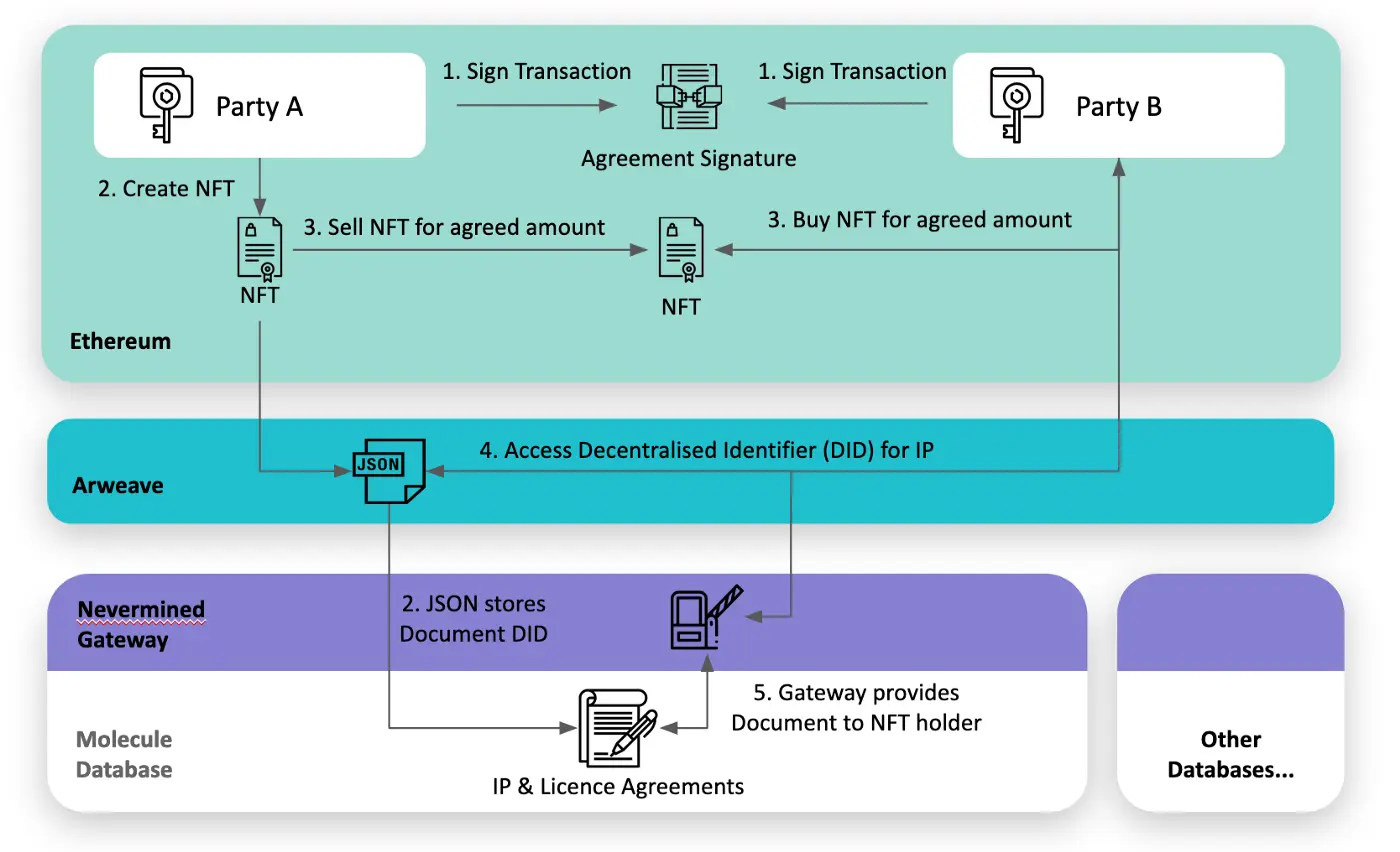
In August 2021, Molecule and VitaDAO completed the first biopharma IP-NFT transaction: a $250,000 investment in longevity drug research at the University of Copenhagen. Modest by pharma standards, but proof of concept: intellectual property rights could be transferred and held onchain, and the world didn't immediately end.
The mechanism has evolved since then. In April 2025, Molecule launched IP Tokens (IPTs), which fractionalize an IP-NFT into smaller pieces so that many people can hold a stake in a specific piece of research, rather than just one entity owning it outright. VitaDAO's first IPT offering, tied to autophagy research from Newcastle University, was oversubscribed by 1,700%.
Molecule's Protocol V2, released in August 2025, went further, linking IP-NFTs to real-world corporate structures so that token holders have a clearer path to equity if the research eventually produces commercial value. A newer tool, Proof of Invention, offers timestamped onchain proof of creation as a cheaper alternative to provisional patents, useful for researchers who want to establish priority without the full cost and timeline of traditional IP filing.
IP-NFTs create and monetize exclusivity: whoever holds the token controls the commercial rights to that research. That can sit uneasily alongside DeSci's open science claims, and moving the ownership onchain doesn't necessarily resolve it.
A DAO, or decentralized autonomous organization, is a group that pools resources and makes collective decisions using blockchain governance, not unlike a shareholder vote where anyone can buy a share. In DeSci, science DAOs (often called BioDAOs) apply this structure to research funding. Members buy governance tokens, researchers submit proposals, and the community votes on what gets funded. The money sits in a smart contract and doesn't move until a vote approves it.
The model works differently from traditional grant funding. Instead of one committee making decisions for thousands of researchers, thousands of token holders make decisions together.
In some BioDAOs, many of those holders are patients, caregivers, or people with personal stakes in the research being funded. Bio Protocol functions as the launchpad and financial layer for this ecosystem, describing itself as "Y Combinator for onchain science." As of early 2026, its network includes more than twelve live BioDAOs spanning longevity, women's health, neurodegeneration, climate biotech, psychedelic medicine, cryonics, and rare diseases.
One thing DeSci gets right is that it doesn't try to do everything through a single funding structure. Several distinct models are running in parallel, each with different strengths.
DAO treasuries pool community capital and allocate it through governance votes. VitaDAO's treasury has deployed more than $10 million across thirty longevity projects since 2021, with thousands of members deciding where that money goes.
Quadratic funding is an elegant idea borrowed from economics: it weights the number of donors to a project rather than the size of their contributions. If a hundred people each give five dollars, the project attracts more matching funds than if one person gives five hundred. The logic is that breadth of support is a better signal of community interest than the depth of a single donor's wallet. Gitcoin has distributed more than $67 million across Web3 projects using this model since 2019, including dedicated DeSci rounds.
Retroactive public goods funding works the other way around: it rewards work after it has proven its value, rather than betting on which work will prove valuable. Optimism's RetroPGF program has allocated substantial token resources using this model. Hypercerts, a related tool developed by Protocol Labs, give organizations a way to mint verifiable onchain records of completed impact, which funders can then reward after the fact. The idea is that hindsight is more reliable than foresight when it comes to evaluating science.
IPT crowdsales let community members invest in specific pieces of research by purchasing fractionalized stakes in an IP-NFT, closer to backing a specific discovery than buying into a company.
Peer review is where DeSci has, undoubtedly, made the least progress. The vision is a transparent, incentivized system where qualified reviewers are paid to evaluate research onchain, replacing the slow and unpaid process that currently underpins most academic publishing. In practice, the gap between vision and what exists today is large.
ResearchHub is the closest working example. Co-founded by Coinbase CEO Brian Armstrong, the platform pays researchers in ResearchCoin (RSC) for peer reviews, comments, and publications, with reviewers receiving around $150 per accepted review. More than 8,500 peer reviews have been completed through the platform, early evidence that the incentive model can work at scale.
ResearchHub is also developing AI-assisted peer review tools, aiming to make the process faster and more consistent. The system isn't fully onchain, and no fully decentralized peer review system operates at scale yet.
DeSci Labs has built the infrastructure layer for decentralized scientific publishing. Its Nodes platform bundles manuscripts, code, and data into research objects with decentralized persistent identifiers: permanent, content-addressed links that don't break or drift over time.
This is important because the scientific literature has a link-rot problem: published references regularly point to files that have moved or disappeared, making it hard to trace the provenance of a finding years later.
The platform is being used by CERN's ATLAS project and UC Berkeley's underground physics research. DeSci Labs has also developed CODEX, an open peer-to-peer publishing protocol, and SciWeave, an AI-powered research assistant with citations.
Ocean Protocol's Compute-to-Data architecture allows researchers to run algorithms on private or sensitive data, including patient health data, without the data ever leaving a secure environment. In practice, a pharmaceutical company could train models on a hospital's patient records without either party gaining access to the other's data. Ocean has an active research partnership with Roche in this area.
Meanwhile, Bittensor, a decentralized AI network, hosts science-focused subnets including one for protein folding and one for drug discovery.
Prime Intellect, which released a 32-billion-parameter model trained through distributed computing in 2025, is partnering with VitaDAO on virtual-cell AI, an early example of decentralized compute infrastructure being built specifically for scientific applications.
What follows is a selective look at DeSci projects verified as operational as of early 2026. The space saw many token launches between 2022 and 2024 that generated noise without generating science; the projects here have recent milestones, active teams, and, in most cases, tangible output.
Molecule is the foundational layer much of the DeSci ecosystem is built on. It created IP-NFTs, helped launch VitaDAO and Bio Protocol, and continues to develop the core infrastructure for tokenizing scientific IP.
Protocol V2, launched in August 2025, bridges IP-NFTs to real-world corporate structures for the first time, giving token holders a clearer path from digital ownership to equity. Molecule raised a $12.7 million seed round in 2022 led by Northpond Ventures, a biotech-focused investor, a signal that the approach has attracted serious scientific capital, not just crypto money.
VitaDAO brings strong evidence that DeSci can fund real science. Since launching in 2021, the community has deployed more than $10 million across thirty-plus longevity research projects, with over 10,000 members voting on what gets funded. Pfizer Ventures co-invested in a $4.1 million fundraise in January 2023, the first time a major pharmaceutical company participated in DAO governance.
The research pipeline has since attracted attention well beyond the DeSci community. VitaDAO spun out Matrix Biosciences in October 2023, the first biotech company born from a DAO, based on research into longevity compounds from naked mole rats (which, for reasons scientists are still working out, are remarkably resistant to cancer and aging). Portfolio company Gero later signed a partnership with Roche subsidiary Chugai for AI-driven longevity drug discovery.
Bio Protocol is the launchpad and financial backbone for the BioDAO ecosystem, founded by Molecule's Paul Kohlhaas. A Genesis sale and a subsequent $6.9 million seed round in September 2025 raised more than $39 million combined, with investors including Arthur Hayes' Maelstrom Fund.
The BIO token listed on Binance in January 2025 as the first DeSci token on that exchange; Bio V2 followed later in the year with a new governance model and Biofy, a platform for commercializing science-backed products. By early 2026, the network spans more than twelve live BioDAOs. One caveat: the BIO token has fallen more than 90% from its all-time high, a reminder that token performance and research progress are not the same thing, and shouldn't be treated as such.
Co-founded by Coinbase CEO Brian Armstrong, ResearchHub pays researchers in ResearchCoin (RSC) for peer reviews, publications, and community engagement. Reviewers receive around $150 per accepted review. More than 8,500 reviews have been completed through the platform, enough to show the incentive model has a track record: token payments can sustain a peer review ecosystem at scale.
ResearchCoin listed on Coinbase in July 2025, and Silo Pharma (Nasdaq: SILO) became the first public company to add RSC to its corporate treasury in October 2025. Nature featured ResearchHub in December 2024.
DeSci Labs is building the publishing infrastructure decentralized science needs to be credible. Its Nodes platform creates permanent, content-addressed research objects that bundle a paper together with its underlying code, data, and methodology, so that future researchers can reproduce what was done, not just read about it.
The platform is being used by CERN's ATLAS project and UC Berkeley's underground physics research. DeSci Labs raised approximately $7 million from investors including Holtzbrinck Digital, one of the major players in traditional academic publishing, an unusual signal of crossover interest from within the industry DeSci is partly trying to disrupt.
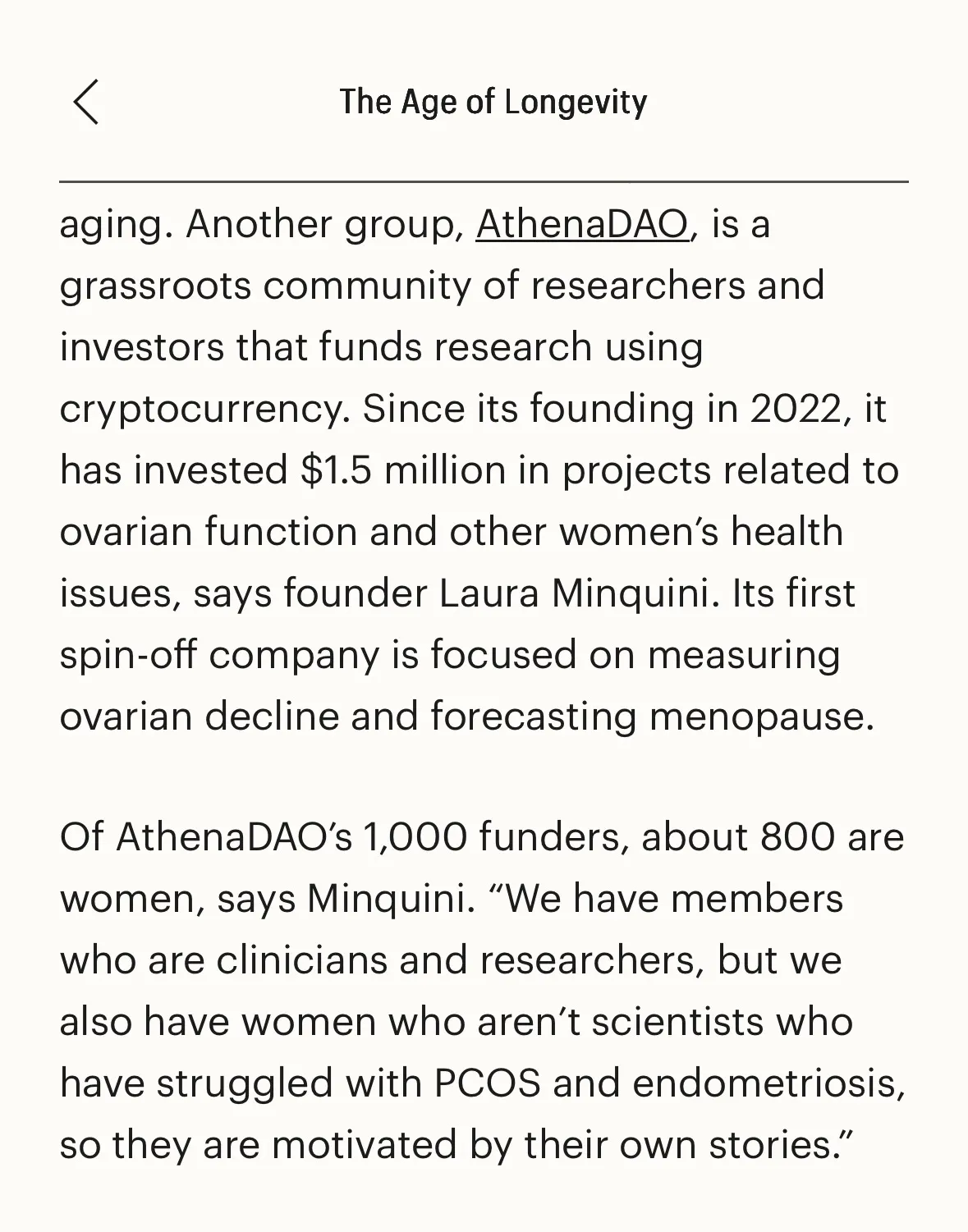
Who decides which diseases get researched? AthenaDAO's bet is that it should be the people living with them. The DAO focuses on women's reproductive health: ovarian aging, menopause, endometriosis, PCOS, and fertility, areas that have been underfunded for decades relative to how many people they affect.
Since its founding in 2022, AthenaDAO has funded approximately $1.5 million across four cohorts, supporting six research labs and ten academic fellowships. Of its 1,000 funders, around 800 are women, many motivated by personal experience with PCOS, endometriosis, or infertility. The community is, in other words, funding research it would directly benefit from, a structural alignment that doesn't exist in traditional grant-making.
The milestones go beyond funding totals. AthenaDAO launched Ovul.AI, initiating what it describes as the first decentralized clinical trial focused on ovarian health. It supported LifeAhead, a spinout company developing menopause forecasting technology from research out of the University of Colorado. The tool can predict individual reproductive milestones with around 75% less uncertainty than population-level estimates, using biological data already collected at routine fertility clinic appointments. LifeAhead is now in the FDA approval process.
In January 2026, TIME Magazine covered AthenaDAO-funded research on ovarian aging in its longevity issue, placing the work alongside some of the most prominent names in aging science.
ValleyDAO funds synthetic biology research with a focus on climate applications, and its results are among the most tangible of any DeSci projects.
The HEMPY project produced novel hydrophobic hemp fiber properties. The Cocoa Zero project engineered yeast to produce fats 90% identical to organic cocoa butter, with the process now scaling at Imperial College London. Spinout BioHalo raised $1.8 million to target PFAS "forever chemicals" using biopolymers.
HairDAO gets credit for one of DeSci's most concrete proofs of concept: a repurposed T3 treatment for hair loss, developed in eighteen months for $140,000. To put that in context, traditional drug development for a condition like this typically takes years and costs hundreds of millions of dollars.
HairDAO also filed what it describes as the first scientific patent filed by a DAO in late 2023, and has since launched a consumer product line and a telehealth platform.
Focused on neurodegeneration and brain health research, CerebrumDAO was the first project to use Molecule's Proof of Invention tool, minting an onchain proof of creation for Fission Pharma's research prior to patent filing. Part of the Bio Protocol ecosystem, active as of early 2026.
Led by Stanford researcher Rohan Dixit, Long COVID Labs raised $2.6 million for clinical research into long-acting monoclonal antibodies for long COVID, a condition affecting tens of millions of people globally with limited treatment options and, until recently, very limited research funding.
The first Solana BioDAO, led by Ethan Perlstein, raised $1.77 million to fund patient-owned drug repurposing for rare metabolic diseases. A participant in Bio Protocol's Incubator Cohort 2.
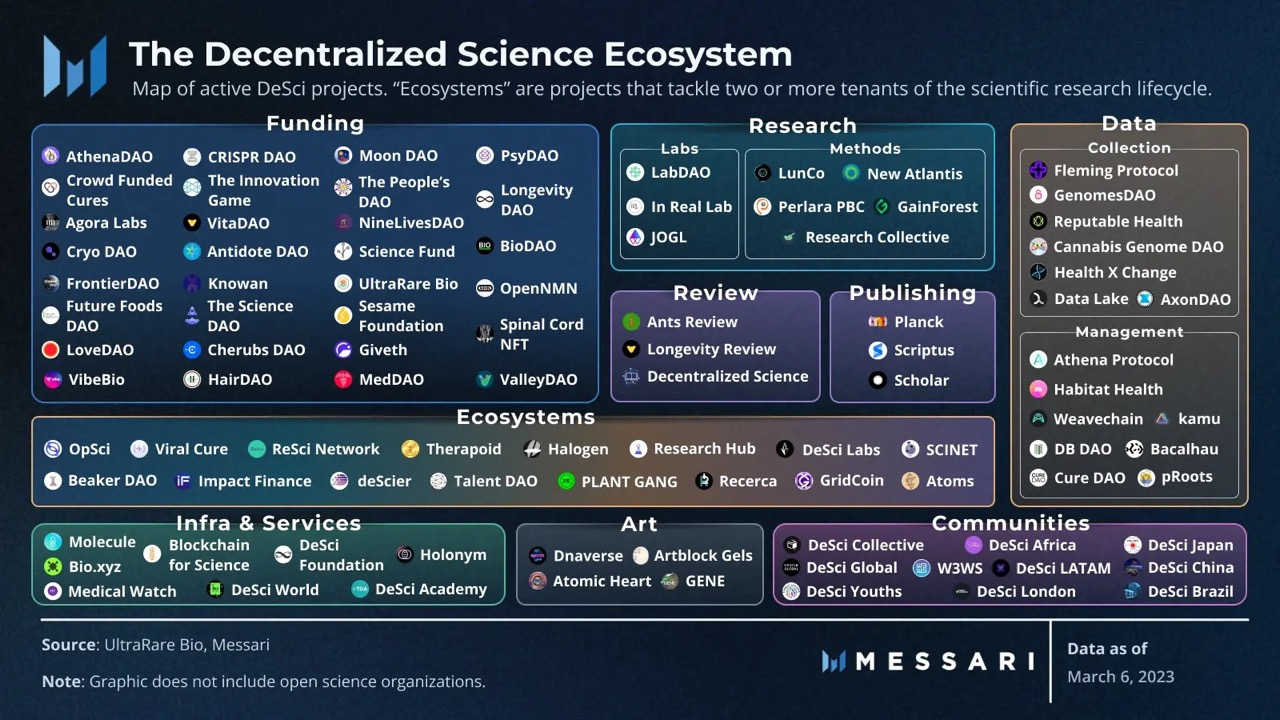
DeSci spent years trying to convince people the research funding system was broken. Then 2025 did the arguing for them. Thousands of NIH and NSF grants were cancelled or suspended, success rates collapsed, and scientists who would have rolled their eyes at DeSci two years ago started showing up at the meetups. DAO funding is still modest by comparison, but the audience has changed.
What's being built inside DeSci has also gotten considerably more interesting. A year ago, AI integration was mostly conference-talk. Now it's in production: Bio Protocol's BioAgents generate research hypotheses autonomously, Bittensor's science subnets apply decentralized compute to protein folding and drug discovery, and ResearchHub is building AI-assisted peer review.
A 2025 paper in Frontiers in Blockchain proposed a "DeScAI" framework for self-verifying research systems that could compress the gap between a discovery and its validation from years to months. Still theoretical, but not by much.
The research categories being funded have quietly expanded too, which might be the most telling sign the model is working. Bio Protocol's incubator now spans quantum biology, long COVID, rare diseases, CRISPR, women's health, and climate biotech. A DAO of token holders is now funding quantum biology research. If that sentence sounds strange, that's kind of the point.
The traditional world has started paying attention, which is its own kind of signal. University partnerships have formalized at Newcastle, Copenhagen, Rochester, Harvard Medical School, and Imperial College London. Pharmaceutical companies are watching VitaDAO's model. Nature, the California Management Review, and Frontiers in Blockchain have all published serious analysis of DeSci in 2025, and the academic literature on the subject grew from roughly two papers in 2021 to more than forty.
The movement has also spread well beyond Berlin and a handful of crypto conferences. DeSciWorld is working directly with researchers in the Global South, where the traditional system has historically offered the least. That's arguably where DeSci has the most to prove, and the most to offer.
The clearest problem DeSci faces is the mismatch between token performance and scientific output. When DeSci tokens reached a combined market cap of over a billion dollars in late 2024, the amount of capital deployed to actual research was in the tens of millions. Token values tracked crypto market sentiment far more reliably than scientific progress; the BIO token fell more than 90% from its high, and most others followed.
Pump.science turned longevity compounds into tradeable Solana tokens, with trading fees nominally funding experiments. The tokens surged to nine-figure valuations. Then, in November 2024, a developer accidentally left a private key in a public GitHub repository, attackers minted fraudulent tokens, and the system collapsed. Critics pointed to it as an example of financial speculation dressed up in a lab coat, and it's hard to argue with that framing.
Fabric Ventures put it plainly in a 2025 analysis: "Hype led to speculation and the valuations of DeSci tokens exceeded their deployed funding by multiple orders of magnitude." That's a credibility problem for a movement trying to be taken seriously by scientists and institutions. Some BioDAOs have made little or no actual research investment while actively marketing their governance tokens.
The best DeSci projects have produced concrete results: VitaDAO has deployed more than $10 million into longevity research and spun out a biotech company; HairDAO brought a treatment to market in eighteen months; ValleyDAO has materials science outputs now scaling commercially; and AthenaDAO has two spinouts, with tangible, funded research.
That said, most funded research is still in early or preclinical stages, and no DeSci-funded project has yet produced a peer-reviewed breakthrough that changes a field. The scale gap matters too: a standard NIH R01 grant provides $250,000 to $500,000 per year for five years. Most DeSci grants are one-time payments in the $50,000 to $350,000 range, rarely enough to run most serious research programs from start to finish on their own.
DAO governance looks democratic in theory. In practice, token-weighted voting tends to concentrate power among large holders. Voter apathy is common, and most proposals pass with minimal participation.
A 2025 study in Frontiers in Blockchain documented that this kind of governance "paradoxically leads to centralization and plutocracy" in DeSci DAOs, and that market valuations of governance tokens "frequently diverge from the scientific value the DAO produces." Domain expertise in the science being funded doesn't come automatically with token ownership, and the model hasn't yet solved how to weight domain knowledge alongside financial stake.
Whether IP-NFTs with royalty streams qualify as securities under U.S. law is unsettled, and GDPR's right to erasure conflicts directly with blockchain immutability for any health data stored onchain. The FDA pathway for DAO-funded therapeutics is undefined. No jurisdiction has yet issued DeSci-specific guidance. The SEC under Chair Atkins took a more permissive posture toward crypto tokens in 2025, which helps at the margins, but the legal questions specific to tokenized IP remain open, and building long-term infrastructure on unsettled regulatory ground carries risk.
For researchers trained in traditional academic settings, DeSci requires learning entirely new infrastructure: blockchain wallets, governance platforms, token mechanics. Academic careers still reward journal publications over DAO contributions, and university IP policies often prevent researchers from tokenizing their work without institutional sign-off, which can be slow or flat-out impossible.
And the reputational association between crypto and financial speculation has made many scientists cautious, even when the underlying ideas are worth taking seriously.
It's easy to look at DeSci and see either too much or too little. Too much, if you read the token charts of late 2024 and assume the movement is mostly noise. Too little, if you look only at the dollars deployed and conclude there isn't enough there to matter.
The reality is much more nuanced, and much more interesting. A few thousand people, scattered across continents, are running a live experiment in whether science can be funded differently. Most of them are not crypto people. Many are researchers, patients, or the family members of patients, who showed up because the traditional system wasn't working for them and they wanted to try something else. The tools are blockchain tools, but the motivation is older than that.
Whether the experiment succeeds in any large sense is unknown. As Crypto Altruists, our honest position, five years in, is that DeSci has proved it can do interesting things at a small scale, but has not yet proved it can do important things at a large one.
It is definitely worth following, though, and not only because the science might pan out. What we like about DeSci is that it’s one of the few places where some of the harder questions about public goods, ownership, and community governance are being worked out on real problems with real money, rather than in white papers.
So, even the parts that won’t succeed can teach the broader Web3 impact ecosystem something useful, regardless of where token charts go next.
Support thoughtful, independent crypto journalism and help us continue highlighting blockchain’s potential for social and environmental impact.
cryptoaltruists.eth