

Crypto offers powerful new tools for fundraising, payments, and transparency, but it also comes with a new set of responsibilities. Unlike traditional banking, there's no customer service line to call if something goes wrong. No fraud department to reverse a transaction. No "forgot password" button to reset your access.
That's the tradeoff: more control means more responsibility. The good news is that securing your crypto isn't complicated, it just requires understanding a few key concepts and building good habits from the start. Whether you're a nonprofit exploring crypto donations for the first time or an individual managing your own assets, these five stages will help you protect what matters.
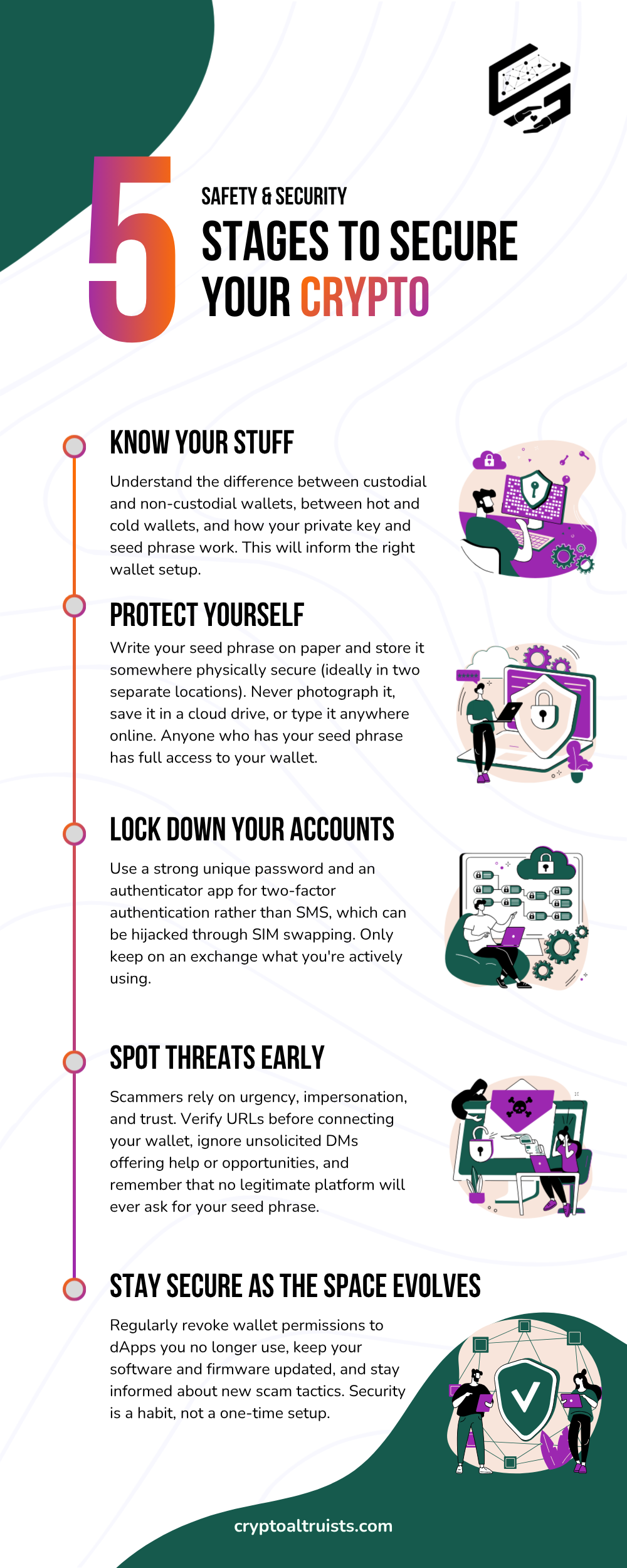
Before you move a single dollar into crypto, take the time to understand how wallets actually work. The choices you make here will shape your security posture for everything that follows.
A custodial wallet means a third party (like an exchange) holds your funds and manages your private keys on your behalf. It's convenient, but it also means you're trusting them with your assets. A non-custodial wallet puts you in full control. You hold the keys, and only you can access your funds.
A hot wallet is connected to the internet (like a mobile app or browser extension), making it convenient for everyday transactions but more vulnerable to hacks. A cold wallet (like a hardware device) stays offline, offering stronger protection for long-term storage.
An individual wallet is controlled by a single private key where one person holds full access. A multi-sig (multi-signature) wallet requires multiple keys to authorize a transaction, such as 2-of-3 or 3-of-5 signers. This adds a layer of protection against single points of failure: no one person can move funds unilaterally, and losing one key doesn't mean losing access entirely. For nonprofits managing organizational funds, multi-sig wallets are increasingly considered best practice as they distribute control, reduce internal risk, and create a clear approval process for transactions.
Your private key is what proves ownership of your wallet. Your seed phrase (usually 12 or 24 words) is the master backup that can restore your wallet if you lose access. Whoever has your seed phrase has full control of your funds, so protecting it is everything.
Understanding these fundamentals will help you choose the right setup for your needs and avoid costly mistakes down the road.
Your seed phrase is the single most important thing to protect. If someone gets it, they can drain your wallet in seconds and there's no way to reverse it.
Don't store it digitally. Don't take a photo. Don't paste it into a notes app or save it in a cloud drive. These shortcuts feel convenient, but they create attack surfaces that scammers and hackers actively exploit.
Ideally, keep copies in two separate locations like a safe at home and a safety deposit box. This protects you from both theft and loss (fire, flood, misplacement).
No legitimate wallet, platform, or support team will ever ask for your seed phrase. If someone does, it's a scam, full stop.
This step is simple, but it's where most people slip up. Treat your seed phrase like the keys to a vault, because that's exactly what it is.
Even with your seed phrase secured, your accounts can still be vulnerable if you're not careful about access controls.
Every account should have its own password; ideally a long, random string generated by a password manager. Reusing passwords across sites is one of the easiest ways to get hacked.
Authenticator apps like Google Authenticator, Authy, or a hardware key like YubiKey are far more secure than text-message codes. SMS-based 2FA can be bypassed through SIM swapping, a technique where scammers convince your mobile carrier to transfer your number to their device.
Exchanges are convenient for trading, but they're also high-value targets for hackers. Only keep on an exchange what you're actively using and move the rest to a wallet you control.
Think of this stage as locking the doors and windows. It won't stop every threat, but it eliminates the easy entry points.
Most crypto scams don't rely on sophisticated hacking, they rely on human psychology. Urgency, impersonation, and misplaced trust are the tools of the trade.
Phishing sites often look identical to legitimate platforms but use slightly altered URLs. Bookmark the sites you use regularly and access them directly rather than clicking links in emails or DMs.
If someone reaches out offering help, investment opportunities, or exclusive access to something, assume it's a scam. Legitimate projects don't cold-DM people asking them to connect wallets or send funds.
Not support teams, not developers, not moderators, not anyone. If you see this request, you're being targeted.
Scammers are creative and constantly evolving their tactics, but most attacks follow the same playbook. Learning to recognize the patterns is one of the best defenses you have.
Security isn't a one-time setup, but an ongoing practice. The crypto landscape changes fast, and staying safe means staying current.
Every time you connect your wallet to a dApp, you grant it certain permissions. Over time, these add up, and if a dApp is compromised, your wallet could be at risk. Use tools like Revoke.cash to review and revoke permissions you no longer need.
Whether it's your hardware wallet, browser extension, or mobile app, updates often include critical security patches. Don't ignore them.
Follow trusted voices in the space, keep up with news about new scam tactics, and revisit your security setup periodically. What was best practice a year ago may no longer be enough.
The organizations and individuals who treat security as a habit, rather than a checklist, are the ones who avoid becoming cautionary tales.
Crypto security can feel overwhelming at first, but it comes down to a few core principles: understand how your tools work, protect your seed phrase like your life depends on it, lock down your accounts, stay alert to scams, and keep your practices up to date.
The learning curve is real, but the payoff is ownership and control that traditional finance can't offer. And for nonprofits exploring blockchain tools for fundraising, payments, or transparency, getting security right from the start isn't optional, it's foundational.
Take it one stage at a time. Build the habits. And don't let the complexity keep you from the opportunity.
Ready to go deeper? Our Web3 Impact Toolkit is a free, self-paced resource for nonprofit professionals exploring blockchain tools for fundraising, payments, and accountability, including how to get started safely and responsibly.
Support thoughtful, independent crypto journalism and help us continue highlighting blockchain’s potential for social and environmental impact.
cryptoaltruists.eth