

In February 2022, days after Russia's full-scale invasion, the Ukrainian government posted a crypto wallet address on Twitter. Within weeks, over $100 million had flowed in.
UkraineDAO organized NFT drops that pulled in millions more. Unchain Fund built rails for transparent, rapid aid distribution. UNHCR partnered with Stellar to send USDC directly to refugees, getting funds into hands in hours rather than the weeks it would have taken through traditional banking.
For a community that had spent years arguing over what crypto was for, these were the most concrete answers yet.
Four years on, that early momentum has been hard to sustain. The war has continued, but international attention has moved on, and the funding has followed. US aid programs have been scaled back sharply, and defense budgets in donor countries are absorbing money that once went to humanitarian work.
Humanitarian needs in Ukraine have deepened, not eased, and the resources to meet them are moving the other way.
Ukraine is not unique in this. Syria, Yemen, Sudan all moved through the same cycle: a surge of attention and funding, then a long drift of both. In this regard, year four of any crisis is harder than year one.
In late 2025, we were connected with Alliance for Public Health through our partnership with Social Equation Hub focused on helping nonprofits leverage web3 primitives to grow their impact. What truly caught our attention was the contrast between what they'd built before the war and what they'd been forced to become during it.
What they'd built was 25 years of HIV programs across Eastern Europe and Central Asia, identifying roughly half of all new infections in Ukraine each year.
When the full-scale invasion began, their work changed overnight. They started coordinating evacuations, buying generators after Russia targeted the power grid, and supplying displaced families with gas and kitchenware.
Tetiana Deshko, who runs their international programs, called it an avalanche of needs.
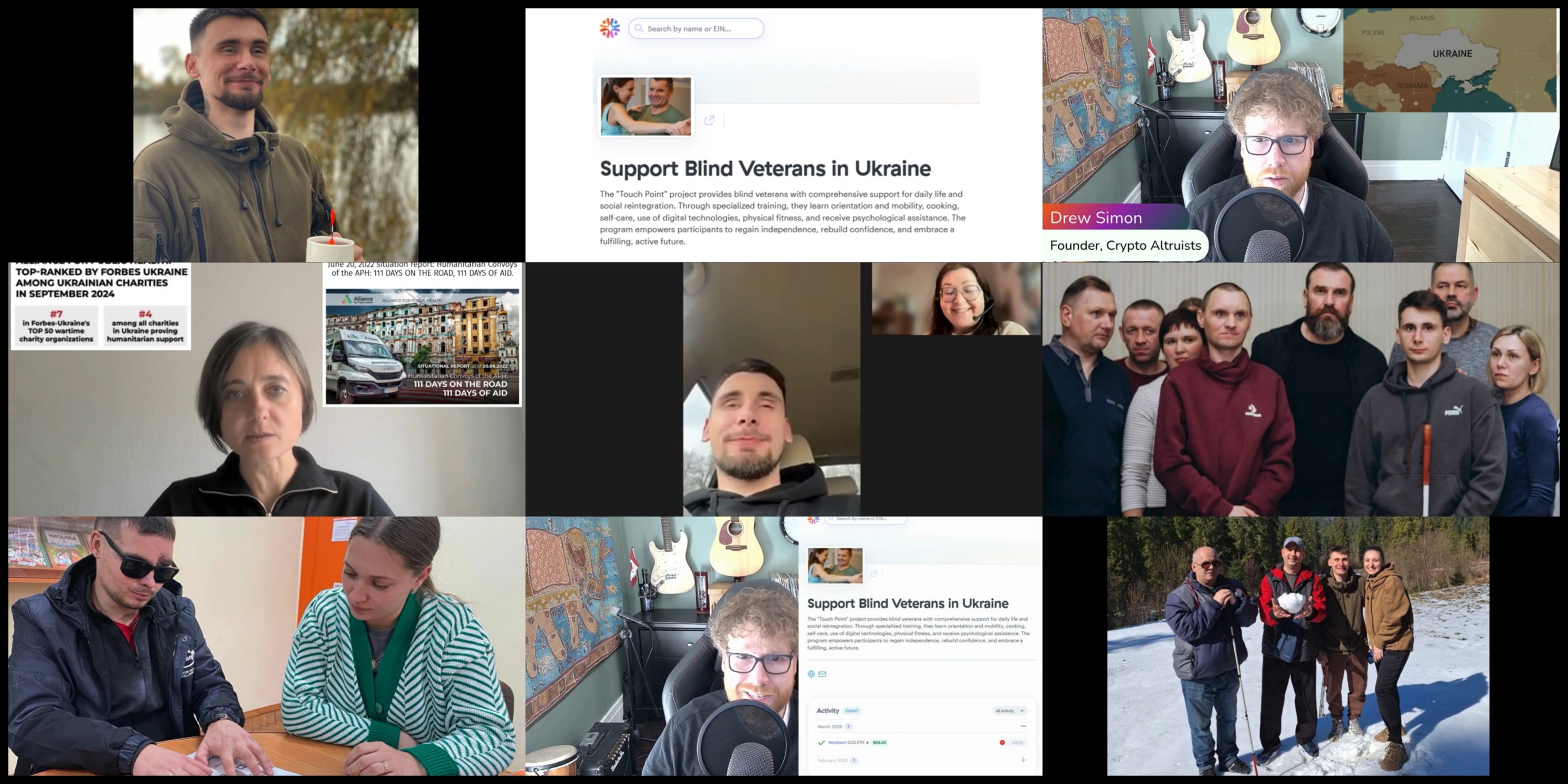
By 2023, they had built a rehabilitation program for veterans who had lost their sight in combat. Ivan was one of the first to come through it.
Ivan was 20 when his bunker on the eastern front took a mortar hit in December 2022. He lost his sight. For months afterward, his world shrank to one room and a stack of audiobooks. He had stopped being able to do anything on his own.
Eventually, and after much convincing from family and friends, he joined Touchpoint, APH's program for veterans who had lost their sight. Four weeks of residential rehab, then a month of follow-up at home.
The cane came first. He started walking the streets again. The phone took longer, but he got there. Cooking came back. So did helping his wife in the kitchen. He found out there were card games made for blind players. He could still dance. Fishing followed, and he found other hobbies like using a metal detector to find lost treasures.
Ivan also volunteers for the same Touchpoint program, supporting other veterans who've lost their sight.
"This is the same person like you," he tells others who have lost their sight. "They can do it, which means you can do it too. It's real. This is not fantasy."
Between 1,000 and 2,500 Ukrainian veterans are estimated to have lost their sight in this war.
Touchpoint has worked with roughly 50 across four cohorts. APH is raising funds now for the next 20. Each cohort costs money that is harder to find than it was a year ago. The cohort after that will need funding too, and the one after that.
A program like this is not expensive in the scheme of things. What makes it fragile is not cost but continuity. It needs to exist next year, and the year after, and the year after that, in a funding environment that has stopped paying attention.
We made a short documentary with Ivan and APH that goes deeper into his story. You can watch it here.
2022 proved that crypto can move money fast when an institution can't. A wallet address on Twitter, $100 million in weeks, no banks to coordinate with, no corridors to negotiate.
We saw that stablecoins can route around broken or slow financial systems and reach individuals directly. And loose coalitions of strangers stood up funding infrastructure in days rather than quarters.
These properties describe the same shape of work: short, urgent, high-attention, high-velocity. Crisis response.
What 2022 did not show was that crypto philanthropy can sustain an organization for a decade. That's a different problem, and the same properties that make crypto useful in week one tend to work against it in year four.
Viral fundraisers peak early and decay fast. The wallets that filled in February 2022 are quiet now. This is a property of how crypto philanthropy has been used so far, not of what it could be.
Long-haul work needs the people writing the checks to still be there when the cameras have left, and to keep being there when the next crisis pulls attention somewhere else.
Crypto can build for this. Some of the pieces already exist:
Most of the activity in crypto philanthropy still clusters around the viral moment.
The question is whether the infrastructure for slow money gets built with the same energy that built the fast.
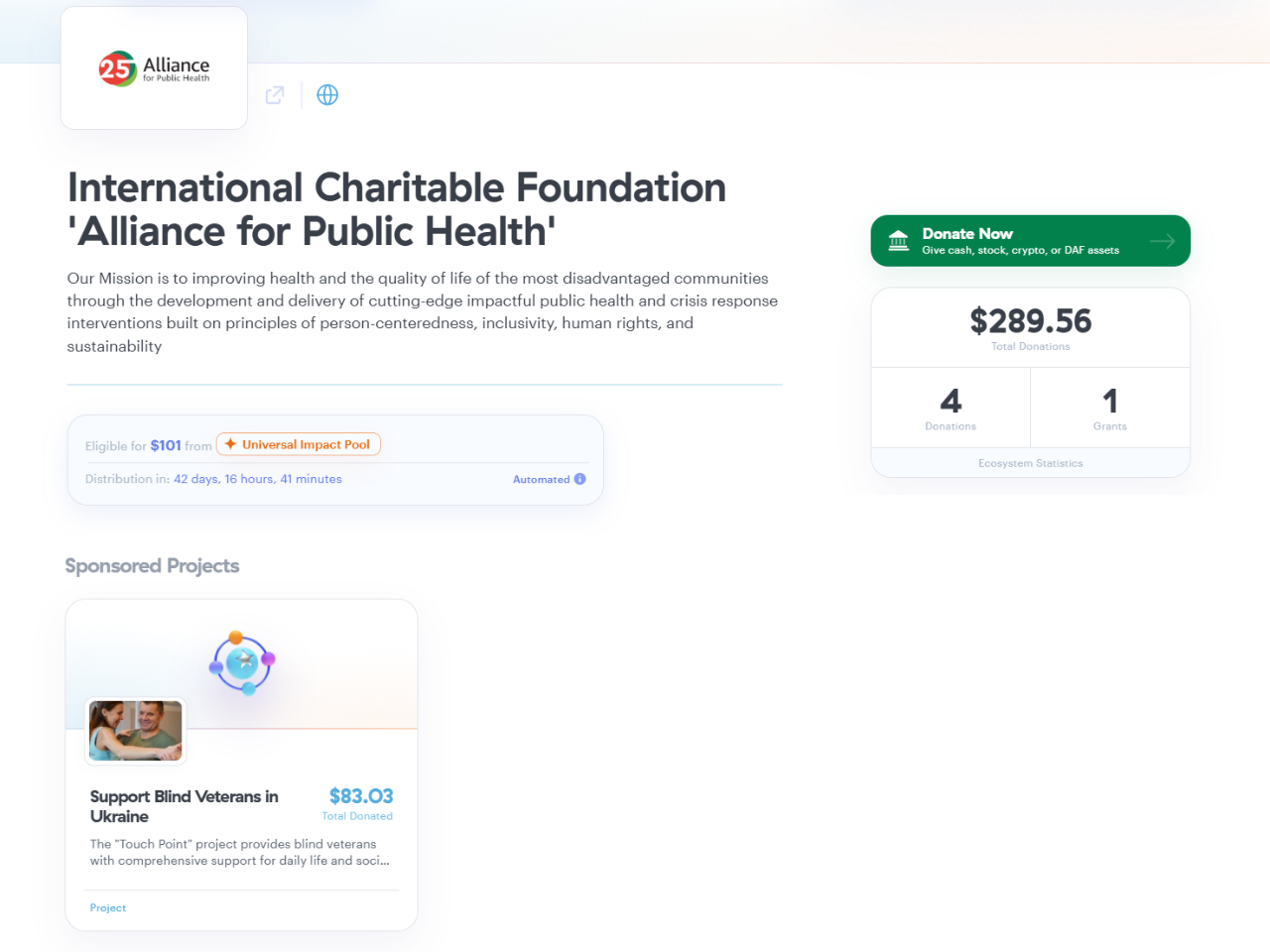
At Crypto Altruists, we're supporting APH with their first fundraising fundraising campaign on Endaoment. Donations in crypto or traditional currency are eligible for matching through Endaoment's Universal Impact Pool, which uses quadratic funding to amplify community-backed organizations.
If you're building infrastructure for the long-haul work, things like recurring giving, on-chain accountability, multi-year pools, we'd like to hear from you.
What Ukraine taught crypto philanthropy in 2022 is that the technology can show up fast at the start of a crisis. What it's teaching now is that fast isn't the only thing that matters.
The other thing worth being good at is staying.
Support thoughtful, independent crypto journalism and help us continue highlighting blockchain’s potential for social and environmental impact.
cryptoaltruists.eth