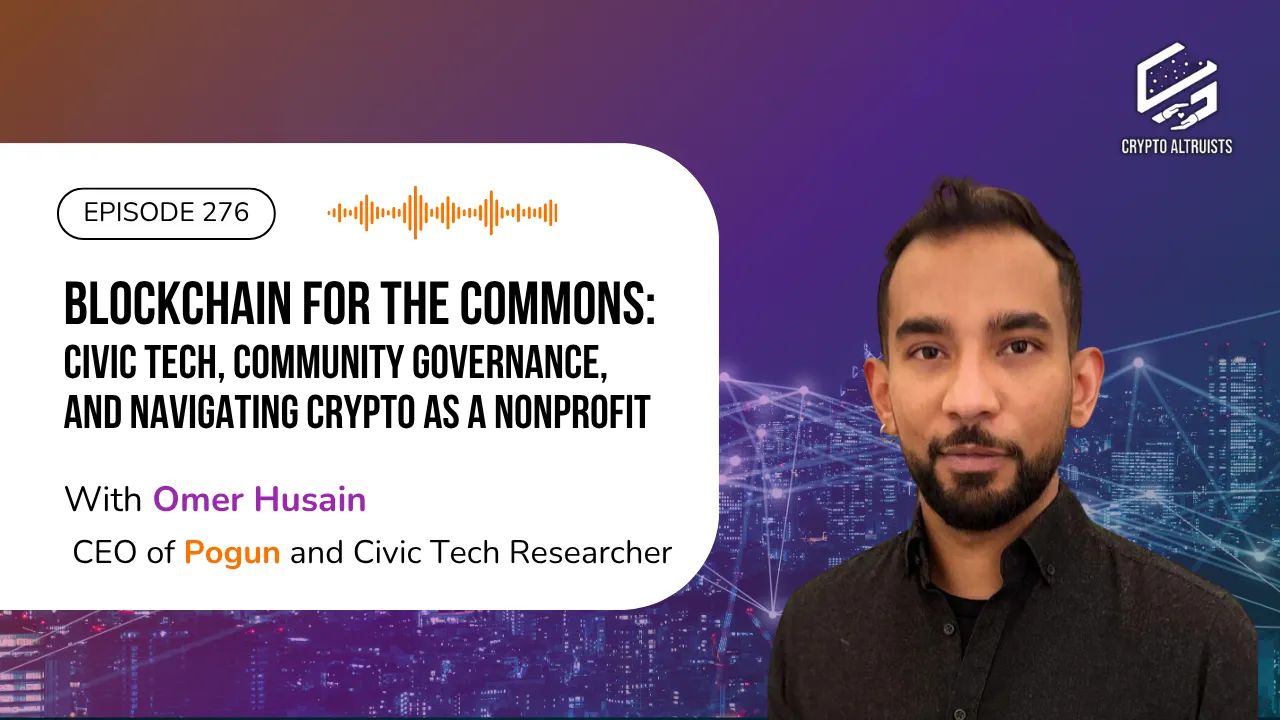


For episode 276 of the Crypto Altruists podcast, we're joined by Omer Husain of Pogun, and a longtime researcher and builder at the intersection of blockchain, civic tech, and finance.
Long before DeFi, NFTs, and token launches dominated the headlines, there was a quieter, more hopeful moment in the history of blockchain. Researchers, citizen groups, and city governments were asking a different kind of question: could this technology help communities govern themselves, share resources, make decisions together, and build systems that served the commons rather than a select few? Some of those early ideals have been realized, some have been forgotten, and some are being rediscovered today.
Omer's path gives him a rare vantage point on those questions. From 2016 to 2020, he was a European Commission-funded researcher working with citizen groups, municipalities, and grassroots projects on how blockchain and peer-to-peer systems could support commons-based governance. From there, he went on to ING's Blockchain Center of Excellence and Input Output, and today he's building in the world of onchain credit. In this conversation, we explore what the early days of civic tech taught us about building with communities, the tension between starting local and building for global scale, and lessons for nonprofits and DAOs looking to involve their communities in decision-making. We also dig into practical advice for nonprofits navigating crypto, and whether blockchain can help make the financial system fairer and more transparent for those who've been left out.
In today's discussion you'll learn:
🏛️ What the early days of civic tech and commons-based governance taught us about building technology centered around communities
🤝 Lessons for nonprofits, impact organizations, and DAOs looking to involve their communities in decision-making
🧭 Practical advice for nonprofits navigating crypto, building partnerships, and exploring potential use cases
🏦 Who gets left out of today's financial system, and whether blockchain can help make it fairer and more transparent
🤝 Explore Crypto Fundraising, AI, and Web3 consulting opportunities with Crypto Altruists
🧰 Check out the Web3 Impact Toolkit
🌱 Start local, then scale: Since the early days of tech, there has been a tension between building for global scale from day one and starting small with local communities. The lessons from civic tech and grassroots work point clearly in one direction: some of the most meaningful, lasting impact happens when technology is built close to the people it's meant to serve. Local communities know their own needs, relationships, and context best, and solutions shaped with them are far more likely to take root. Scale can come later, but only once something works for real people on the ground.
🧭 For nonprofits, the technology should never be the starting point: For nonprofits curious about crypto and blockchain, the most important first step has nothing to do with technology. It starts with identifying a clear need, a use case that makes sense for your mission, and clear KPIs to measure whether it's working. Often, organizations start with the tool and then search for a problem to solve, which rarely leads to a useful outcome. And when the technology is the right fit, it often works best behind the scenes, hiding the complexity so that staff, donors, and communities can benefit without needing to understand how it works. The goal isn't to adopt blockchain for its own sake, but to solve real problems more effectively.
🤝 The commons offers a blueprint for community governance: Many nonprofits, impact organizations, and DAOs are experimenting with ways to involve their communities in decision-making, and the commons-based governance movement offers a rich set of lessons to draw from. Long before DAOs had a name, citizen groups and grassroots projects were exploring how communities could manage shared resources and make decisions together. The core insight still holds, that technology can support community governance, but it can't replace the trust, relationships, and human engagement that make it work. For organizations looking to give their communities a greater voice, the lessons from the commons are a good place to start.
Omer's Publications
03:15 - Your experience in the field has been diverse: European Commission-funded researcher working with citizen groups on civic tech and commons-based governance, ING’s Blockchain Center of Excellence, Input Output, and now CEO of Pogun. What first drew you to this work, and what have you carried with you from your civic tech days into your work today?
10:00 - Before we dive into what you’re working on today, I’d like to go back a bit. From 2016 to 2020, you worked with citizen groups, municipalities, and grassroots projects exploring how blockchain and peer-to-peer systems could support commons-based governance. From your civic tech days to now, what are some of the key lessons you still think about today?
14:10 - Since the early days of Web3, there has been this tension between building for scale, and focusing on local communities. From your work in civic tech and with grassroots groups, what did you learn about the importance of localism and building with communities.
20:45 - Following your days researching civic tech, you worked in a number of web3 roles including with ING’s Blockchain Center of Excellence and Input Output. Tell me about this part of your journey and what you took away from it.
25:00 - Let’s shift gears to focus on what you’re doing today, and I’d like to start with the problem. Many people struggle to access credit, whether it’s a mortgage application turned down repeatedly with no clear reason, or entire communities locked out of fair lending altogether. From your time inside a major bank and in this space, who gets left out of today’s credit system, and why?
33:45 - Let’s zoom out. Traditional lenders have locked certain people and communities out of fair credit for generations. Do you think onchain credit can genuinely challenge that, or is the more realistic goal to make existing credit markets fairer and more transparent?
38:15 - We have many listeners who tune in from the nonprofit world, and more nonprofits than ever are receiving crypto donations. That said, many don’t yet have a clear plan for what to do once it arrives: convert it right away, hold it, or keep some in stablecoins. Drawing on your experience in finance and digital assets, how should an organization think about managing crypto responsibly, and do you have any advice on what should belong in a nonprofit’s crypto policy?
45:20 - Many impact orgs and nonprofits are experimenting with community governance and shared ownership. From your work on commons-based governance with grassroots groups, what lessons would you pass on to organizations looking to involve the community more in decision making?
48:50 - For listeners who want to learn more about yourself or Pogun, where should they go? What’s your call to action for listeners?
Support thoughtful, independent crypto journalism and help us continue highlighting blockchain’s potential for social and environmental impact.
cryptoaltruists.eth
While we may discuss specific web3 projects or cryptocurrencies on this podcast, please do not take any of this as investment advice, and please make sure to do your own research on potential investment opportunities, or any opportunity. We host a variety of guests on this podcast with the sole purpose of highlighting the social impact use cases of this technology. That being said, Crypto Altruism does not endorse any of these projects, and we recognize that, since this is an emerging sector, some may be operating in regulatory grey areas, and as such, we cannot confirm their legality in the jurisdictions in which they operate, especially as it pertains to decentralized finance protocols. So, before getting involved with any project, it’s important that you do your own research and confirm the legality of the project. More available HERE.