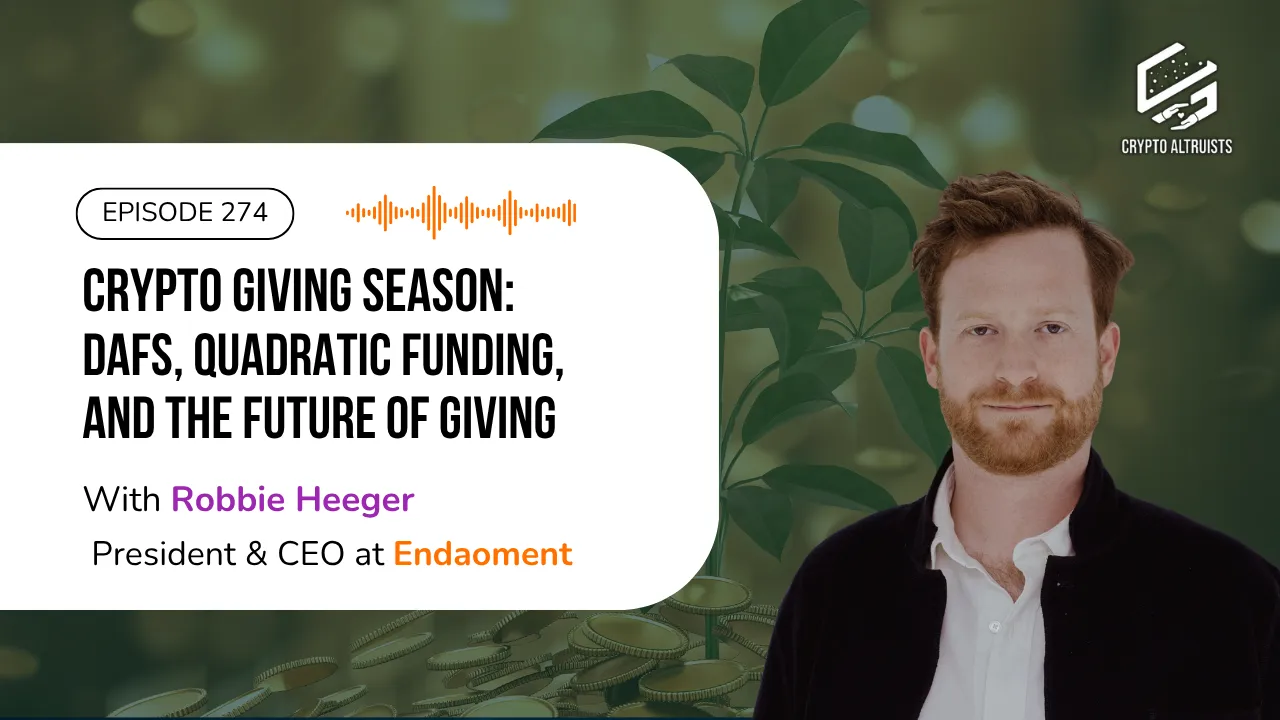


For episode 274 of the Crypto Altruists podcast, we’re thrilled to welcome back Robbie Heeger, President and CEO of Endaoment, to explore how nonprofits and donors can make the most of crypto giving season, and how the infrastructure behind giving is being rebuilt.
Giving Season is here, and for many nonprofits, the next few weeks are the most important fundraising window of the year. This year, it arrives at an especially uncertain moment, with funding cuts, shifting donor behavior, and many organizations wondering how to stand out. At the same time, the way people give is changing. More donors are giving crypto, stock, and other non-cash assets, donor-advised funds have become one of the fastest-growing ways to give, and accepting crypto donations is easier for nonprofits than ever before.
Endaoment started in 2019 as one of the early crypto-native giving platforms. Today, it provides the infrastructure to convert any asset, from cash, stocks, and bonds to crypto and alternative assets like private equity, real estate, and pre-IPO shares, into transparent, tax-deductible support for any of more than 1.8 million nonprofits, with every gift verifiable onchain. In this conversation, Robbie shares how Endaoment’s vision has evolved, why its partnership with Altruist could make giving part of people’s financial plans year-round, and how its work with ResearchHub is helping crypto and traditional giving fund scientific research together.
We also dig into one of the biggest criticisms of donor-advised funds: money that goes in and never comes out. Robbie explains how Endaoment’s Universal Impact Pool uses quadratic funding to turn idle DAFs into real impact for nonprofits, and shares tips for donors organizations looking to make the most of crypto giving season.
In today’s discussion you’ll learn:
🎁 How nonprofits can make the most of crypto giving season, with practical tips for one of the most important fundraising windows of the year
🏦 How Endaoment is turning any asset, from crypto to stocks to real estate, into transparent, tax-deductible support for nonprofits
🔄 How the Universal Impact Pool uses quadratic funding to turn idle donor-advised funds into real impact
🔬 How crypto and traditional giving can work together to fund hard-to-fund causes like scientific research
🤝 Explore Crypto Fundraising, AI, and Web3 consulting opportunities with Crypto Altruists
🧰 Check out the Web3 Impact Toolkit
🎁 Giving Season is a critical opportunity to connect with crypto donors: After a challenging year for so many organizations, Giving Season is more important than ever. It’s the moment when many donors are actively looking to make a gift, and for those holding crypto, donating appreciated assets can come with meaningful tax benefits. That makes it one of the best times of year for nonprofits to connect with crypto donors. And the good news is that crypto philanthropy has never been easier to access. Nonprofits no longer need to build complicated systems or hold crypto themselves to receive these gifts. Platforms like Endaoment handle the conversion behind the scenes, so organizations can focus on what matters most: telling their story and building relationships with the people who want to support them.
⛓️ Blockchain is the plumbing behind the scenes: Endaoment began as a crypto-native platform, and while crypto is no longer the only asset it supports, blockchain remains the plumbing working quietly behind the scenes. Smart contracts and stablecoins help make giving faster, cheaper, and more transparent, with every gift verifiable onchain. The result is that donors can give almost any asset, from crypto and stock to real estate and private equity, while nonprofits simply receive the support. It’s a great example of a theme we come back to often on this show: the best technology is often the kind you don’t notice. Most donors and nonprofits never need to think about the blockchain, but they still benefit from the speed, cost savings, and transparency it provides.
🔄 Donor-advised funds are a gamechanger, if the money keeps moving: Donor-advised funds have become one of the most powerful ways to give, letting donors contribute assets, take a tax deduction, and recommend grants over time. But one of their biggest criticisms is the idle DAF problem: money that goes in and never reaches a nonprofit. Endaoment tackles this head-on with its Universal Impact Pool. When a fund goes too long without meaningful grant activity, 10% of its balance can move into the pool each quarter, and each quarter, 25% of the pool goes back out as grants. Those grants are distributed using quadratic funding, which rewards the number of people who give rather than just the size of their gifts. That means smaller nonprofits with passionate communities can compete, and dormant capital finally becomes real impact.
Robbie
Endaoment
03:40 - Robbie, welcome back to the show! To kick things off, can you share a bit about your journey, and give listeners an overview of Endaoment and what you’re building today?
08:50 - Endaoment started in 2019 as one of the early crypto-native giving platforms. Your mission has grown since then, and to-date, Endaoment has created $160 million in impact for millions of nonprofits, with every gift verifiable onchain. Did you ever imagine it becoming what it is today? How has your vision evolved over the years?
13:15 - You recently announced a partnership with Altruist bringing donor-advised funds into a platform where financial advisors already work. Tell me more about this, and why it’s a meaningful shift for philanthropy?
26:20 - You’ve spoken a lot about the importance of abstracting away the complexity of blockchain, and that it should really serve in the background as a way to make giving more fast, cheaper, and user friendly. What is the value add of blockchain as a tech stack when compared to traditional technologies?
35:35 - Shifting gears, I’d like to discuss your partnership with ResearchHub, a crowdfunding platform where people can fund scientific research proposals directly. Since April 2025, Endaoment has been turning ResearchHub’s RSC token into dollars any university can receive, moving more than $1.6 million to researchers so far, and donors can now give directly from their donor-advised fund at checkout. And universities don’t need to handle any cryptocurrency, since funds arrive at their foundation as a standard cash gift. How did this partnership come together, and what does it show about how crypto and traditional giving can work together to support hard-to-fund areas like science?
45:10 - I’d love to talk about your Universal Impact Pool, which recently turned three years old. For listeners who aren’t familiar, it uses quadratic funding, a formula that cares more about how many people gave than how much each person gave. Can you walk us through how the pool works, and why you built it?
49:10 - We’re heading into Giving Season, which for many orgs is the most important fundraising window of the year, and it feels more uncertain than ever. What are your top tips for donors and nonprofits looking to make the most of it?
Support thoughtful, independent crypto journalism and help us continue highlighting blockchain’s potential for social and environmental impact.
cryptoaltruists.eth
While we may discuss specific web3 projects or cryptocurrencies on this podcast, please do not take any of this as investment advice, and please make sure to do your own research on potential investment opportunities, or any opportunity. We host a variety of guests on this podcast with the sole purpose of highlighting the social impact use cases of this technology. That being said, Crypto Altruism does not endorse any of these projects, and we recognize that, since this is an emerging sector, some may be operating in regulatory grey areas, and as such, we cannot confirm their legality in the jurisdictions in which they operate, especially as it pertains to decentralized finance protocols. So, before getting involved with any project, it’s important that you do your own research and confirm the legality of the project. More available HERE.