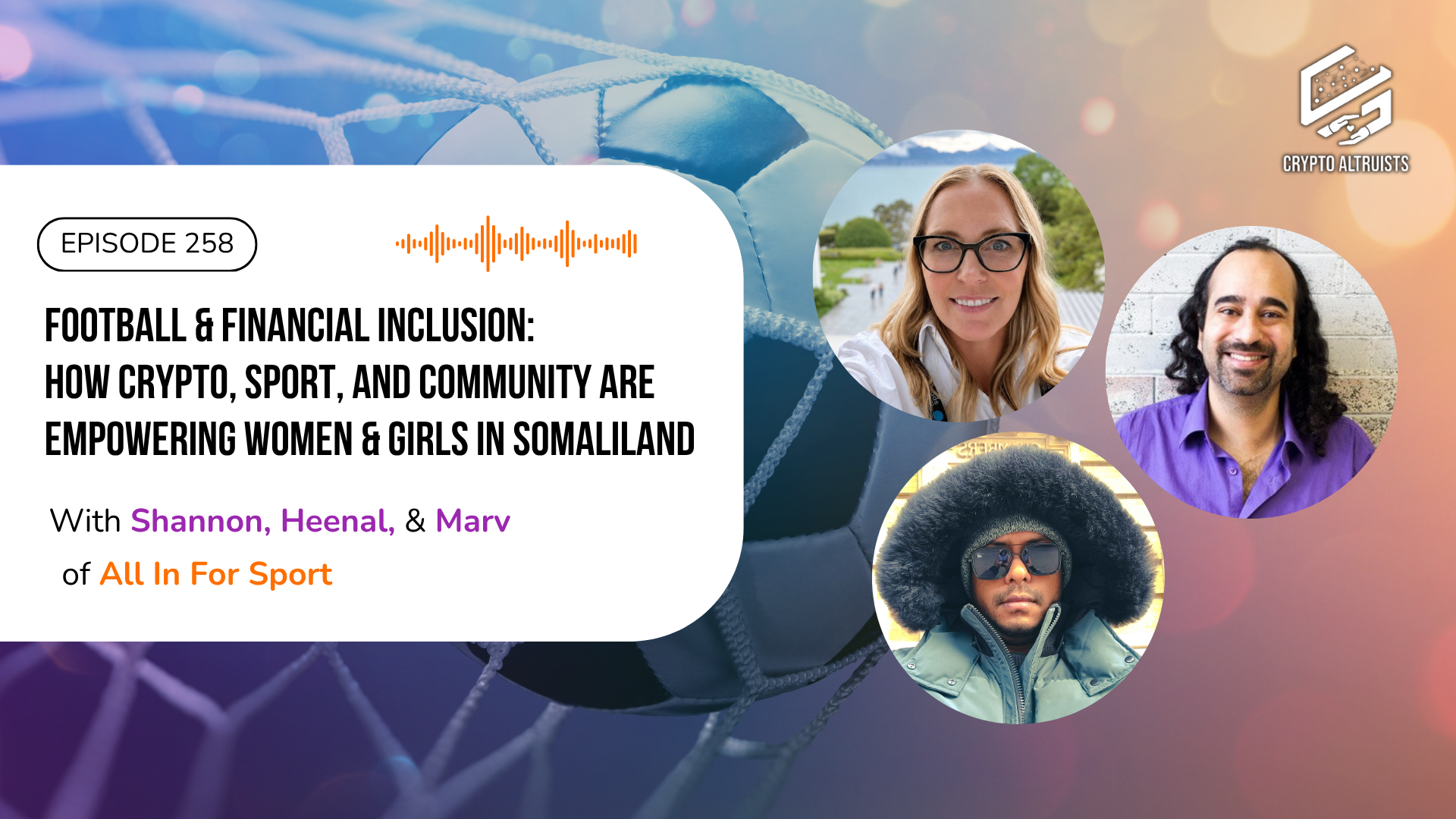


For episode 258 of the Crypto Altruists podcast, we’re excited to welcome Shannon Lanigan, Heenal Rajani, and Marvin Paul of All In For Sport, a decentralized autonomous organization (DAO) on a mission to create a “coordi-nation” to support projects that advance inclusion and empowerment through sport.
This episode is part two of an ongoing conversation, so let me set the stage. In episode 245, we sat down with the team at SuperBenefit to explore their Reimagining Power series. That conversation was about the theory and the possibilities: how Web3 could be a tool for systems change, how we might redistribute power rather than concentrate it, and how we can confront the uncomfortable history of development work and philanthropy instead of repeating its mistakes in Web3.
It was a rich, thought-provoking discussion. But it lived mostly in the realm of ideas. Today, we get to see those ideas put into practice with a case study, a real-world test of what we discussed in that first conversation. We highlight All In For Sport’s collaboration with Sarreya, an organization that has spent over a decade creating space for women and girls to play sport in Somaliland.
The project, The Six-Month Wire Transfer (And What We're Doing About It), is named after a very real experience: a routine grant payment that took six months to reach Sarreya, blocked, rerouted, and questioned every step of the way. And it grew into something much bigger than a payments experiment. It became a test of whether Web3 tools could not only move money to a community the traditional financial system overlooks, but also shift power, introducing governance structures and transparent treasury management that keep decision-making in the hands of the community itself.
In today’s discussion you’ll learn:
⚽ How All In For Sport and Sarreya are leveraging crypto to support women and girls playing sport in Somaliland
💸 The story behind a routine grant payment that took six months to arrive, blocked and rerouted along the way, and what it revealed about the state of financial inclusion
🗳️ How this project went beyond moving money to introduce governance and transparent treasury management, keeping power in community hands
🌍 What it takes to get resources to communities the system has overlooked, and best practices for implementing Web3 initiatives in hard-to-reach areas
📨 Subscribe to the Crypto Altruists' Newsletter!
🌍 This isn't about imposing technology. It's about working with communities and their strengths: There's a common assumption that underserved communities need to be taught or introduced to new technology. But Somaliland has had mobile money since the early 2000s, before a lot of the West had anything like it. So this was never about bringing tech to a community that lacked it. It was about working alongside Sarreya to leverage the strengths they already have, and implementing Web3 tools in a way that elevates their work rather than changing who they are. The best technology partnerships start with humility and respect, meeting communities where they are instead of assuming they need to catch up.
💸 A tangible pain point became something much bigger than a payments pilot: The project started with a very real, very concrete problem: a routine grant payment that took six months to reach Sarreya, blocked and rerouted every step of the way. It would have been easy to stop at "let's move money faster." But this became so much more than a cash transfer experiment. It grew into a test of governance, transparency, and community-led decision-making, an exploration of how Web3 can not only move resources but shift power. Sometimes the most meaningful work begins with solving one clear, painful problem, then following it to something deeper.
🤝 The goal is to provide the tools, then get out of the way. Perhaps the most powerful principle from this conversation: it's about providing communities with the tools they need, and then getting out of the way. Real empowerment isn't about outsiders staying in control or taking credit. It's about equipping people to lead their own progress and trusting them to do it. This is what it looks like to do development with a community rather than to them, and it's a lesson that applies far beyond this single project.
Case Study Article: The Six-Month Wire Transfer (And What We're Doing About It)
03:20 - To kick things off, I'd love to hear from each of you. Can you share a bit about your journey and what led you to the work you're doing with Open Frontier?
10:40 - For listeners who aren't familiar, can you give us an introduction to Open Frontier? What's the mission, and what gap did you see that made this work feel necessary right now?
13:55 - On your website, it mentions how “technology is not destiny. What matters is who shapes it, who benefits from it and what rules govern it.” Can you unpack that? Why does it matter who's at the table when these systems are being designed?
21:25 - Let's talk about safeguards. You advocate for "smart regulation," and Carole, you've framed it well, stating how the challenge isn't innovation versus regulation, it's whether we have the vision to design smart rules and trustworthy tech together. How does that look in practice?
26:40 - There's a real irony here: a technology built on the promise of decentralization and democratization could just as easily end up concentrating power in the hands of a few. What's the nightmare scenario if values-driven communities stay on the sidelines, and how close are we to it
31:15 - For listeners around the world who care about these issues and want to make sure digital finance serves everyday people, what are some tangible steps they can take, and how can they engage with Open Frontier's work?
34:10 - Let's talk about hope. What are some of the most inspiring ways you've seen these technologies used to advance values like inclusion, democratic accountability, and financial freedom? What gets you genuinely excited about where this is heading?
40:10 - Every financial system in history has eventually been captured by the powerful, no matter how egalitarian it started. What makes you believe that AI and digital finance can break that pattern, and what has to be true for it to happen?
Support thoughtful, independent crypto journalism and help us continue highlighting blockchain’s potential for social and environmental impact.
cryptoaltruists.eth
While we may discuss specific web3 projects or cryptocurrencies on this podcast, please do not take any of this as investment advice, and please make sure to do your own research on potential investment opportunities, or any opportunity. We host a variety of guests on this podcast with the sole purpose of highlighting the social impact use cases of this technology. That being said, Crypto Altruism does not endorse any of these projects, and we recognize that, since this is an emerging sector, some may be operating in regulatory grey areas, and as such, we cannot confirm their legality in the jurisdictions in which they operate, especially as it pertains to decentralized finance protocols. So, before getting involved with any project, it’s important that you do your own research and confirm the legality of the project. More available HERE.