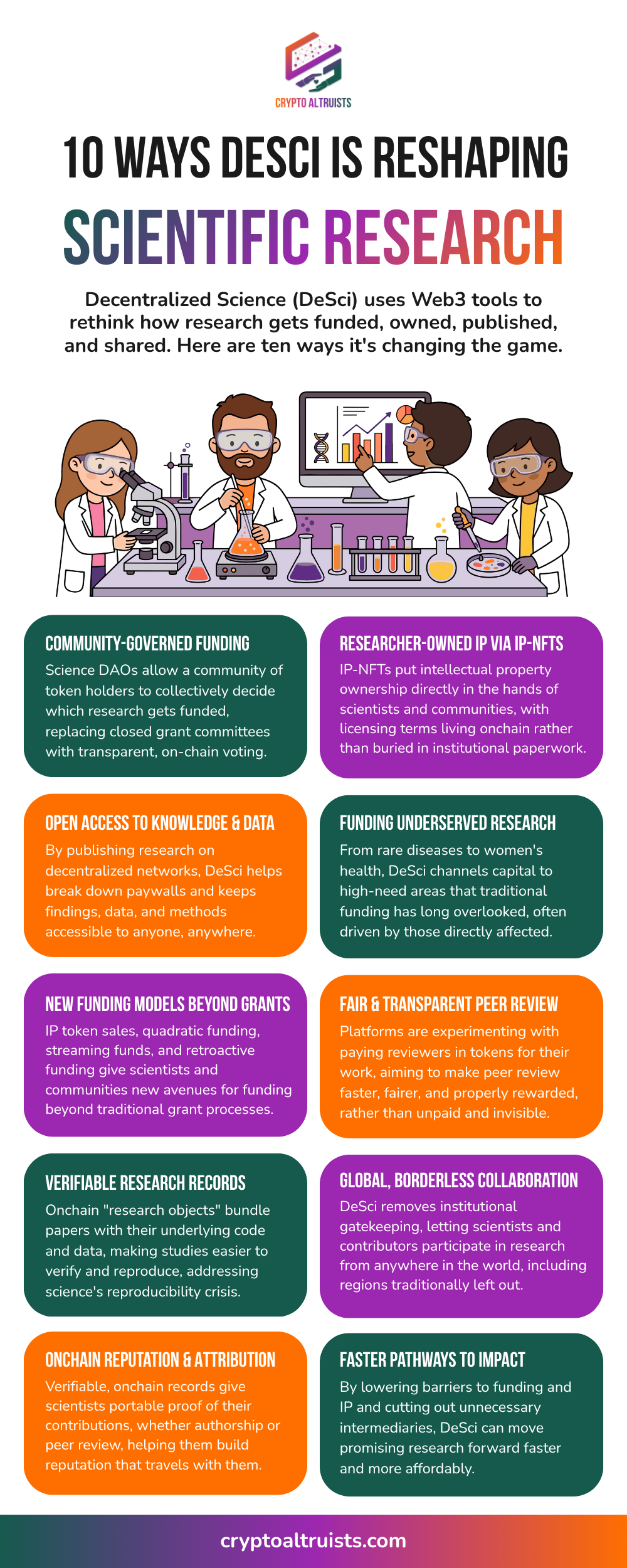


Decentralized Science (DeSci) uses Web3 tools to rethink how research gets funded, owned, published, and shared. The traditional research system, for all its achievements, is weighed down by structural problems: grant success rates are in freefall, much of the world's research sits locked behind expensive paywalls, peer reviewers work for free, and far too many promising discoveries stall before reaching the people who need them.
DeSci is a growing movement that uses community treasuries, smart contracts, onchain ownership, and decentralized storage to tackle these problems head-on, shifting power away from the institutions that have long controlled research and toward the scientists, patients, and communities those institutions were built to serve
Here are ten ways Decentralized Science is changing the game.
Science DAOs (decentralized autonomous organizations) allow token holders to collectively decide which research gets funded, replacing closed grant committees with transparent, onchain voting. Instead of a small panel making decisions for thousands of researchers, the community itself sets priorities and allocates capital, with funds held in smart contracts that don't move until a vote approves them. Because these organizations are decentralized and open to participation, token holders can include anyone with a stake in the outcome, including scientists, clinicians, patients, caregivers, funders, or passionate community members, helping to align research decisions with the people who stand to benefit most.
IP-NFTs put intellectual property ownership directly in the hands of scientists and communities, with licensing terms living onchain rather than buried in institutional paperwork. By wrapping legal IP rights inside a smart contract, an IP-NFT acts like a portable title deed for a piece of research. It can be transferred, licensed, or even fractionalized so many people can hold a stake in a single discovery. This gives researchers far more control over their own work and a clearer path to sharing in the value it creates, rather than signing those rights away to a journal, university, or company before the science ever reaches the world.
By publishing research on decentralized networks, DeSci helps break down paywalls and keeps findings, data, and methods permanently accessible to anyone, anywhere. The current system often locks publicly funded research behind expensive subscriptions, putting it out of reach for independent researchers, smaller institutions, and scientists in lower-income regions. Storing research on decentralized networks like IPFS and Arweave ensures it stays available for the long term and is not dependent on a single publisher's website or subject to link rot. The end result is that knowledge remains a shared public good rather than a private asset.
From rare diseases to women's health, DeSci channels capital toward high-need areas that traditional funding has long overlooked, often driven by the communities directly affected. Commercial research tends to follow profit potential, leaving conditions with smaller or less lucrative markets chronically underfunded, regardless of how many people they affect. DeSci flips this logic: when patients and their families can pool resources and vote on what gets studied, funding flows toward genuine need. Communities organizing around longevity, women's reproductive health, neurodegeneration, and rare diseases are already funding research they have a direct, personal stake in seeing succeed.
IP token sales, quadratic funding, streaming funds, and retroactive funding give scientists and communities new avenues for funding beyond traditional grant processes. Each model solves a different problem: quadratic funding weights the number of supporters over the size of any single donation, rewarding broad community backing; retroactive funding pays for work after it has proven its value rather than betting on it upfront; streaming payments release capital continuously instead of in lump sums; and IP token sales let communities invest directly in specific discoveries. Together, they create a more flexible, resilient funding landscape that doesn't hinge on winning a single, increasingly competitive grant.
Platforms are experimenting with paying reviewers in tokens for their work, aiming to make peer review faster, fairer, and properly compensated rather than unpaid and invisible. In the traditional model, peer review is a free service that researchers provide on top of their actual jobs, which contributes to slow turnaround times and an opaque process. By rewarding reviewers with tokens and recording their contributions transparently, DeSci aims to turn peer review into recognized, compensated work. It's still early, and this remains one of the harder problems to solve at scale, but the early experiments point toward a model where quality review is valued rather than taken for granted.
Onchain "research objects" bundle papers with their underlying code and data, making studies easier to verify and reproduce while building the infrastructure to address science's reproducibility crisis. A staggering share of published findings can't be independently reproduced, a problem that undermines everything built on top of that research, from drug development to public health policy. By packaging a study together with the data and methodology behind it, and giving it a permanent, content-addressed identifier that won't break over time, DeSci makes it possible to trace exactly how a result was produced. That transparency is a foundational step toward more trustworthy, verifiable science.
DeSci removes institutional gatekeeping, letting scientists, patients, and contributors participate in research from anywhere in the world, including regions traditionally left out. Participation no longer requires a prestigious university affiliation, access to grant networks, or the right institutional credentials, just an internet connection and something to contribute. This opens the door to a far more diverse range of researchers and perspectives, and it's especially meaningful in the Global South, where the traditional research system has historically offered the least access to funding, publishing, and recognition.
Verifiable, onchain records give scientists portable proof of their contributions, whether it be authorship or peer review, helping them build reputation that travels with them across platforms. In the current system, much of the work scientists do, like reviewing papers, sharing data, and contributing to others' projects, goes largely unrecognized and is difficult to prove. Recording these contributions transparently onchain creates a durable, tamper-proof track record that researchers own and carry with them, independent of any single institution or journal. Over time, this could reshape how scientific credibility is built and recognized, rewarding a much fuller picture of what researchers actually contribute.
By lowering barriers to funding and IP and cutting out unnecessary intermediaries, DeSci can move promising research forward faster and more affordably. The traditional journey from a lab finding to a real-world application is slow and expensive, with discoveries often stalling in the gap between academic research and commercial development. By streamlining how research gets funded, owned, and advanced, DeSci can compress that timeline dramatically. As a result, early DeSci projects have produced tangible results in a fraction of the usual time and cost, hinting at what becomes possible when the friction is removed.
Support thoughtful, independent crypto journalism and help us continue highlighting blockchain’s potential for social and environmental impact.
cryptoaltruists.eth