.png)


Every year, they raise $3.7 trillion in the United States alone. They operate under a level of scrutiny most industries would find paralyzing, answerable to governments, funders, and the communities they serve simultaneously. Trust takes years to build and one headline to destroy. By any operational measure, they are among the most sophisticated financial actors in the world.
They are nonprofits. And the infrastructure they operate with has never come close to matching their work.
Sending money across borders costs an average of 6.4% globally, which is more than double the UN's Sustainable Development Goal target. In the regions where most humanitarian work actually happens, it's closer to 8.4%. That's before accounting for the multiple correspondent banks a typical international grant passes through, each one adding days, costs, and a new point of failure.
And when the money finally arrives, there's rarely any way to verify in real time whether it reached the right people at all.
Impact reporting runs on annual cycles, meaning the organization that received funding twelve months ago is only now writing about what happened, in a document that is self-reported and nearly impossible to independently verify.
This has never been a problem of bad intentions. It is a structural failure sitting in plain sight for decades, and the sector has largely learned to live with it.
The fee problem is a routing problem. Money moves through so many intermediaries not because it has to, but because there was never infrastructure that let it move any other way.
The transparency problem is a trust problem; one that exists because there's no shared, neutral record that funders and recipients can both read.
The reporting problem is a timing problem. Annual cycles aren't a philosophical choice; they're the result of systems that can't move any faster.
These are infrastructure problems. And infrastructure problems have infrastructure solutions.
What's changed is that the solutions now exist, and they've already been tested. When Afghanistan's formal banking system effectively collapsed under sanctions after 2021, humanitarian organizations faced a near-impossible problem: authorized to operate in the country, but with no functional rails to move money in. Stablecoin transfers became the answer.
A joint pilot by Mercy Corps and the Crypto Council for Innovation delivered aid with full transaction traceability, eliminated intermediaries, and, when surveyed afterward, 98% of recipients said they preferred stablecoin payments over cash for future programs.
No new system was built for them. An existing one finally reached them. That's what Web3 offers this sector in practice: cross-border transfers that skip the correspondent banking layer entirely, grants that release automatically when verified milestones are met, and impact records any funder can check in real time without waiting twelve months for a report.
Most industries chasing new financial infrastructure are looking for marginal gains. Nonprofits are working with systems so broken that the same tools don't produce marginal gains, they produce a fundamentally different outcome.
GiveDirectly, one of the most efficient aid organizations on the planet, sends around 85% of donations directly to recipients. Traditional humanitarian operations cost around $214 per person reached. The gap between those two numbers is where onchain infrastructure lives. And for nonprofits, closing it isn't an optimization, it's the whole point.
The problem is that most nonprofit professionals have never had a practical way into these tools.
Builders designed these tools for a specific community, with a specific language and a specific set of assumptions about who the user was. But a program director in Nairobi or Bogotá isn't browsing crypto Twitter. They aren’t reading whitepapers. And you won’t see them at EthCC.
The tools exist, but not enough people deliberately translated this world for nonprofit professionals: the program managers, the finance leads, the executive directors making decisions about where donor money goes. The context, the trust, the plain-language explanation of what works and what doesn't in their setting. That work is still largely missing.
That's the opportunity hiding in plain sight, and one we're making a priority to change.
To be clear: recommending a nonprofit adopt these tools in 2018 would have been irresponsible. The volatility was real, the risks were serious, the infrastructure was still being stress-tested. But that window has closed.
Stablecoin rails have been tested where banks don't operate. Governance frameworks have moved hundreds of thousands of dollars transparently and accountably. Crypto donations alone hit $100 million in 2025, with an average gift size of $11,019 — larger than most traditional online donations by a significant margin. The tools have matured, and the organizations still waiting to use them are the ones paying the price.
At Crypto Altruists, we've spent almost five years at this intersection, covering the use cases, interviewing the practitioners, documenting what worked and what didn't. The same gap appeared in every conversation: organizations doing serious work, with serious questions, and nowhere serious to go for answers.
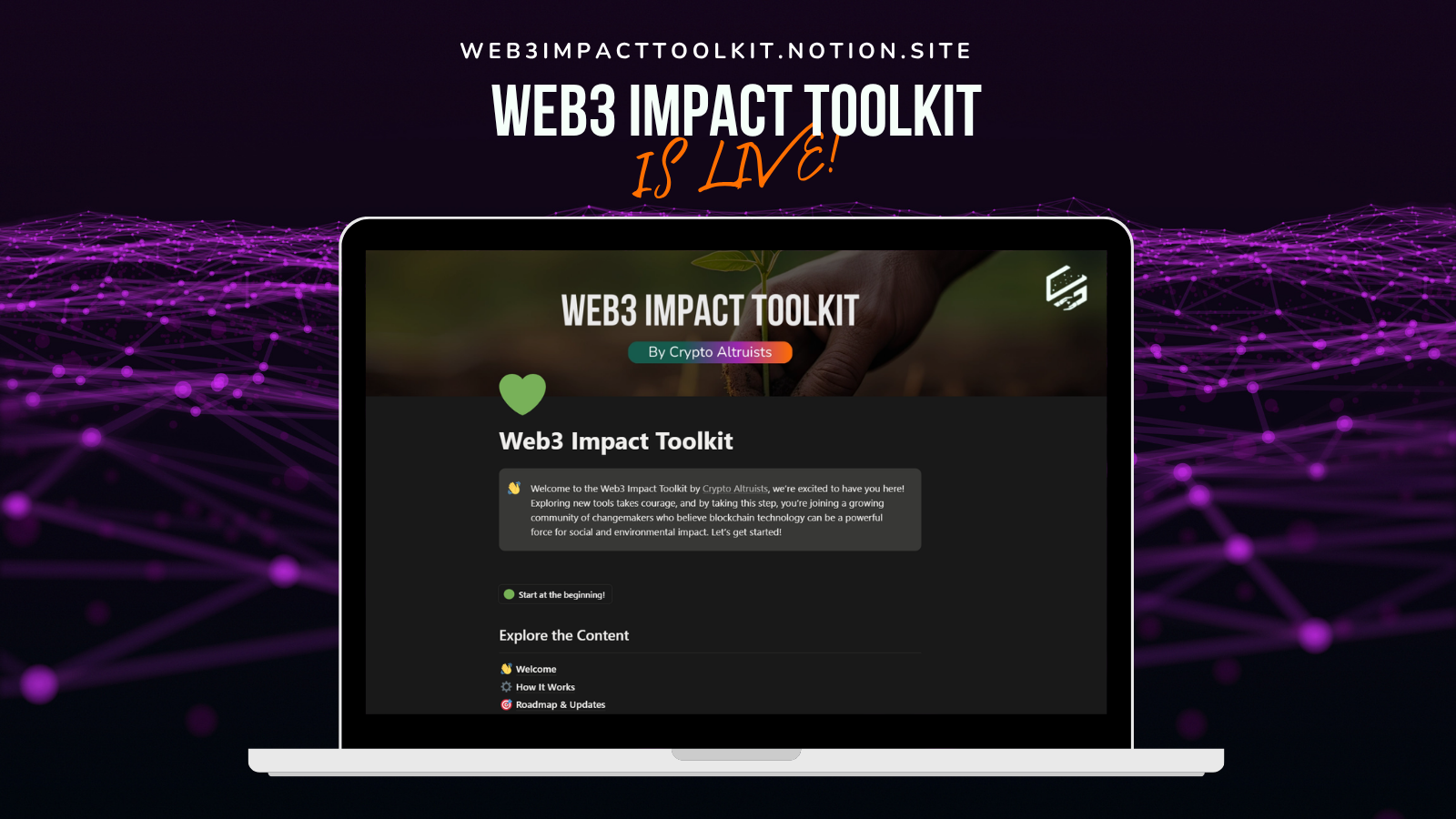
The Web3 Impact Toolkit is our attempt to close it. It's a free, self-paced resource built for nonprofit professionals who want to move from curiosity to action without having to become crypto experts first.
Each module comes with real case studies from organizations that have already made this work, a resource library of vetted tools and platforms, a crypto nonprofit policy hub, and in the near future, a Web3 Action Planning tool to help teams map out their own next steps. It's honest about where the technology is ready and where it isn't.
This work has truly been a team effort, and the Web3 Impact Toolkit wouldn't exist without the support of three incredible organizations who believed in it early.
The GSR Foundation, our Flagship Partner, is an independent charity and grantmaker that envisions a world where everyone benefits from technology. Their support is enabling us to expand the Toolkit's reach, develop new learning modules and self-serve tools, and launch dedicated cohorts to help mission-driven teams explore blockchain for good confidently and responsibly.
Endaoment, our Impact Partner, is the world's first fully on-chain 501(c)(3) nonprofit, and has spent years bridging the gap between crypto donors and the organizations they want to support with simple tools for donating diverse assets. Their backing helped us get the Toolkit off the ground and directly inspired our podcast series, The Web3 Nonprofit.
Social Equation Hub, our Nonprofit Education Partner, is dedicated to helping nonprofits and social enterprises navigate emerging technologies responsibly. They bring a critical lens on language, framing, and accessibility to the toolkit, and will be key in ensuring the toolkit is accessible to diverse organizations at every stage of their Web3 journey.

The nonprofit sector has never had better tools to close the gap between intention and impact. We built the Web3 Impact Toolkit to make sure the people doing that work are the first ones to benefit.
Support thoughtful, independent crypto journalism and help us continue highlighting blockchain’s potential for social and environmental impact.
cryptoaltruists.eth