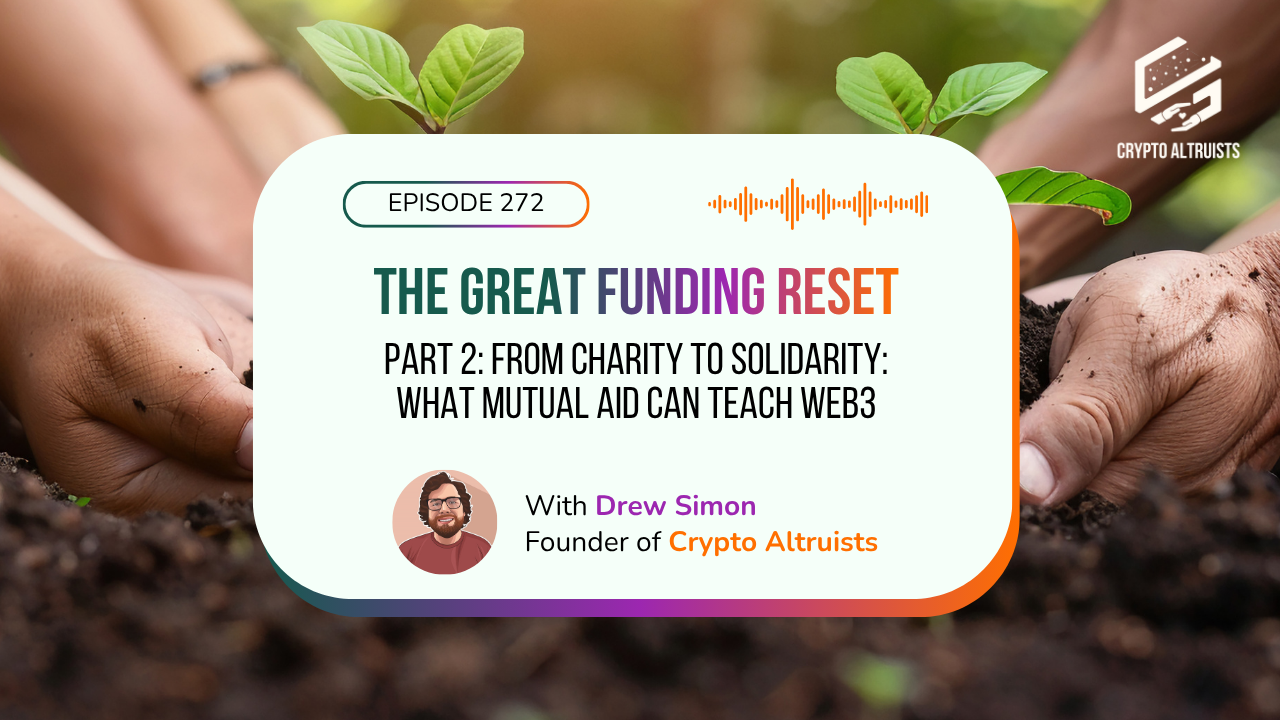


For episode 272 of the Crypto Altruists podcast, we explore the intersection of mutual aid and Web3, picking up where our last episode, The Great Funding Reset, left off. In that episode, we explored the two funding storms hitting impact builders right now: the cooling of Web3 public goods funding, and the largest drop in international aid on record. And we ended on an important idea: that community-owned funding might be the oldest and most resilient funding model there is, because it never depended on outside money in the first place.
Long before there were foundations, aid agencies, token treasuries, or quadratic funding rounds, people found ways to take care of each other. They pooled what they had, and showed up for each other in hard times. And some of the models they built are still working today, decades or even centuries later. In this episode, we explore what mutual aid is, and why “solidarity, not charity” is a powerful way to think about supporting one another. We look at four remarkable mutual aid models from around the world, including Broodfonds, the Dutch “bread funds” where freelancers support each other through illness; WIR Bank, the Swiss community currency that has helped small businesses weather economic downturns since 1934; Fureai Kippu, Japan’s “caring relationship tickets” for elder care; and Mission Asset Fund, which turns traditional lending circles into a pathway to building credit.
We also take an honest look at the limits of mutual aid, before exploring the Web3 projects building on these traditions, including Bread Cooperative’s Solidarity Fund, Grassroots Economics’ commitment pooling in Kenya, and Circles’ trust-based community currency. Finally, we share what Web3 builders can learn from mutual aid, and how blockchain technology can help these time-tested models reach further than ever before.
In today’s discussion you’ll learn:
🤝 What mutual aid is, and why “solidarity, not charity” is a powerful way to think about supporting each other
🌍 Four case studies of innovative mutual aid models from around the world, involving everyone from Dutch freelancers to Swiss small businesses to elder care in Japan
🍞 How Web3 projects like Bread Cooperative and Grassroots Economics are building on the traditions of mutual aid
🧭 What Web3 builders can learn from mutual aid, and the benefits that blockchain technology can bring to the table
🤝 Solidarity, not charity: mutual aid is the oldest safety net in the world: Charity usually flows in one direction, from donor to recipient. Mutual aid flows in every direction. Today you might give, and tomorrow you might receive, but everyone is part of the same circle. That simple shift changes the relationship from generosity to solidarity, where people support each other as equals. And because mutual aid is built on communities supporting themselves rather than depending on outside funding, it has a unique kind of resilience. In a year when aid cuts and platform shutdowns have left so many organizations exposed, models like savings circles, cooperatives, and commitment pools remind us that when institutions fall short, people have always found ways to take care of each other.
🌍 The best mutual aid models put relationships first: The mutual aid models we explored each offer a powerful lesson. Broodfonds in the Netherlands shows that trust scales best through small, relational groups, where members know each other. WIR Bank in Switzerland shows that community currencies can act as economic shock absorbers. Fureai Kippu in Japan shows that care itself can be a currency, and that money can sometimes crowd out kindness. And Mission Asset Fund in the US shows that making traditional practices visible to the formal system can unlock incredible opportunity.
🍞 Web3 should honor mutual aid, not try to replace it: Many Web3 builders are reimagining ideas that mutual aid communities have practised for generations, and the most promising projects are the ones that learn from those traditions directly. Bread Cooperative is building a full mutual aid toolkit, from its Solidarity Fund to Stacks, a reimagining of savings circles, and Safety Net, a community insurance model inspired by the Dutch Broodfonds. Grassroots Economics brings Kenya’s tradition of pooled commitments onto digital rails, helping communities keep value flowing even when cash is scarce. And Circles experiments with money built entirely on trust. Technology can’t replace the trust at the heart of mutual aid, but it can extend it, through transparency, portability across borders, lower administrative costs, and connections between communities.
Projects Covered in the Podcast:
Other Episodes Highlighted:
03:00 - What is Mutual Aid?
05:30 - Four Mutual Aid Models From Around the World
14:00 - The Limits of Mutual Aid
15:05 - Web3 Projects Building on the Foundations of Mutual Aid
21:10 - Lessons for Builders, and the Value Add of Web3 to Mutual Aid
Support thoughtful, independent crypto journalism and help us continue highlighting blockchain’s potential for social and environmental impact.
cryptoaltruists.eth
While we may discuss specific web3 projects or cryptocurrencies on this podcast, please do not take any of this as investment advice, and please make sure to do your own research on potential investment opportunities, or any opportunity. We host a variety of guests on this podcast with the sole purpose of highlighting the social impact use cases of this technology. That being said, Crypto Altruism does not endorse any of these projects, and we recognize that, since this is an emerging sector, some may be operating in regulatory grey areas, and as such, we cannot confirm their legality in the jurisdictions in which they operate, especially as it pertains to decentralized finance protocols. So, before getting involved with any project, it’s important that you do your own research and confirm the legality of the project. More available HERE.